Feeds:
Posts
Comments

Archive for the ‘conqueror challenges’ Category

I finally found a bit of space to start reading up on the Mt. Everest virtual challenge which I completed last month, and although I had decided to not post any further posts about the various challenges I’m following, this was so very interesting that I changed my mind and so here we go….I hope you enjoy reading more about Everest and what the climbers who actually go there experience. So often we read or hear about climbers and teams of people who climb Mt Everest but we seldom read about the finer details. So this has been really interesting.

I actually started the challenge in Ramsgate on the 10th February on the tail-end of the ‘beast from the east’ snow storm. So this is a bit behind the actual times 😉 But since it’s not real anyway, it doesn’t really matter…anyway, I hope you enjoy reading these posts…
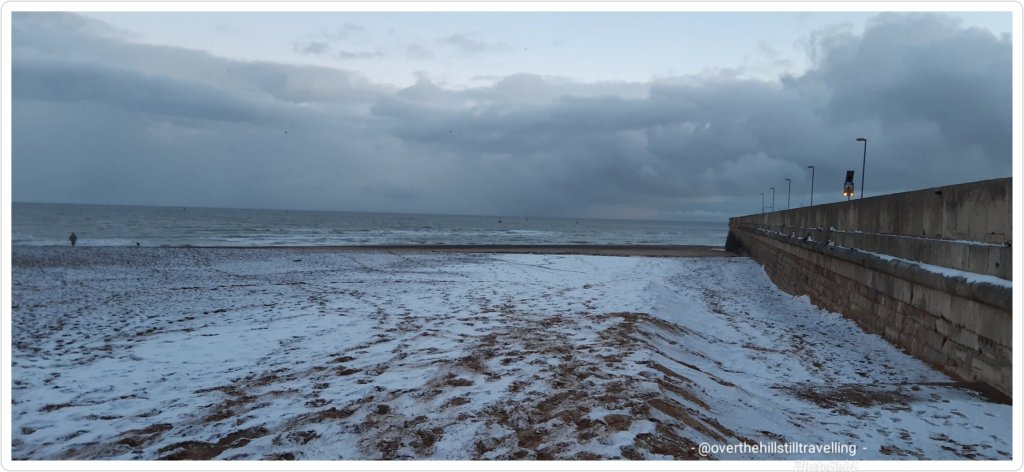
Where I actually was….pretty realistic really

Flying into Kathmandu is a walk in the park when compared to Lukla. Dubbed as the most dangerous airport in the world, Lukla’s runway is a mere 1,729ft (527m) long, with mountainous terrain to the north and a steeply angled drop to the south. It is built on a 12% uphill gradient to help planes slow down. There are no go-around procedures if the planes miss their approach, as such only highly experienced pilots with short-takeoff-and-landing missions under their belt, experience in Nepal and ten flights in Lukla with a certified instructor, are permitted to land at the airport. In a nutshell if climbing Everest doesn’t cause prickles on the back of your neck, then a high intensity landing in Lukla certainly should.
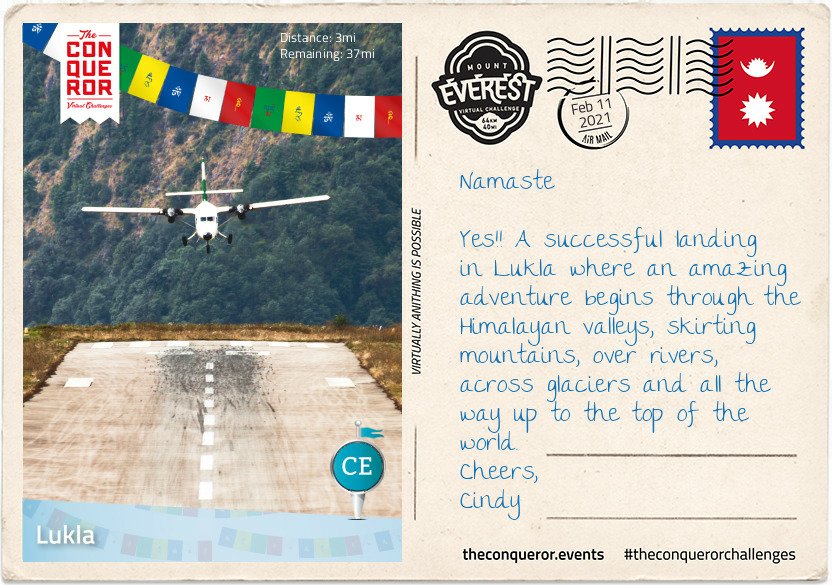
Where I wasn’t really 😁😁 Stage 1

In 2008, Lukla airport was renamed Tenzing-Hillary Airport in honour of Sir Edmund Hillary and Sherpa Tenzing Norgay, the first climbers to reach the summit of Everest. Hillary was instrumental in the construction of the airfield in Lukla, building an unsurfaced airstrip on a mountain shelf in 1964. It took 37 years to finally asphalt the runway.

Home to 1200 people, the village sits at 9,383ft (2,860m) above sea level, nestled on a small plateau amongst the awe inspiring mountain peaks of the Himalayan Ranges. The nearly 40mi (64km) trek to Mount Everest, skirts steep mountainsides, through deep valleys and over alpine glaciers. The hike travels through small villages and teahouses, past prayer wheels and fluttering prayer flags to the memorial site honouring mountaineers and Sherpas who lost their lives climbing the mountain, continuing to Base Camp and then the final summit climb.
Leaving the viewing platform of the Lukla airport, I made my way through the centre of town on a narrow street that was sometimes cobbled and sometimes just compacted soil. Double-storey buildings lined the street filled with shops, teahouses and lodging services.

Shortly after leaving the village I passed through the National Luminary Pasan Lhamu Memorial Gate which was built to honour Pasan Lhamu, the first Sherpa woman to summit Everest in 1993. It is the gateway to the Khumbu Region that encompasses the Sagarmatha National Park and the Nepalese side of Mount Everest.

It was a gradual downhill hike, passing through a forest on narrow paths with the colossal mountainside ever present to my right. I continued on this downward hike, on a trail that wound itself up and down, passing through villages with teahouses until I reached Phakding, a small village that lies in the Dudh Kosi river valley. Here was the first of many suspension bridge crossings. The bridge, about 100ft (30m) above the river, stretched across what seemed to be an old landslide with large boulders and debris settling beside the river. As the bridge swayed and moved beneath my feet, I pondered about those whose fear of heights may find the crossing challenging. This isn’t the tallest suspension bridge on this trek, that is yet to come.

Finally reaching the small village of Benkar with its tin-roofed, brightly painted window frames, four-storey residences/storefronts, I settled into one of the teahouses for a meal. Known to aid with altitude adaptation I had garlic soup with Tibetan flat bread. Between the warmth of the soup and the crusty on the outside, fluffy on the inside bread, I filled my belly and finished with a Tibetan tea.
Rested and fed, I resumed my hike crossing another suspension bridge. Soon I reached the entrance to Sagarmatha National Park. A UNESCO listed site since 1976, the 1,148km² park is home to the Sherpa people, rare species like the snow leopard and several mountains including Mount Everest.

After obtaining the necessary permits to enter the park, I walked through the Jorsalle Entrance Gate, a concrete structure with Buddhist artwork on its interior walls to a set of steps that began a steep descent into a gorge, onto Jorsalle village, alongside the thundering Dhudh Kosi river and over two more suspension bridges.

However, what goes down, must come up and it wasn’t long before I engaged my hiking poles to start the steep ascent onto a woodland path until I reached a wide open low lying land beside the river filled with stones and boulders making trekking through it unstable and difficult.

But nothing prepared me for the next suspension bridge. Like all the others, Hillary Bridge was made of galvanized steel cables that’s connected to the grated deck by interlinked wire fence. An old version of the bridge was right beneath this one just hanging, blowing in the wind, no longer in use. At 410ft (125m) above the Dhudh Kosi river, this 459ft (140m) long bridge was exposed to the elements swaying laterally and vertically as the strong wind blew through the valley. It was a heart thumping, adrenaline spiking exercise that on this trek one could do without. I was grateful to reach solid ground.

If I ever entertained even the slightest idea of ACTUALLY doing this ‘walk’, reading about that bridge has pretty much scuppered any possibility 🤣🤣🤣 I don’t have a fear of heights and I’m a bit of an adrenaline junkie, but I have my limits 🤪🤪

So, no go for me thanks, virtual suits me just fine.

Read Full Post »

I arrived home last night, after a 4.5 hour journey, from a week’s booking in Salisbury. As much as what I really enjoyed exploring the city, and learning more of the history and her green spaces, it was wonderful to be back home.

You cannot underestimate the sheer joy of coming ‘home’ to your own place. It may not be much, but it’s got my stuff in it, and I’m home.

My own duvet…magic

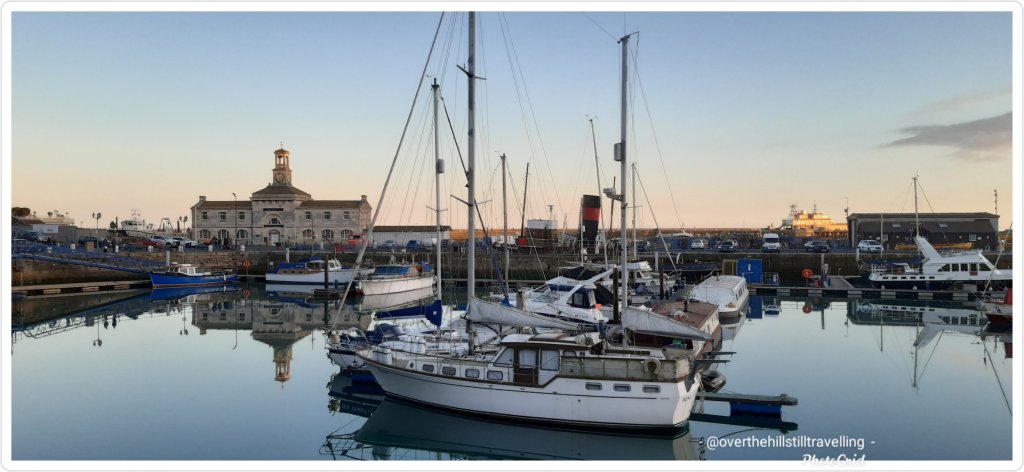
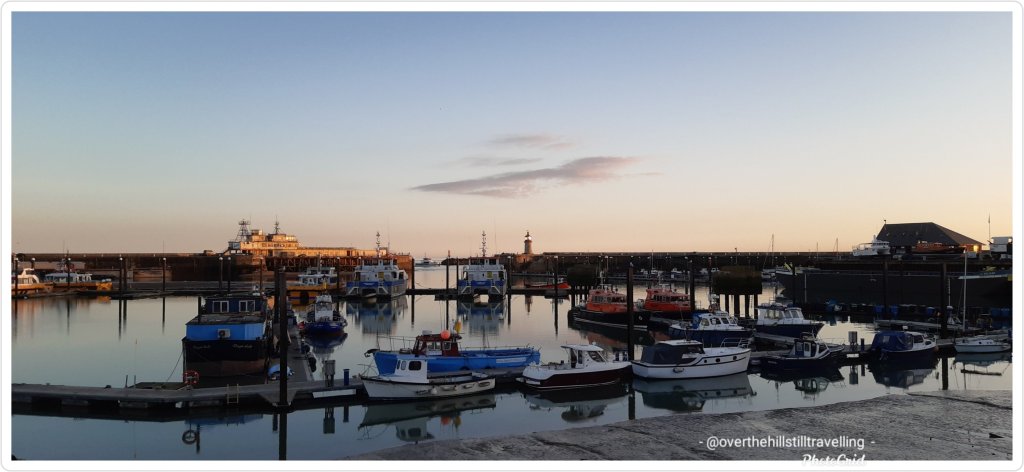
After I’d dropped my bags off, I grabbed my walking poles and immediately set off for a sunset walk to the harbour

Absolutely stunning
A Royal harbour
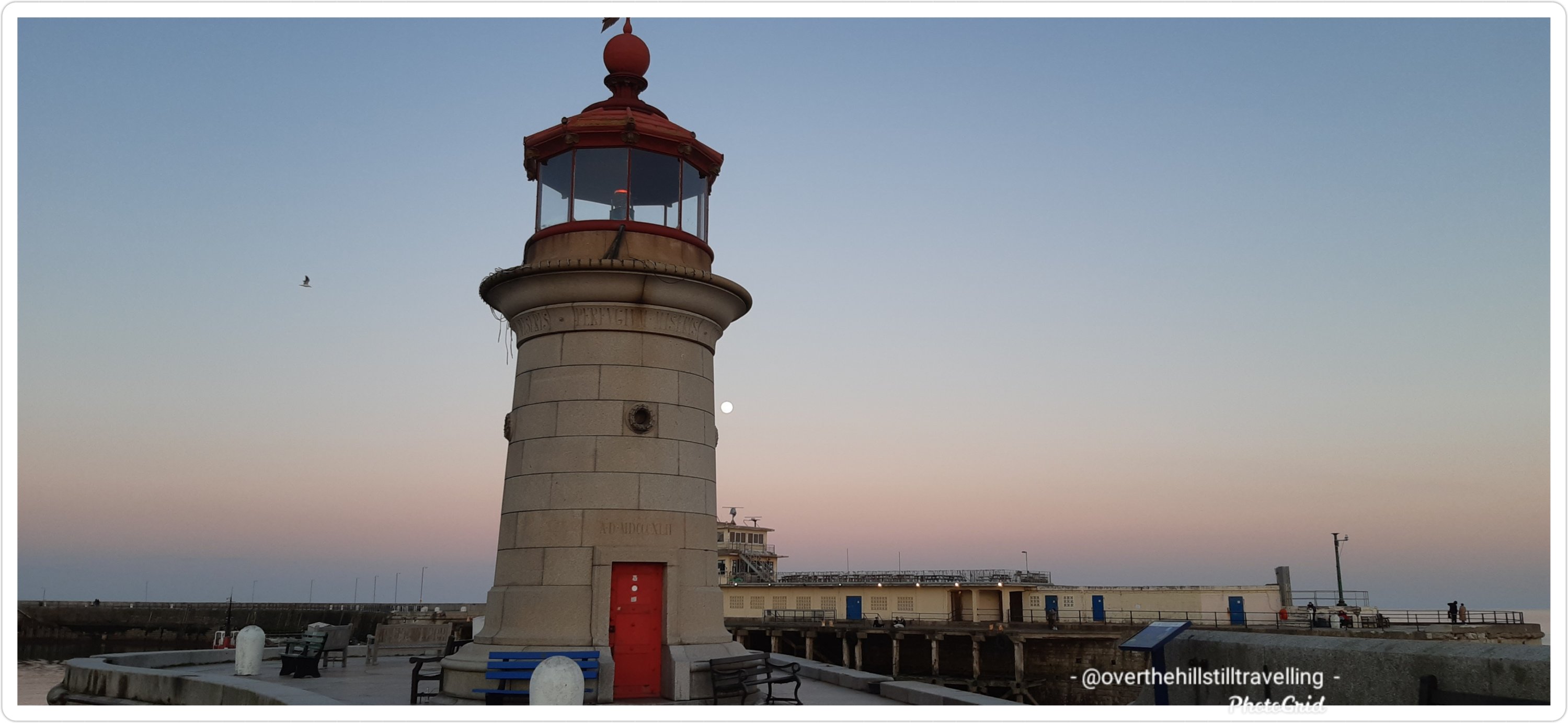
Can you see the moon?
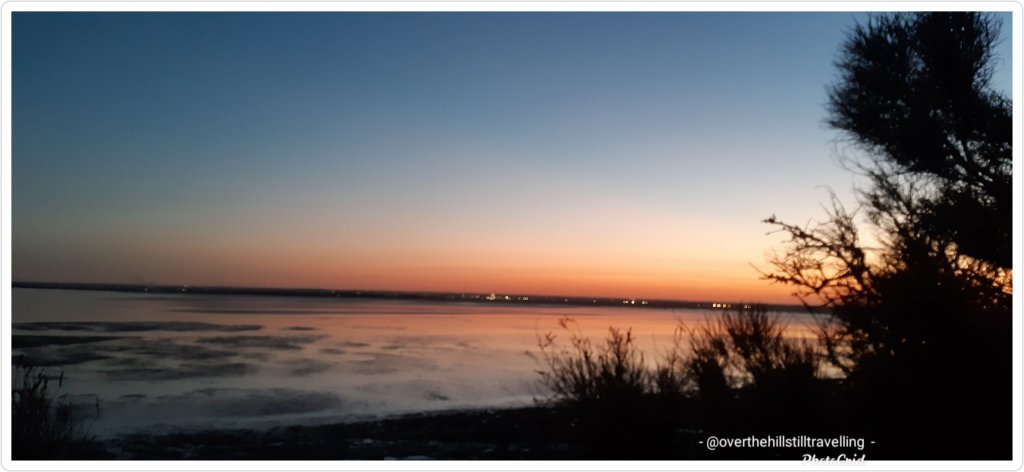
The sun setting in front of me

and then along the lower promenade

The snow moon rising behind me

before climbing up to the clifftop and a walk to Pegwell Bay.

View of Pegwell Bay from the bottom of the cliffs
From halfway up the path to the top of the cliffs

It was quite dark already by the time I reached the hotel, so I stopped there for a few photos and then walked back along the clifftop.

View from Pegwell Bay hotel
A bit of fun with the moon and the hands and molecules sculpture
One lone boat still has its Christmas lights on

A magical walk with no pressure to get back within 2 hours, and 9.9 kms added to my 2021 Conqueror virtual challenge.

I’m going to start the Ring Road Iceland virtual challenge on Monday 1st March. I’m so looking forward to the postcards, should be amazing. My daughter and I had a fantastic 4 day trip to Iceland in 2014, so I’m really keen to see the information that comes with the postcards.

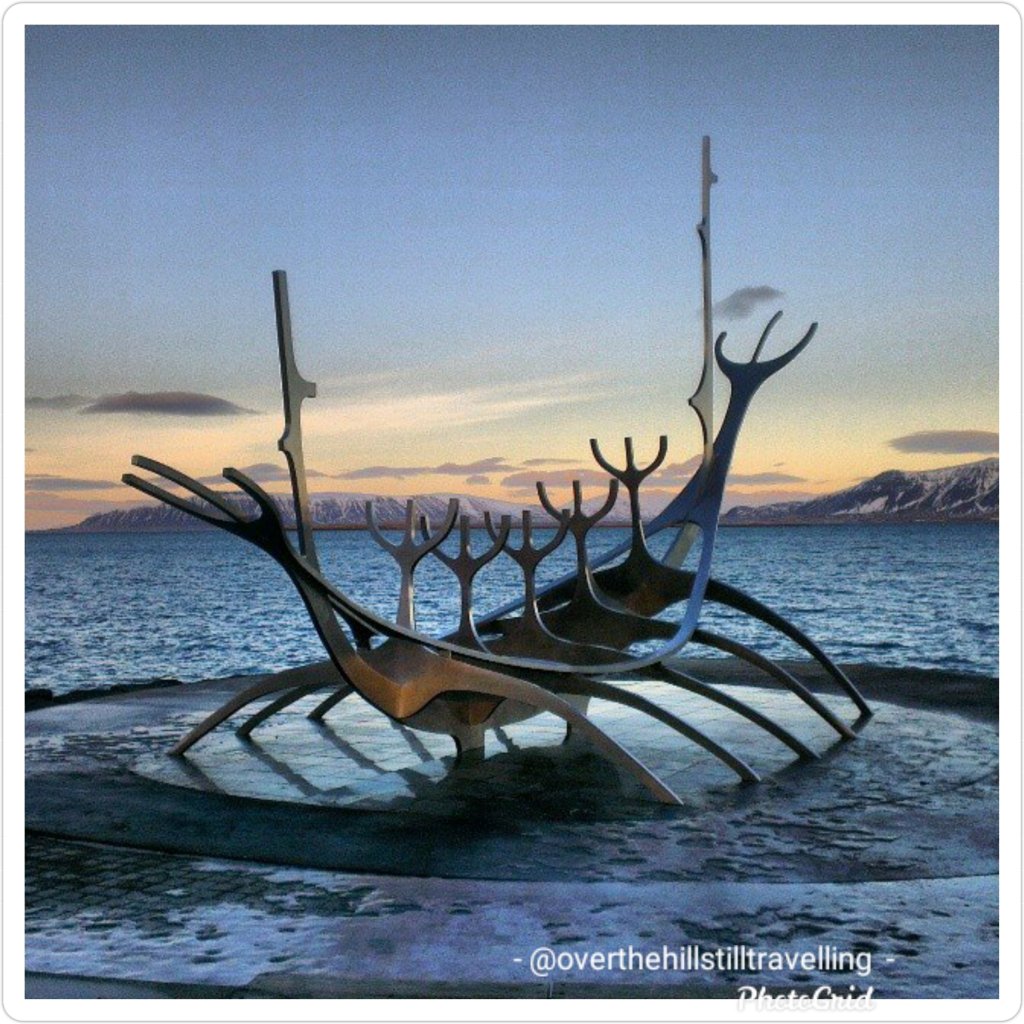
The Sun Voyager (Icelandic: Sólfar); a sculpture by Jón Gunnar Árnason

Read Full Post »

When I got back from my Throwley booking earlier this month, I decided to take a walk along the beach to get some kms in since I’d completed the Alps to Ocean challenge and started climbing Mt. Everest 🥶🥶🥶🗻🗻 (also completed while in Salisbury).

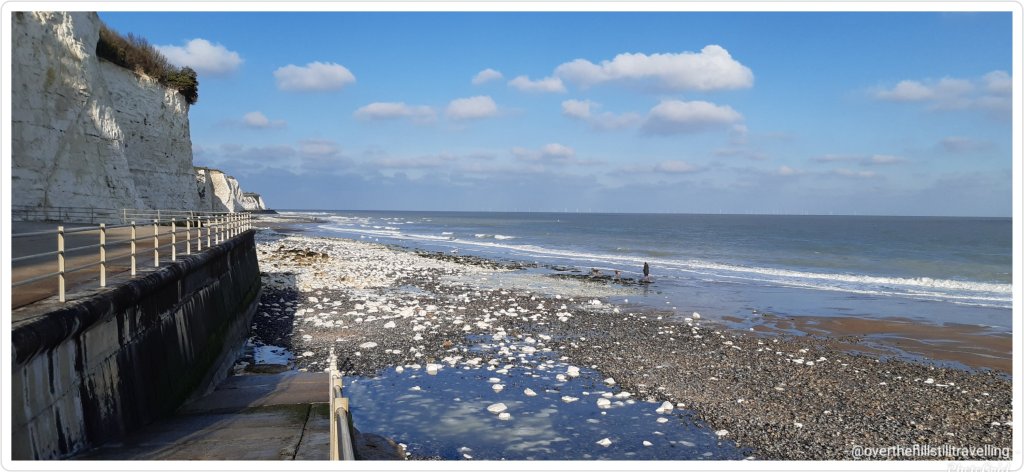
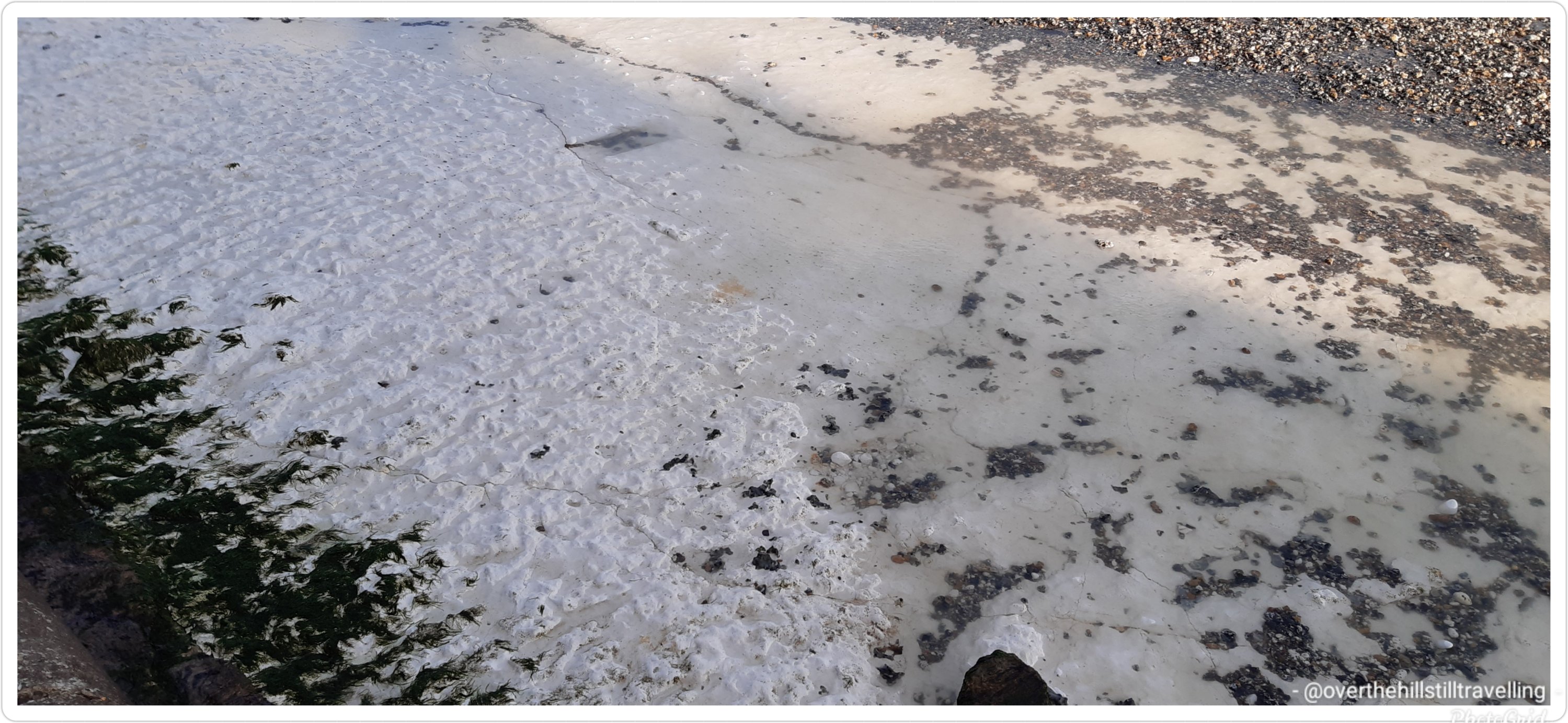
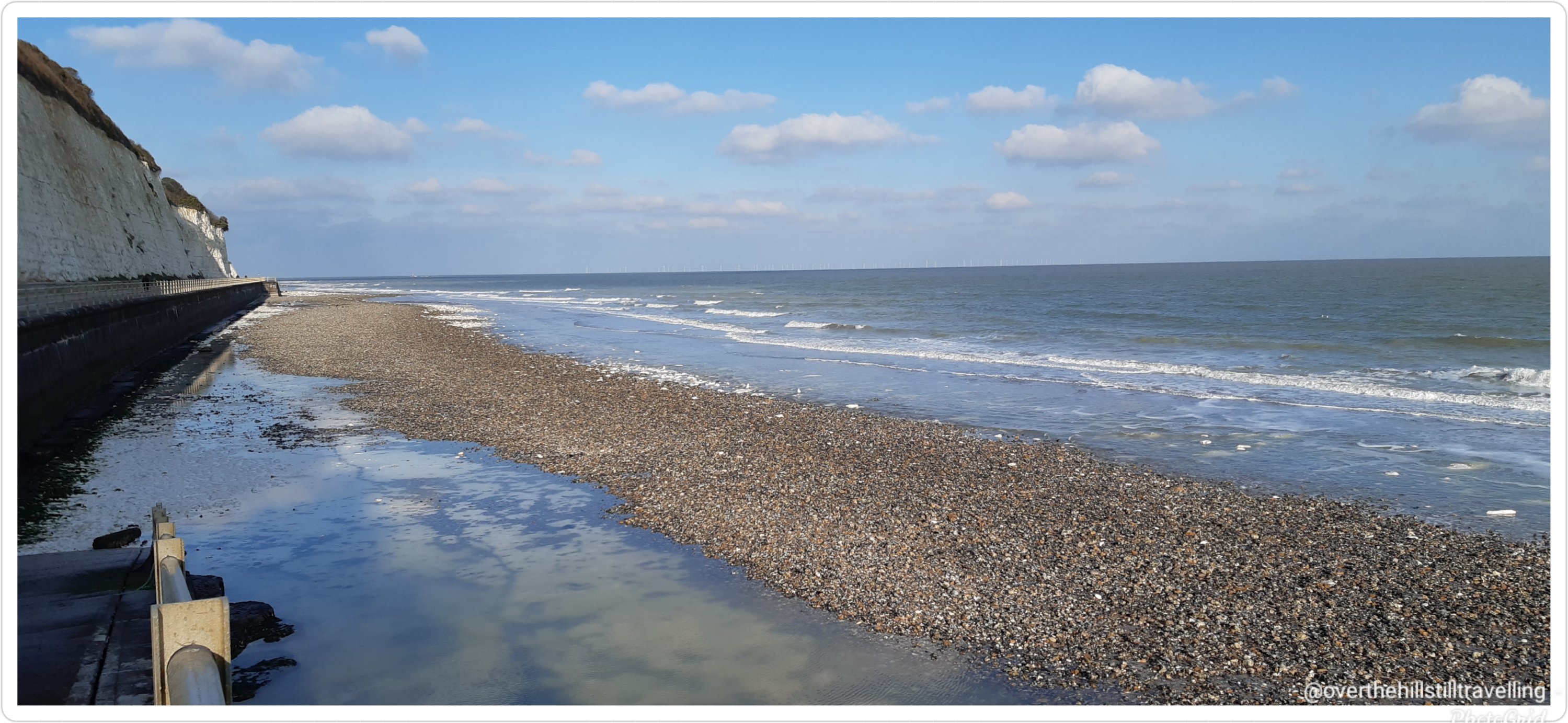
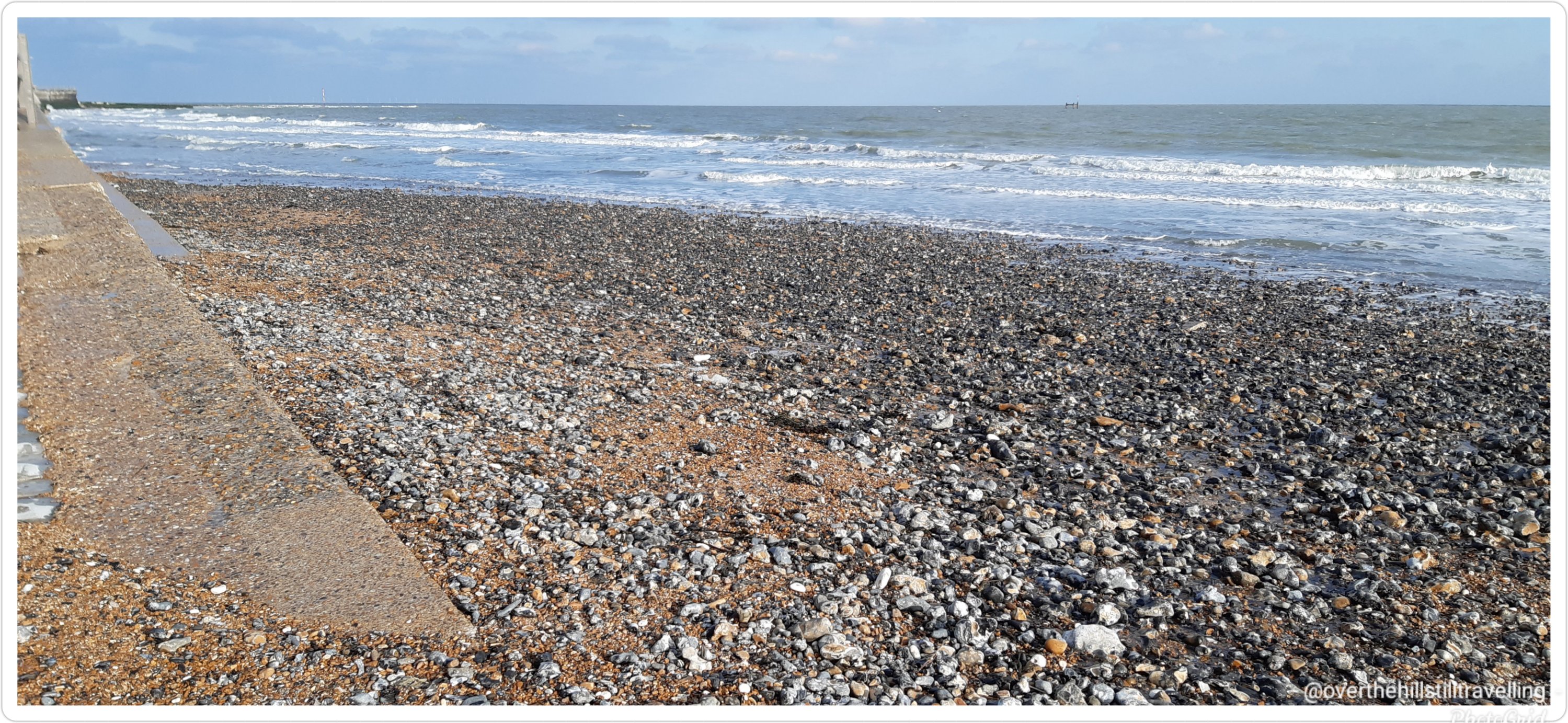
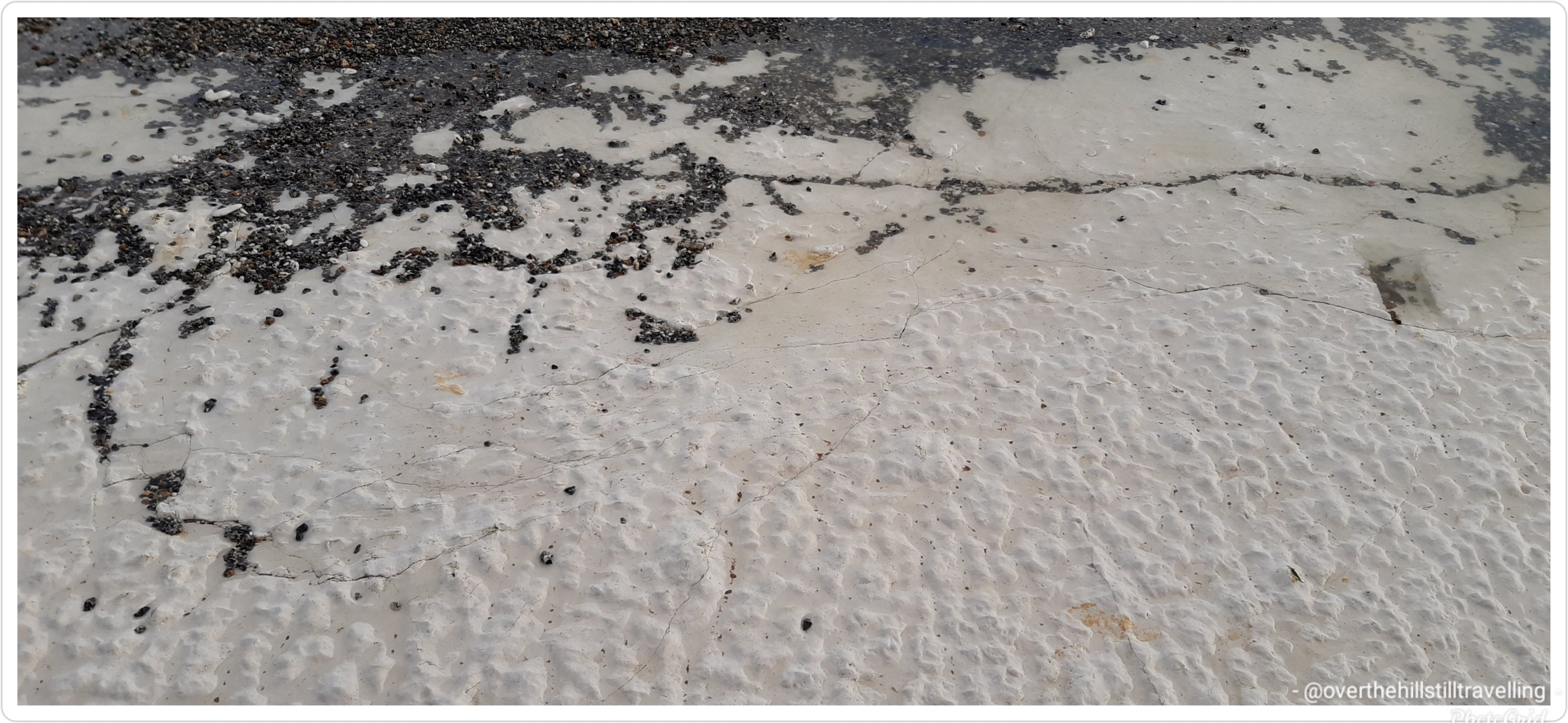
BUT!!! To my horror I found that most of the beach has been stripped away by the storm. As far as the eye can see, used to be beach…its now mostly stones and rocks and the sand has been stripped right down to the chalk bedrock. I genuinely could not believe my eyes. I can see just beneath the waves there’s still some beach, but not sure how far it extends.

The beach where I used to take my grandson to play is now just a rocky morass.

To give you an idea of the power of the sea, this great big chunk of very degraded concrete was washed up and dumped onto the beach almost halfway up towards the Royal Pavilion
Quite awesome to see the pure chalk bottom though…just think….this is billions of sea creatures solidified into chalk from millions of years ago.

Unreal, the power of nature. I’m saddened too because it’s one of my favourite places to walk. But a local said the wind and sea will likely blow it all back when the winds blow from another direction. Meanwhile…😔😔😔 no beach walking🚶🏻‍♀️🚶🏻‍♀️ for me atm, I’ll have to try catch it when the tide is out.

Meanwhile, I shall have to head southward and visit Pegwell Bay again.

Read Full Post »

I’m not sure if I mentioned this before 🤔🤔 but I’m walking the Thames Path for my birthday…its a milestone birthday in as much as according to the government I can officially retire!!!  🤪🤪🤪 if only.

Initially I really wanted to walk from source to sea, but have not been able to find a good relevant guide book. The Cicerone books are excellent but they only had a sea to source guide, which has been irritating me.
So I’ve been pondering how I can turn this around so I can enjoy the walk instead of feeling like I’m doing it the wrong way around…

And I just had an idea 💡 ping the old  🧠 woke up….I shall pretend I’m an explorer 😁🕵️‍♀️🕵️‍♀️🚶🏻‍♀️🚶🏻‍♀️ who has just stumbled upon this great river, and now I have to follow it to find the mysterious source hidden in the jungle….in reality it’s in a barren field and the stream is mostly dry,🤦🏼‍♀️🤦🏼‍♀️ but who’s checking 🤷‍♀️🤷‍♀️ this is my adventure and if I say it’s a jungle, then it’s a jungle 🐒🐒🐒🐆🐅🦏🐘🦒🐊🤪🤪

Sometimes it helps to be on the verge of senility, you can make up all sorts of 💩🤣🤣🤣

Thames Path…I shall 👀👉 in April well that’s the plan anyway…the PM may scupper those plans once again, unless I go incognito.

Walking the Thames Path has been a dream of mine ever since we lived in London, and I’m actually quite excited that finally I can bring my dream to fruition 😃😃 Hoorah

Gravesend
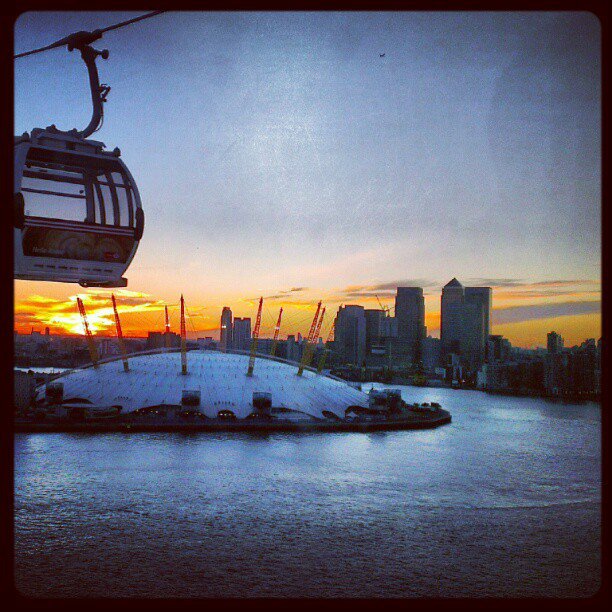
The O2
Bermondsey
City of London – Commemorating the 1666 Great Fire of London in 2016
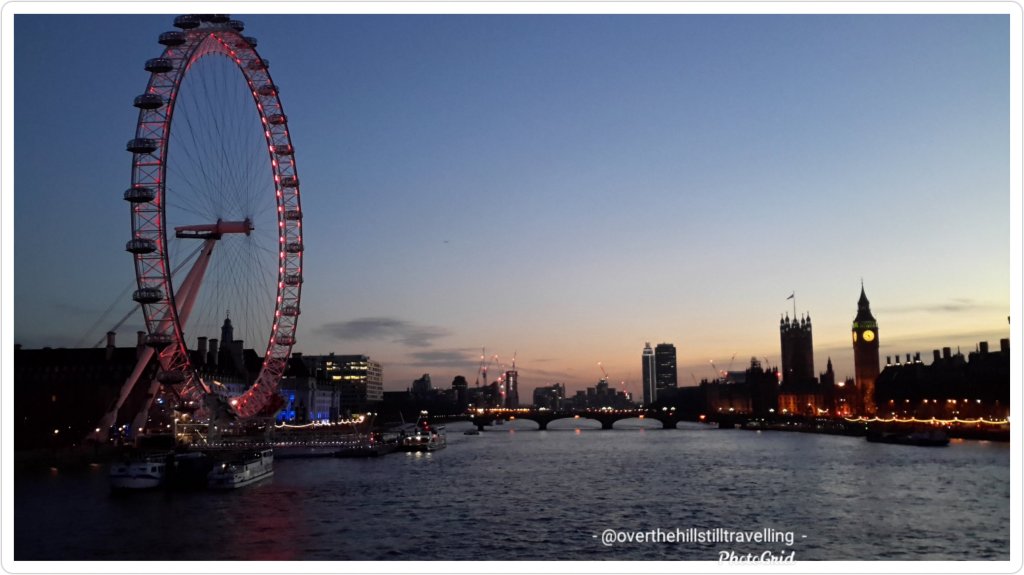
Westminster
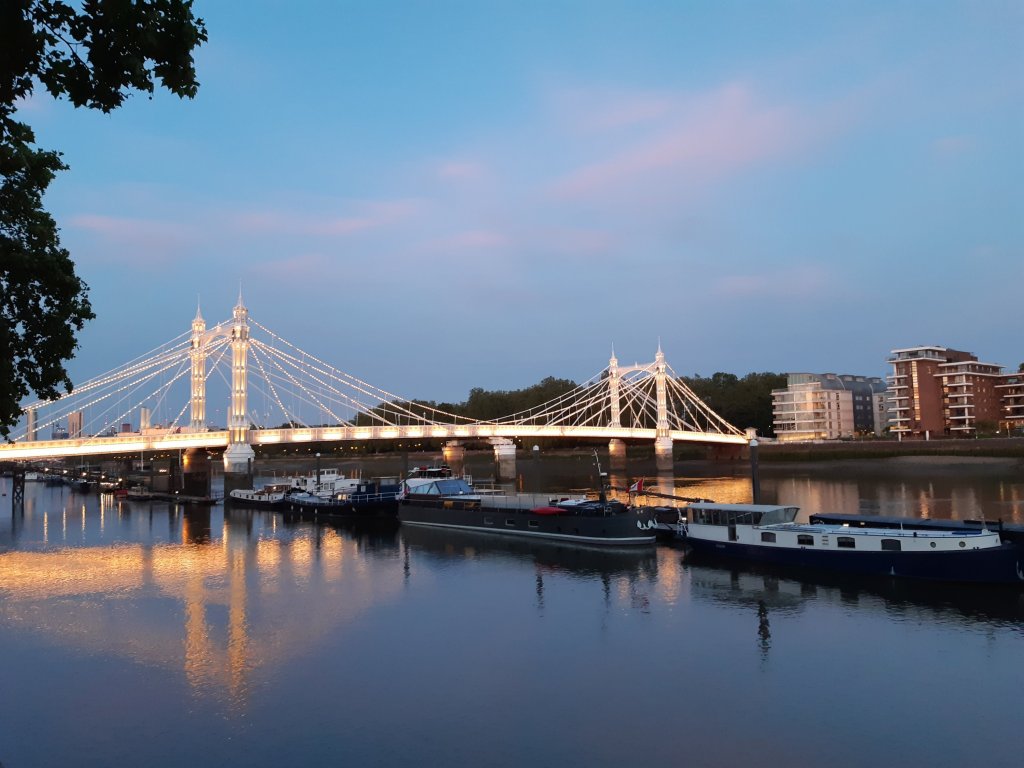
Chelsea
Richmond lock
The Great River Race 2016 Richmond
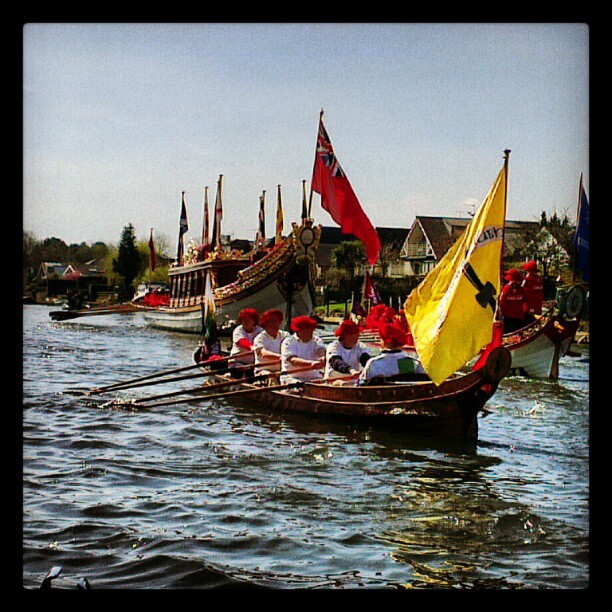
The Gloriana processing along The Thames during the Tudor Pull near Teddington
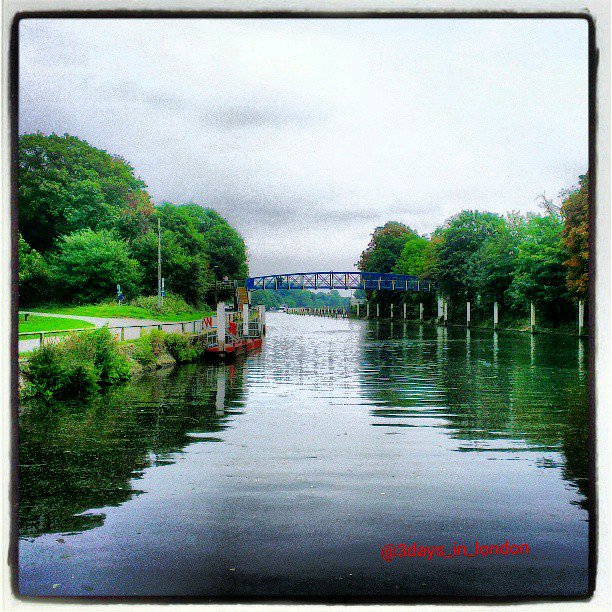
Teddington Lock (during my 3 Days in London days)

Over the years I’ve walked sections of the Thames Path from Gravesend to Hampton Court and I initially toyed with the idea of skipping this section, which will take me 3 days of solid walking at approximately 20/5 kms per day, BUT I know myself too well…I won’t feel as if I’ve ‘actually’ walked the whole Thames Path unless I walk the whole route.

So, according to the guide, the path starts at the Thames Barrier, so that’s where I shall start my adventure…

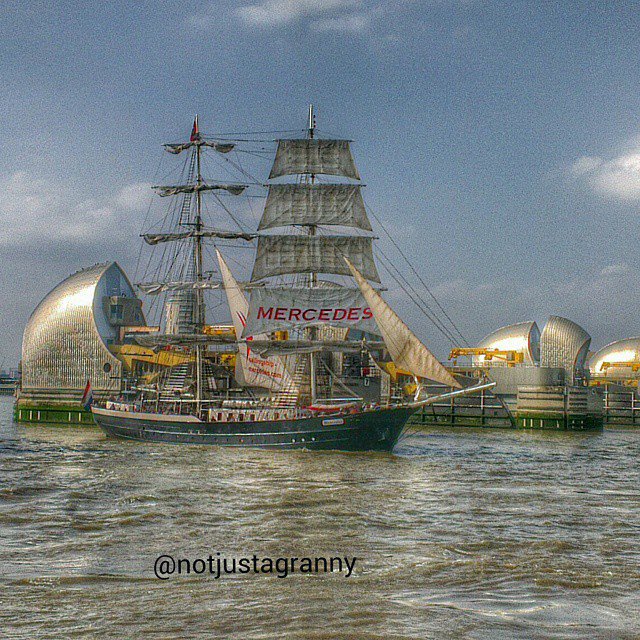
The Thames Barrier

Did you know that the River Thames, a tidal river, is considered to be part of the English Coast right up until Teddington Lock ….

All I need now is for everyone to 🤞🤞🤞 that we don’t go into another lockdown before 20th April…thank you 😉

Read Full Post »

I had to concede defeat today and had my first Covid vaccine jab. I’m not happy about it, but when you start hearing things like “have you had a test recently, or when will you be having your innoculation?” from prospective clients et al, along with talk of vaccine passports, you know the writing is on the wall. We are but a commodity.

So I just said, to hell with it  and booked an appointment. So many people are still totally ignorant of Covid and its transmission. Having the vaccine is not going to stop me from inadvertently passing it on to someone else in the event I come into contact with it. Its seems that some folk think it’s a magic wand, and once you have the jab you’re safe. You’re not. You’re just less likely to get really ill, and even then it’s no guarantee. Even the scientists are not wholly in agreement about the efficacy and what it means. Ugh. Anyway, it’s done. I can’t afford to not work.

The process itself was painless in all respects, and the system was smooth and flowed easily. Because of previous negative responses to a flu vaccine, I stayed institu for 25 minutes after the jab, just to make sure I didn’t just keel over and die 🤪🤪 and then I was away…the staff were friendly and well organised and I was impressed with the efficiency of it all. I still, 9 hours later have had no ill-effects. In case you’re wondering, I had the Astra-Zeneca vaccine. 🤔🤔🤔

The good thing that came out of it is that I had an unexpected trip to Deal. After the jab, I set off for a walk to Walmer Castle. Its amazing how close the 2 castles are to each other…25 minutes brisk walk. But first I had a most delicious curried vegetable pie from Al’s Bakery on the High Street…totally recommended. If I’d known it would be so yummy, I’d have bought 2.

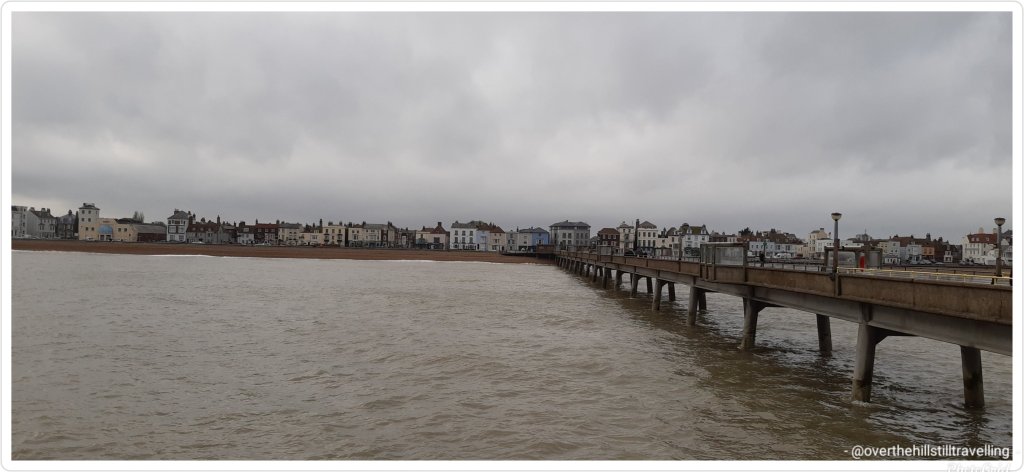
A quick walk along the pier as well, then back on the train…which remarkably, considering the delays caused by the land slip near Folkestone, arrived at Deal and stopped at exactly 14:32 (I was watching the clock) – even a Swiss train would be hard put to match that!! 😉

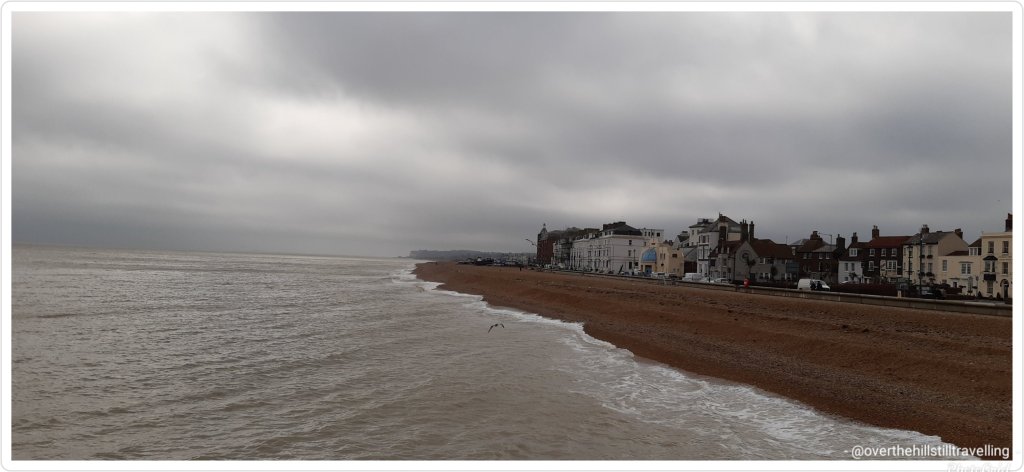
It’s a very long pier

Oh, and see that arrow pointing to the land in the distance in the next image… that’s the White Cliffs of Dover and last year I walked from Walmer to Dover via the cliffs…awesome walk and really beautiful

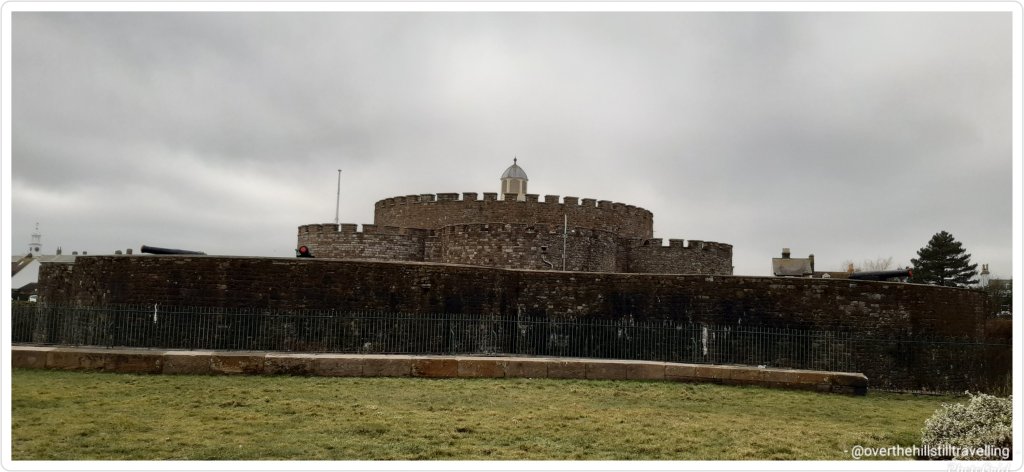
Deal Castle
Walmer Castle

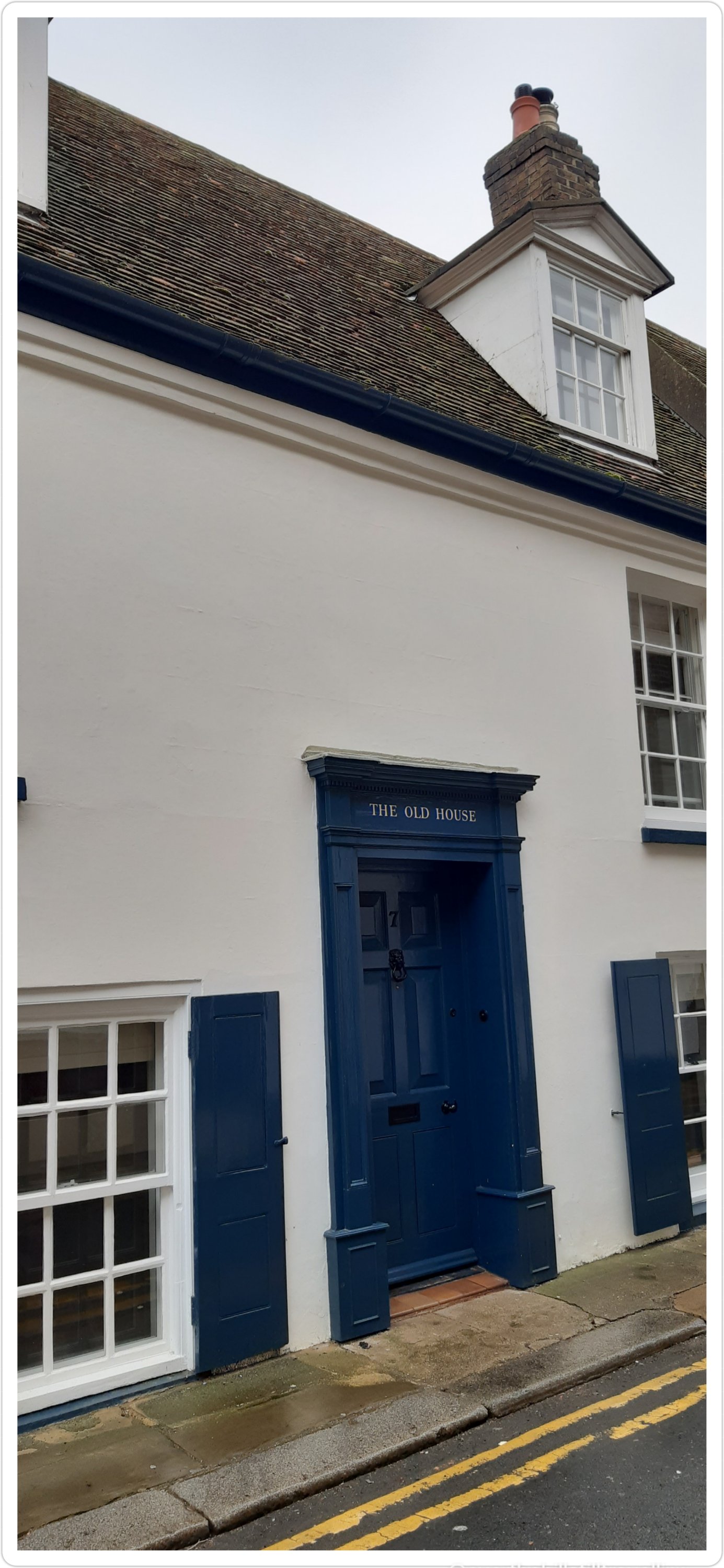
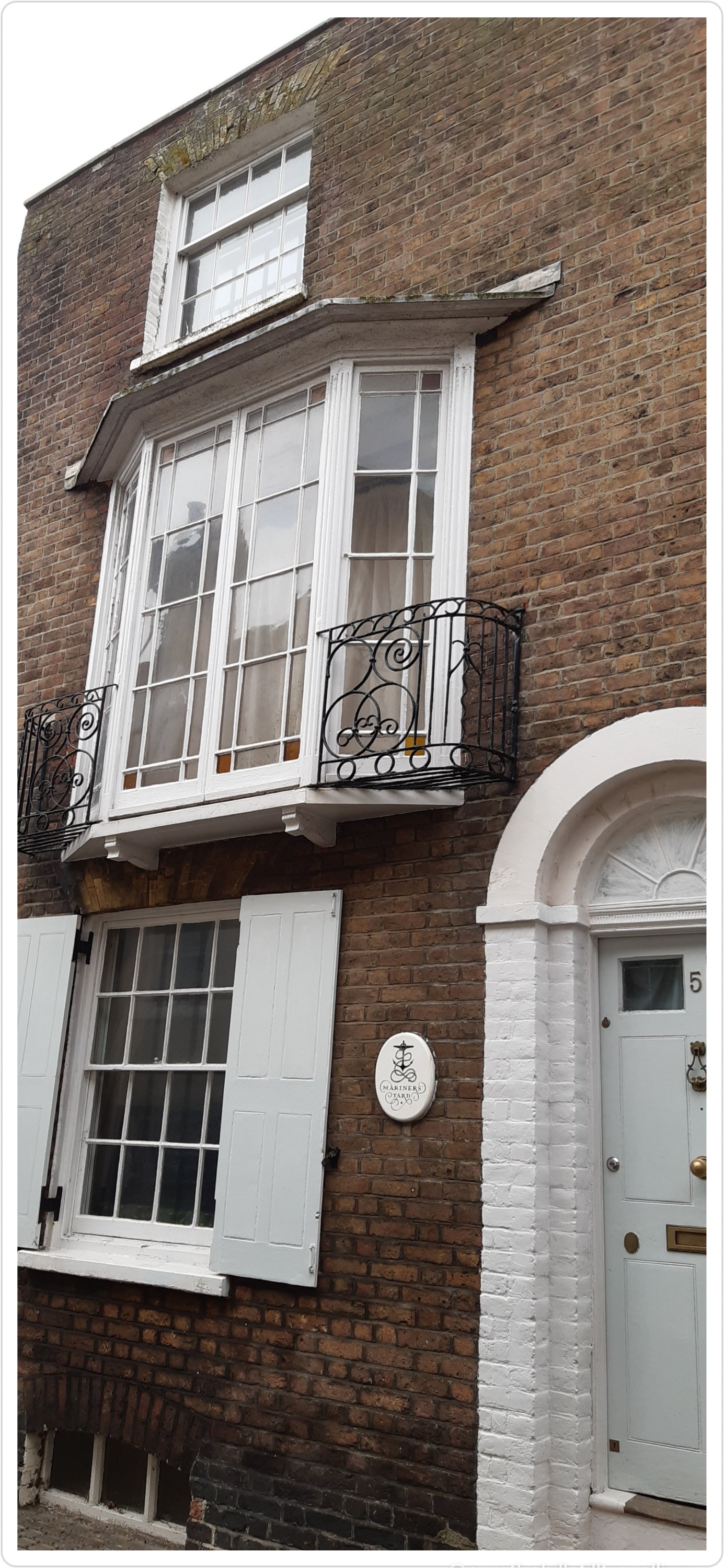
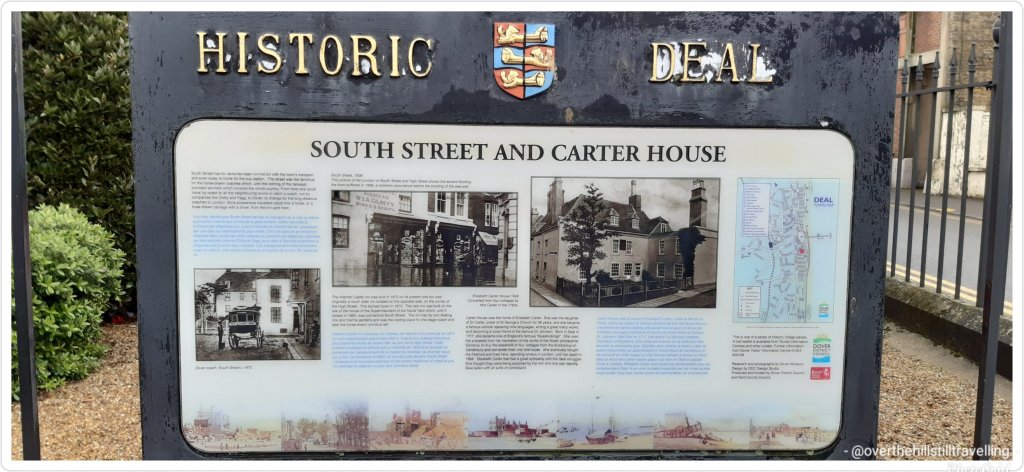
Deal is an incredibly historic town with some amazing old houses

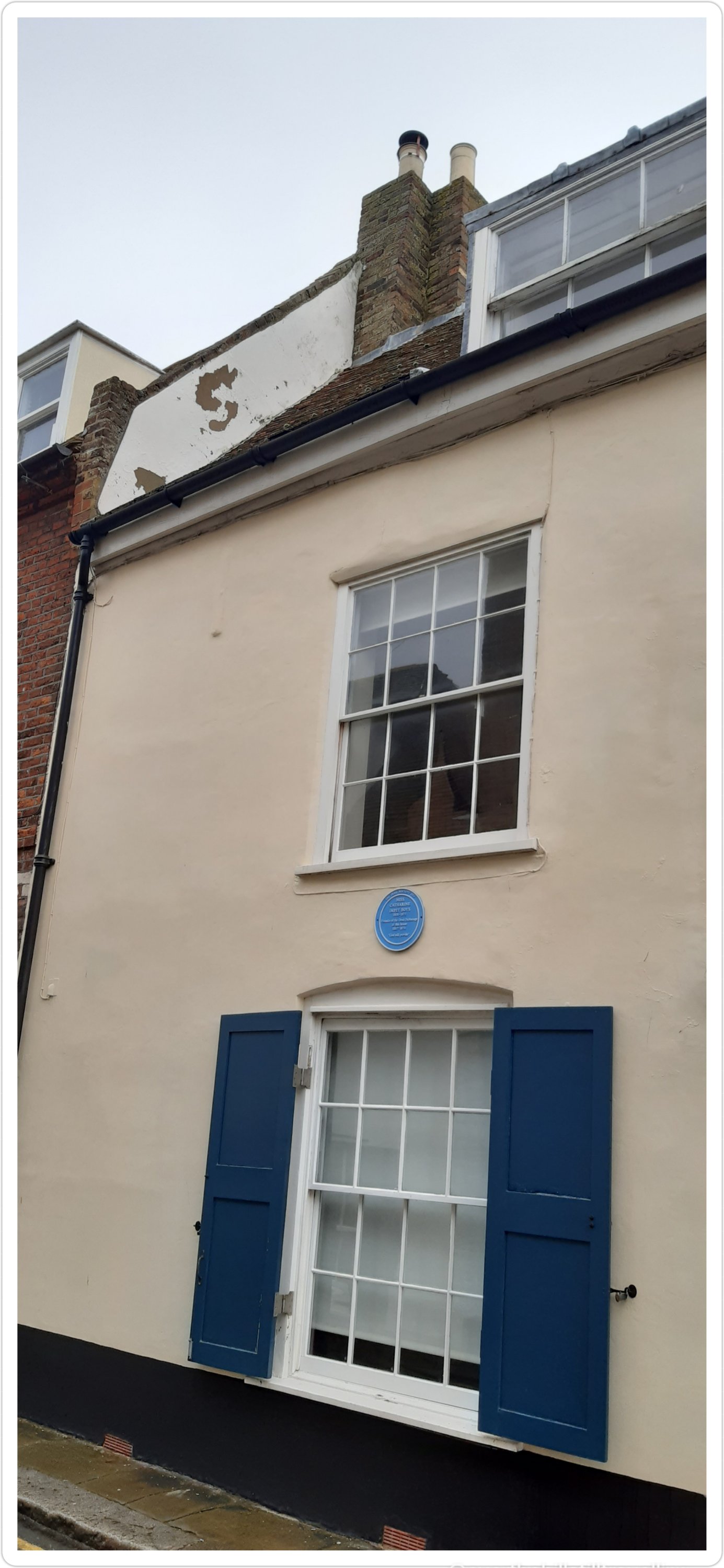
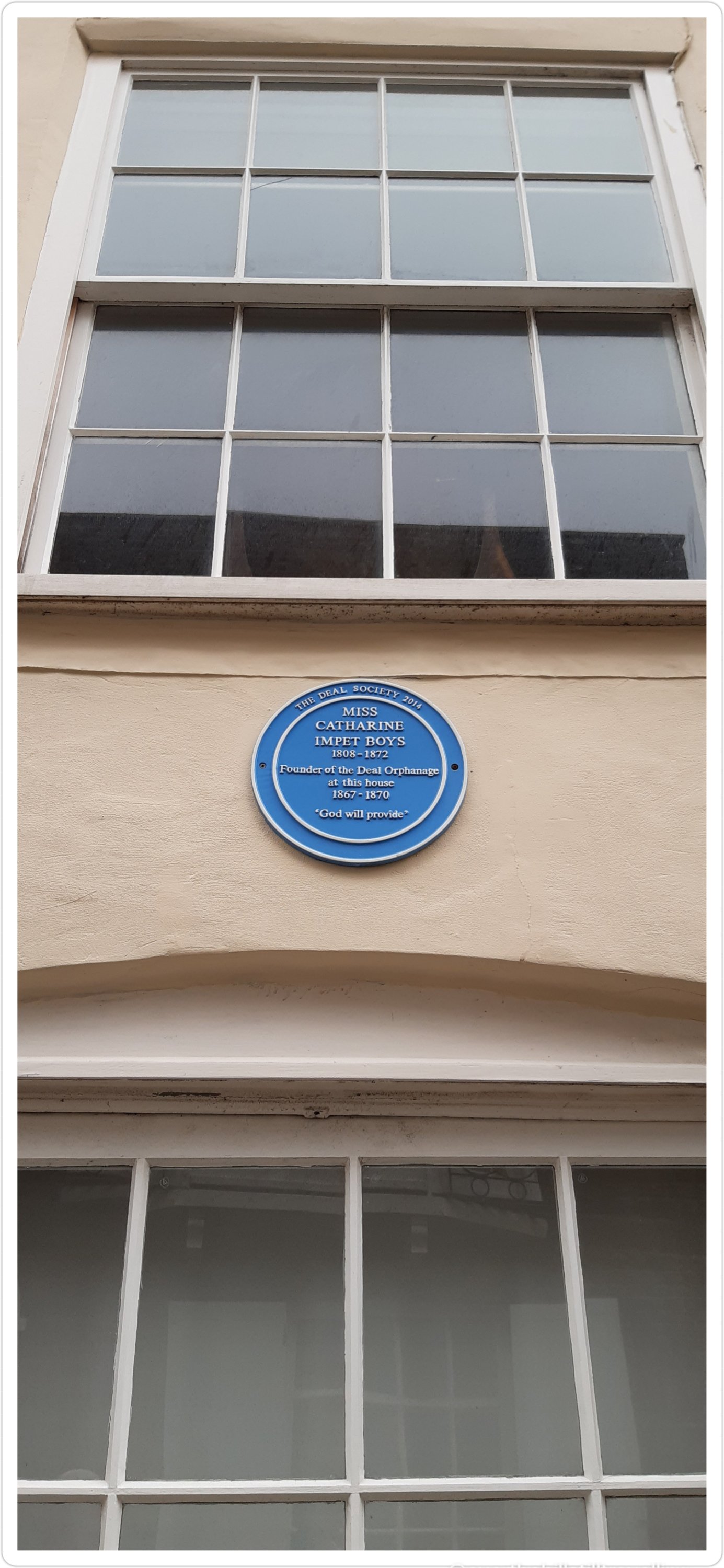
Carter House

Although it was wet, cold and blustery, I really enjoyed my walk and as usual could have just kept going….as soon as lockdown lifts, that’s exactly what I’m going to do…

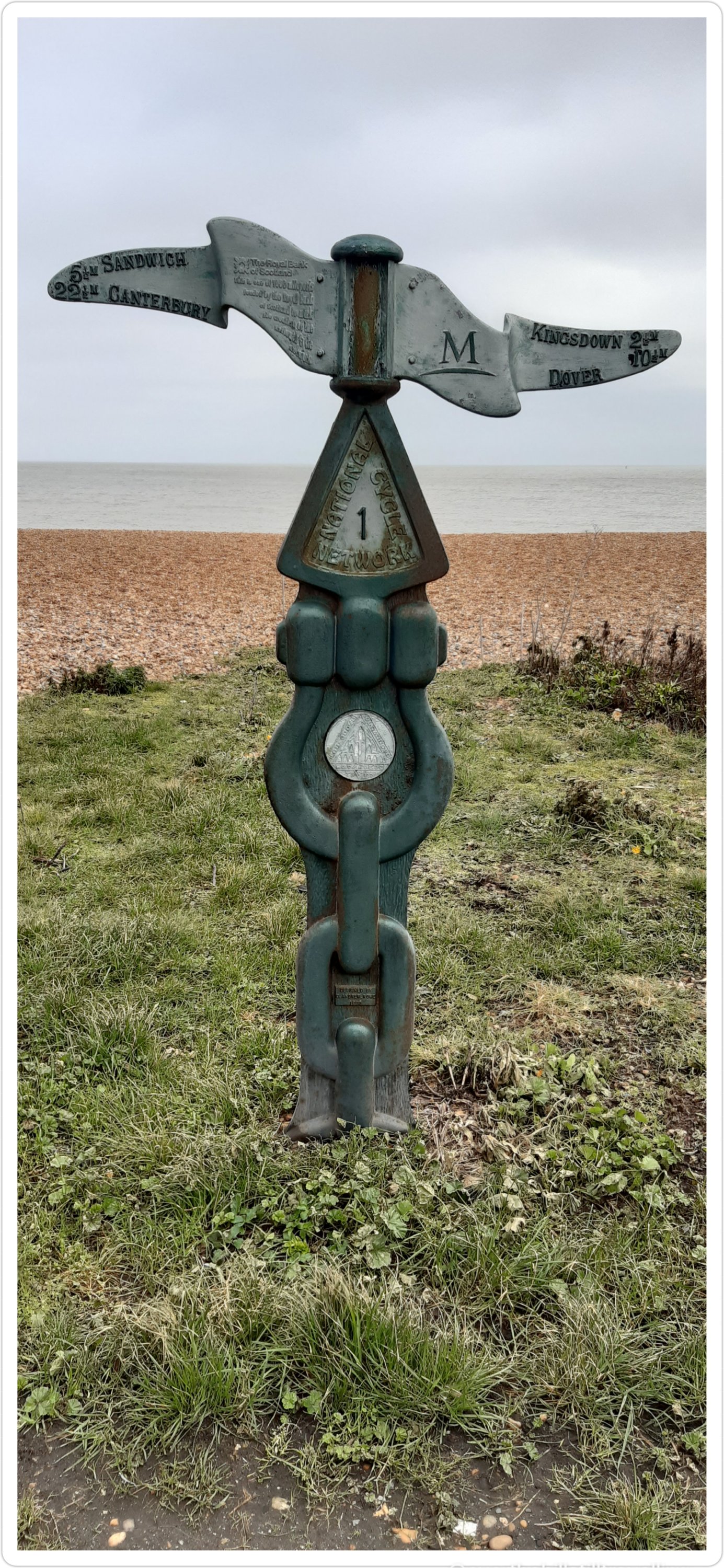
I love these cycle path signs….tempted to follow them one day 🚴‍♀️🚴‍♀️🚴‍♀️

I love this little square

And of course, you can’t visit a seaside town and not stop to look at the boats

A pretty fishing boat

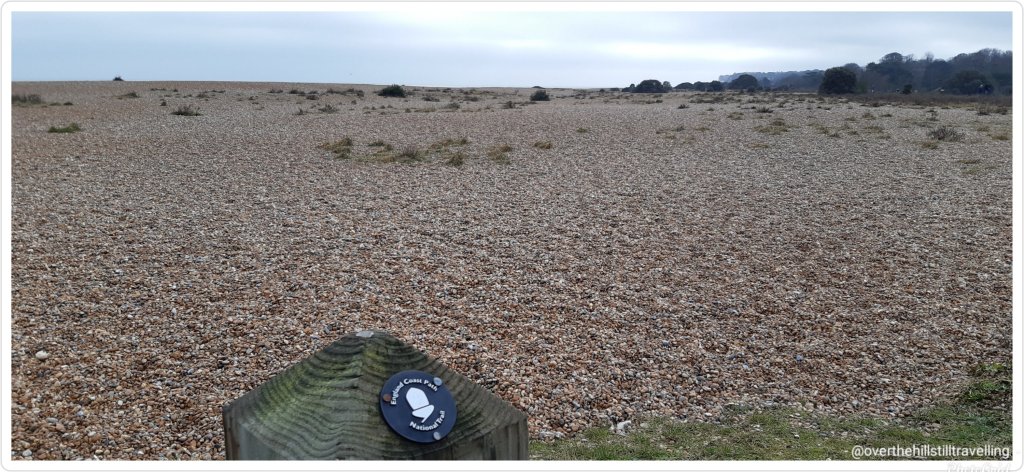
And finally, one of my favourite signs

The Acorn – symbol of the National Trails – England Coastal Path

And today’s walk added another 8kms to my Mt. Everest virtual challenge and takes me to nearly half way through the challenge 🚶🏻‍♀️🚶🏻‍♀️🚶🏻‍♀️👏👏👏

Both Deal and Walmer are mentioned in the 1086 Domesday Book :

Deal was a settlement in Domesday Book, listed as Addelam, in the hundred of Cornilo and the county of Kent. It had a recorded population of 31 households in 1086, putting it in the largest 40% of settlements recorded in Domesday, and is listed under 5 owners in Domesday Book.

Julius Caesar reputedly landed on the beach at Walmer in 55 BC and 54 BC. It is only one possible landing place, proposed judging from the distances given in his account of the landings in his Gallic Wars. However, recent archaeological research and digs have found that he landed at Pegwell Bay. Walmer is probably the settlement Wealemere listed in the Domesday Book.

As I mentioned….loads of history, and both castles are well worth a visit

Read Full Post »

And tah dah!!!! I’m done! I reached Stage 9 and the end of my Alps to Ocean challenge on 2nd February. Hoorah.

Finally here I am 180miles (290km) later, having travelled from the alps of Mount Cook, along multiple lakes, countless connecting rivers, past seven Waitaki Hydro power stations, various mountain ranges, through tussock grasslands, beside electric fences (do not touch) to arrive in the urban town of Oamaru on the shore of the Pacific Ocean.

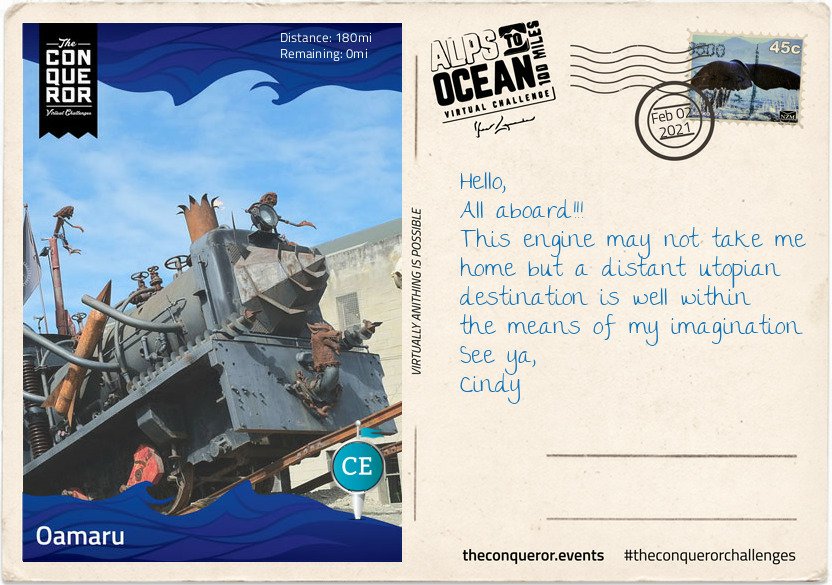
Oamaru is the largest town in the region and renowned for its Victorian precinct. A commercial streetscape, the Neoclassical architecture is a result of Scottish architect and engineer, Thomas Forrester, who emigrated with his family to NZ in 1861. Arriving in Oamaru to supervise the construction of the Bank of Otago, Forrester stayed on and shortly afterwards was integral to the construction of the Oamaru Harbour. Taking samples from the harbour floor, he deduced that the seabed could be dredged permitting the development of a deep water anchorage. This in turn allowed large ocean-going vessels to safely steer in and out of the harbour. Forrester then changed direction and together with his business partner, over a period of three decades, designed and built the various commercial buildings that still stand today. The precinct bustles with cafes, antiquity shops, bookshops and galleries. Each year it conducts the Victoria Fete, a one day fundraising event with stalls, music, food and period costumes. The funds raised go towards the ongoing care and restoration of the Victorian buildings.

For steampunk enthusiasts, inside one of the Victorian buildings is Steampunk HQ showcasing a collection of quirky items in retro-futuristic sci-fi style whilst outside is a full size train engine spitting fire and billowing smoke. Promoting sustainability and recycling Steampunk HQ collaborates with like-minded artists on projects to continue expanding the collection. Wish you could join me for a steampunk-Victorian era inspired dress-up and for a time feel like we have been transported into an alternative 19th century England.

At the north end of the Victorian precinct is the oldest public garden in NZ. When the town was surveyed in 1858 an area of 34 acres was set aside as a public reserve. Eighteen years later in 1876, the Oamaru Botanical Gardens was opened. Besides the flower beddings, bushes and trees the garden is dotted with various attractions such as the Japanese red bridge, Oriental garden, croquet lawn, sundial, aviary, peacock house, an Italian marble fountain and the Wonderland Statue made by the famous Scottish sculptor Thomas J Clapperton which he donated to the children of Oamaru in 1926. Thomas also made the bronze soldier sculpture on the World War 1 Memorial in Oamaru and is famous for his Robert the Bruce sculpture adorning the entrance of Edinburgh Castle, Scotland.

As I stand on the end of the pier and look across the expanse and vastness of the Pacific Ocean, I wonder at its hidden stories, sunken ships and deep trenches. I wonder what Portuguese explorer, Ferdinand Magellan was thinking when in 1521 he sailed across the Strait of Magellan into the Pacific Ocean and was inspired to name it Mar Pacifico which translates as Peaceful Sea. It’s certainly questionable when you consider the heavy swells, the earthquakes, volcanoes and tsunamis that have battered many Pacific islands and sometimes obliterated complete towns. When I consider the depth and perpetual darkness of the Mariana Trench or the Pacific Rim with the highly active Ring of Fire, peaceful is not something that comes to mind but it is intriguing and fascinating.

This has been such a fascinating journey, it is indeed intriguing. I mean snippets like this are just awesome: Mar Pacifico which translates as Peaceful Sea, although I’m not too sure about the earthquakes et al.

Albeit a virtual journey, it’s made more exciting with the postcards and the information you receive as you reach each stage, and how much I’d love to see that train!! I’ve learned more about New Zealand than I ever knew, as well as from my previous challenges: Mt. Fuji in Japan, The Great Ocean Road in Australia, Ring of Kerry in Ireland etc They’ve all been so interesting.

So far I’ve completed 9 challenges which includes the Conquer 2020 challenge which was a sum total of all my challenges and more in 2020. My favourite so far has been Hadrian’s Wall and I never did get to blog about it…I only thought about sharing these challenges on my blog while I was doing Mt. Fuji because it was so fascinating. I’ll try to blog about the others, but I’ll stick with the shorter ones otherwise it gets too tedious for everyone….anyway, The Ring Road in Iceland is 1,332kms long and I imagine has lots of postcards LOL and the St Francis Way is 503 kms…so likewise.

But I’m starting the Mt. Everest challenge next, and then the Giza Pyramids challenge after I’ve done The Cabot Trail in Canada, so I’ll share that at the time. Of course I may just change my mind and blog about The Cabot Trail too 😉 And here is my certificate. Seriously, within seconds of updating the app, the final postcard and certificate land in my mailbox. I’m going to make books from all of them for each walk….will be fun to look back on one day when I’m older, and infirm and unable to walk far….if I live that long LOL

Not too bad eh!! 5 weeks and not every day walked

Read Full Post »

You have received a new postcard! 🙌 its ridiculous how excited I get when I post a day’s mileage to my app and within seconds I hear the ping of a new email 😃😃 I reached Stage 8 on 28th January, and

It’s with mounting excitement that I realise I’m nearing the end of my virtual journey on the Alps to Ocean route in New Zealand. I started off the challenge on 30th December 2020, and except for a few days along the Kent coast, the majority of my walking has been in the countryside of Throwley, near Faversham – still in Kent.

I’ve been hard put to get my kms in because I only get a 2 hour break each day and some days due to weather I’ve not been able to walk at all. I set my initial goal at 5 weeks but was hoping to complete the challenge in 4 weeks. However, that plan was scuppered when the booking was extended for 3 weeks. 🤔🤔🤔 Nonetheless, I’m not complaining, I’ve enjoyed my stay in Throwley and with another 10 days to go till I leave (as of the 28th), I’m hoping to finish the Alps to Ocean challenge and start on the Giza Pyramids…meanwhile

Stage 8
Stage 8

The small farming-town of Duntroon is home to around 120 residents. It’s main economy is largely sheep farming and crop growing such as wheat and barley.

The town was bestowed its name by one of a handful of Robert Campbells that emigrated from the United Kingdom to Australia and New Zealand. It took quite a bit of unravelling and genealogical construction to discover which of the four generations of Robert Campbells was the relevant one associated with Duntroon. It seems that the name Robert was greatly favoured in the family.

The first Robert (#1) was a grand-uncle from Scotland who was the first merchant in the 1788 British colony New South Wales (Australia) and later a politician. Having built a private wharf at the time he is now referred to as “Campbell of the Wharf”. He had a son named Robert but his brother, John, also had a son named Robert (#2).

This nephew, Robert (#2), arrived in Sydney in 1806 and by 1818 he was the Director and afterwards the President of the first formal bank in Sydney, the Bank of NSW, today known as Westpac. Having also built himself a mercantile business on Bligh Street, Sydney, he became known as “Campbell of Bligh Street”. This Robert, unsurprisingly had a son also called Robert (#3), who was born in Sydney but chose to return to England and became a Member of Parliament from which he was unfortunately unseated threes month later. To distinguish him from previous Roberts’ he was given the appellation “Robert Campbell Tertius” meaning the third.

Finally the relevant Robert (#4), son of Robert Campbell Tertius, who was born in England in 1843, travelled to New Zealand early 1860s to either buy or lease land on behalf of the family. Robert became a successful sheep farmer, property owner and later politician. Together with his father, he owned a sheep station in the Waitaki District upon which they built a small town they named, Duntroon, a Scottish name possibly as homage to their ancestry and their ties to Clan Campbell of Argyll, Scotland.

Robert’s (#4) wife, Emma, bequeathed £6,000 to the parochial district with instructions to build a church for the benefits of Church of England members. The result was St Martin’s Anglican Church in a 14th century Gothic style, built out of limestone quarried in a nearby region. The side church door bears the Clan Campbell coat of arms. Sadly both Robert and Emma died childless and within a few months of each other.

By 1875 much of the acquired Campbell lands became plagued by rabbits that were imported in the 1830s and released for sport. Unable to curtail their rapid reproduction rate, by the early 1880s the pastures were depleted and hillsides eroded. This in turn produced lower quality wool thereby affecting the prices of wool. In the end, the devastation wrought in the region forced many sheep station owners into bankruptcy and the Campbell’s businesses in NZ were eventually wound up and ceased operating by 1920.

Just off the main highway is the Vanished World Heritage Centre, a fossil and geology museum that includes the fossils of two species of extinct genus of large penguins from around 27-28MYA. Known as Archaeospheniscus, the species is about the size of an Emperor Penguin. There was a third species, albeit a smaller one, in this genus that was discovered in Antarctica. These three species are the only ones currently existent in this genus.

Having left Duntroon, I’ve parted ways from Waitaki River which has been my companion since the Waitaki Dam and moved in a south-east zig-zag direction until I stopped at the Rakis Railway Tunnel, an old disused railway line. During the 1880s depression era the construction of the railway provided much needed unemployment relief. The 11mi (19km) line was in use from 1887 to 1930. Today the tunnel is only 330ft (100m) long and although it can be explored, a torch is needed because halfway in the tunnel curves cutting out all source of natural light.
Today will be by far my longest route of this entire journey, hence writing this letter on one of my rest stops. I look forward to rolling into my final destination, Oamaru.

Interesting information provided…..and therein lies the foolishness of history. You can’t just import alien species into a country for whatever reason and expect it to have a happy outcome. If you read history, you’ll discover that there were dozens of similarly stupid and foolish mistakes made by the invaders (of the people kind, not the animal or plant kind) of these islands as well as in Australia and various other countries around the world; the British Empire!! Geez. Well I have to admit that I have no sympathy for the unfortunate Campbells, shooting rabbits for sport – how cruel…and talk about a lack of imagination. With the huge variety of names on offer, could they not come up with something a little different…I mean I like the name Robert on the whole, but surely a little variety wouldn’t have gone amiss?

I do like the Elephant Rocks though and the Vanished World Heritage Centre, sounds like an awesome place to visit.

Anyway…. I’m rapidly reaching the end of my Alps to Ocean NZ challenge!! I always feel a little sad really when they reach the last few miles…..they become friends eventually LOL Okay, okay, don’t say it…I know, it’s daft.

Didn’t take any photos of the area this day because, seriously I have so many already, but I did spot that gorgeous iris hiding under a hedge and the snowdrops are in bloom. So pretty..I love this time of year when the first snowdrops appear…

And because I didn’t faff around too much taking photos, I managed to clock up 11.44kms in 2.5 hours 👏👏👏😁

Read Full Post »

Nearing the end of my virtual journey, with just 46 miles/74 kms to go…this postcard and story about the route, popped up on 26 January….

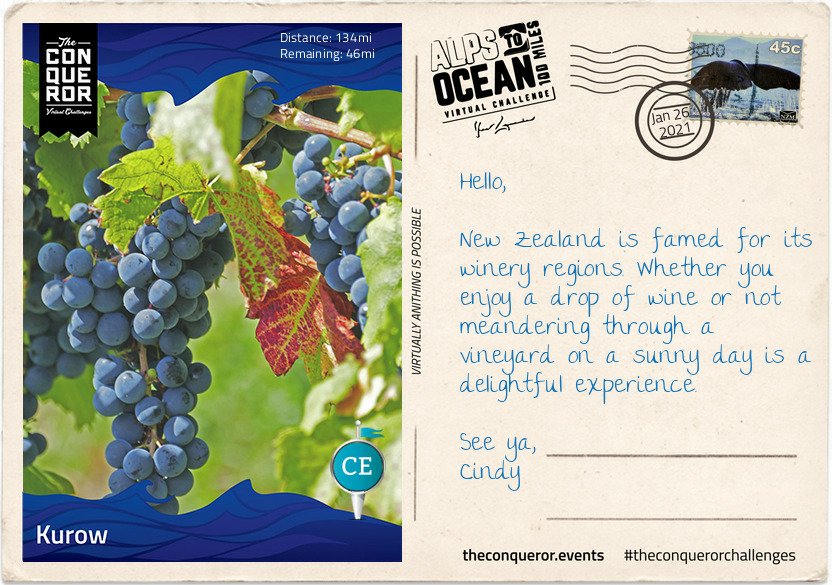
Summer fruit orchards and wineries seem to be the economic backbone of Kurow, a small town that in the 1920s was the base for the construction of the Waitaki Dam.

Kurow sits within the Waitaki Valley, a rich limestone region with a cool maritime climate. With warm summers and long, dry autumns this region is a wonderful environment to grow grapes for wines such as pinots noir and pinot gris. The first vines were only planted in 2001, making this valley a very young winery region. I can imagine it took passionate and dedicated viticulturists to have the courage to explore new grounds and experiment with different plantings. Small scale, family-run vineyards are now dotted through the valley creating bespoke, boutique wines.

Stage 7
Stage 7

Just outside of Kurow is a family-run orchard growing summer fruits such as peaches, apricots and cherries. Conscious about fruit that is rejected by supermarkets due to imperfections, the family built a commercial kitchen and went about turning rejected fruit into a range of products such as jams, sorbets and baked goods. With a half dozen box of summerfruit tarts under my arms, I was ready to leave Kurow.

Joining the trail alongside the Waitaki River, I marvelled at its characteristics. This 68mi (110km) braided river begins at the confluence of Pukaki, Tekapo and Ohau Rivers with Lake Benmore atop it. The river acts like a link between the lower lakes by running through and connecting Lake Benmore to Lake Aviemore to Lake Waitaki before it freely and swiftly flows the rest of the way into the Pacific Ocean.

Between Kurow and Duntroon, I had to ford three rivers and I was grateful they were not flooded permitting me to travel beside Waitaki River and admire the mountain range behind it, instead of using a trail next to the highway. I’m also glad I read the instructions to not touch the fences along the way as many are electrically charged and not necessarily marked for information. Might’ve added an element of excitement I wasn’t really looking for.

Just before reaching Duntroon, I stopped at the Takiroa Rock Art Shelter to see the Maori art on the limestone rock that dates back to between 1400 and 1900AD. After the rock art site, I carried on through Duntroon’s Wetlands into Duntroon straight to the local pub for a feed and more Waitaki Valley wine sampling.

Seeing those grapes reminded me of when I was in Portugal on the Portuguese Camino coastal route to Santiago. The path invariably goes inland at some stages, and one day it took me through a vineyard. I shouted “Ola!! Buenas dias” to an elderly couple amongst the vines cutting down bunches of purple grapes. The lady and I got to chatting (her English was way superior to my Portuguese), and it turned out her daughter was at that time, living and working in London 😃😃😃 How cool is that. So after a long conversation, she gave me a big fat bunch of the MOST delicious, juicy, aromatic grapes you could imagine…the flavour was like heaven.

I strolled along eating the grapes with relish, and shortly afterwards met the one and only snake in my entire Camino. 🐍😱😱 It was lying there, on the path, looking for all the world like a skinny stick, and as I was hesitating, thinking “is it, or isn’t it ” – the bastard moved. 🤣🤣🤣🤣🤣🤣😱😱😱😱

It still cracks me up when I think about that…3 things happened simultaneously : I discovered that I could indeed run if I needed to, I lost most of the grapes, and peed my myself 😜😜😜😜 of course the bloody snake slithered off into the grass with an evil grin ‘gotcha’. 😬😬 not funny.

Of course, encountering that snake, thereafter put a slightly different perspective on my walk, and I never looked at a stick in quite the same way again, or crept off into the bushes without trepidation 🧐🧐🧐

Meanwhile, I’m nearing the end of my Alps to Ocean virtual challenge across New Zealand. And I’m now seriously considering actually doing this route when I visit the island. It might mean postponing my trip down south to Ozzie land for a year to save more funds, but it would be totally awesome. And of course, if I did, and since I’m going that way, I’ve pinned my ‘intention’ to my metaphorical board of walking the Kumano Kodo in Japan. I mean seriously, how awesome would that be!!

Like the Camino de Santiago, the Kumano Kodo is designated a UNESCO heritage site and would slot in nicely with my Project 101 https://www.japan-guide.com/e/e4952.html

Read Full Post »

I got back yesterday after working away for 5 weeks and opened my vast pile of post….

It’s like Christmas really 😄😄😄

And in the pile were my last 4 Conqueror medals 👏👏👏🏅🏅🏅🏅

In order of completion, from left to right

Great Ocean Road, Mt. Fuji, Conquer 2020 and Alps to Ocean which I completed this month. Awesome 😃😃

My target for 2020 was 2,020kms and I reached that on 31 December 2020

I probably walked wayyyyy more than that, but I mostly count ‘boots on’ mileage and if I’m stuck indoors at work and unable to get out for my break on any particular day, I count my indoor walking, which extraordinarily sometimes amounts to 12kms between going on duty at 8am to 2pm when I take my 2 hour break. Mostly I try to get out to walk, but sometimes like these last few days, I get snowed in, or its pouring with rain….ergo, no good for walking if you don’t have the right gear.

I first started these virtual challenges on 26th March 2020, and the Alps to Ocean is my 9th challenge completed. I have 5 to do this year, as well as the Conquer 2021 challenge which is a compilation of all challenges walked during the year. Of course they may well introduce more…in which case 😁😁😁 and ‘boots on’ and getttt walking!!!

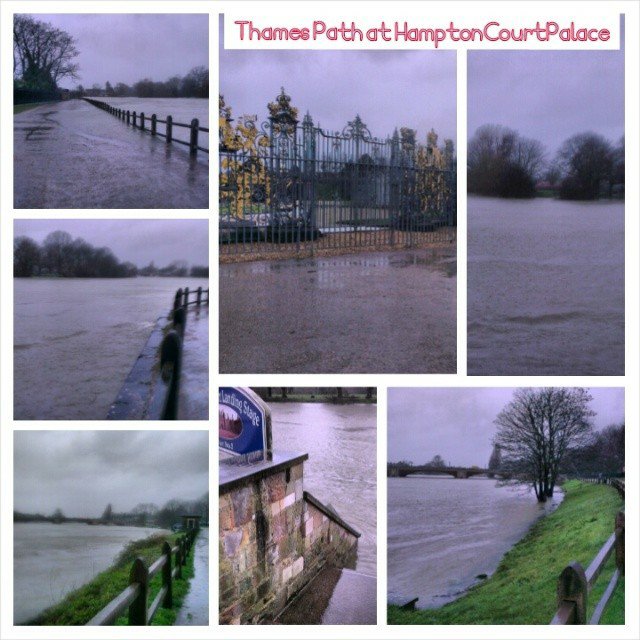
Also in the mail were my next two Cicerone books: The Thames Path, which I’m planning on walking in April for my birthday. Its something I’ve wanted to do for years, and years, and of course I’ve walked many miles along the River Thames between Hampton Court Palace and as far as Greenwich – not all in one go, but different sections over the years, and right along the whole length between Rotherhithe and Lambeth, also at different times.

And of course the South Downs Way is a desirable walk for this year too.🤞🤞🤞 because so many factors affect that possibility.

Read Full Post »

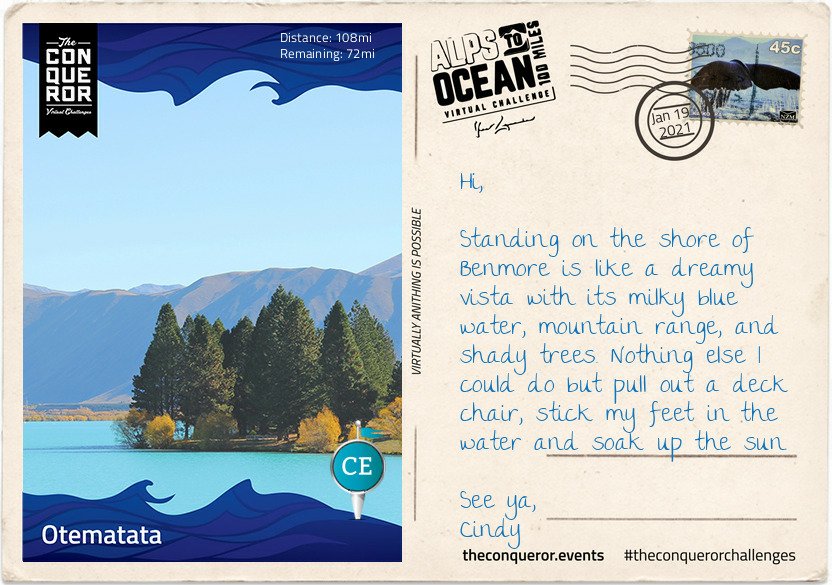
I reached this stage on 19 January, so not too far behind the last stage…either I was walking a lot more, or the distance to this stage was shorter. Of course all I have to do is check the details on the postcard!! In real life, from 1st January to the 19th I’d walked 128km which is just over 80 miles. Not too bad.

And doesn’t that water look amazing. Reminds me of the sea along the Thanet coastline when the water gets cloudy from the chalk after a storm…

Defined as “a populated area less than a town”, Otematata is more of a holiday town nowadays when it’s small population of around 180 explodes to 5,000 during the summer season. With easy access to both Lake Benmore, downstream Lake Aviemore and nearby hiking trails (known as tramping in NZ), holiday makers swarm to the area for camping, water skiing, boating, fishing, swimming and cycling among other activities.

Stage 6
Stage 6

Otematata sprung up in 1958 as a base for construction workers of the Benmore and Aviemore Dams. Within a year the population grew to 450 and at its peak it was as high as 4,000 residents. Built by the Ministry of Works the town had all the necessary facilities and services such as schools, clubs, pub, cinema and mall. The 1,500 strong workforce of engineers, builders, electricians, concreters and truckies spent seven years building the dam. Once the dam was finished, as it often happens with these kind of projects, the town was slowly dismantled. The houses that were trucked into town were years later trucked out and moved to Twizel for the next project. Benmore Dam is the largest earth-filled dam in NZ and the largest of eight in the Waitaki hydro scheme. As the second largest hydro station in the country, Benmore generates sufficient electricity to cover nearly 300,000 NZ homes.

Leaving Otematata, I travelled north on a sealed pathway alongside the Waitaki River until I reached the massive Benmore Dam and stood atop it with a bird’s eye view of the lake to the north and the river to the south. When the lake is over capacity, the floodgates open to release the water down a spillway and to prevent erosion a lip was inserted at the end to deflect the water. The spillway can handle ten times the normal river flow thereby allowing it to cope with severe flooding.

I skirted around the shore on a narrow sealed road to Deep Stream Track on Lake Aviemore for a walk along a flooded canyon. The deep green water was quite inviting for a swim but I settled for a picnic under a shaded tree enjoying the tranquility of this location and the reflection of the hills on the water.

A little further I crossed the Aviemore Dam back onto the State Highway and was relieved to be travelling on an off-road path beside the main road all the way to Waitaki Dam. Aviemore Dam was built in 1968 and the construction was on uneven ground because the Waitangi Fault runs beneath it. Although at the time of construction the fault was considered inactive, in the 2000s the fault was upgraded to dormant and as such the dam was reinforced against earthquakes and potential landslides. Because of the fault the dam is a mixed structure being part solid rock topped with concrete on the north side and earth-fill where the fault line runs beneath on the south side.

The Waitaki Dam is steeped in NZ history. As the smallest in the Waitaki hydro scheme, it is also the oldest having been built in 1935. Being the first dam to be built on the South Island, it was also the last to use pick and shovel. These archaic tools were retained because politicians wanted to reduce the unemployment rate during the Depression Era.

The building of the Waitaki Dam inadvertently played a major role in the birth of the social welfare system. In 1928, the Waitaki Hydro Medical Association together with the Waitaki Hospital Board developed a scheme to deduct monthly fees from wages in order to provide medical and ambulance services to the workers. When two politicians, one a doctor and the other a reverend, took office in 1935, they based the social welfare scheme on the one developed by the dam project.

From here it was a 5mi (8km) journey into Kurow. I heard the Waitaki Valley, which begins in Omarama, is a young winery region with a flair for developing good pinot noir and pinot gris. I’ll be sure to sample some after a hearty meal. I’m thinking fish and chips at the nearest pub.

I could live with fish and chips!! And do my journey continues. Seriously though, reading these emails makes me really really want to walk this route for real….

Read Full Post »

« Newer Posts - Older Posts »

Self Propelled

Self propelled adventures through life; blogging on cycling, touring, micro-adventures, general shenanigans, and environmental news

johnelsewhere

Thoughtful wanderer in search of virtual meaning

Things Helen Loves

TRAVEL, WALKS & EVERYDAY ADVENTURES

Short Walks Long Paths

Wandering trails around the coast of Wales

Port Side Travel By Jill

My travels, photos, tips/tricks and anything else I think of!

Wonderwall

My 360: wonderwalls,theatre, travel, Sheffield, books...

Robyn's Ramblings

My Thoughts. Expressed.

Graham's Long Walk

Graham King's long walks around Britain

The Lawsons on the Loose

Philip & Heather are making memories through their travels.