Feeds:
Posts
Comments

Or Stage pre-2 🀣🀣🀣

Oooopps, it seems I missed a stage on my Mt. Fuji virtual walk, and frankly it’s a pretty awesome stage, so even though I missed the email (found whilst tidying up my mailbox last night), I thought I’d share it anyway. So here it is; the correct Stage 2…

Mt. Fuji – Aokigahara Forest

Aokigahara nicknamed Sea of Trees and at times infamously referred to as Suicide Forest, is a dense, moss-covered forest that sits within the Hakone Izu National Park. Registered as a National Natural Treasure the forest was born out of an eruption from Mount Fuji about 1,200 years ago, when new trees started sprouting from cooled lava. Because the forest is formed on top of dried magma, trees are unable to grow their roots deep into the ground. Although the thickness of the soil is only 10cm, the forest is filled with evergreen conifers, Mongolian oak, Fuji cherry and maple trees.

Hiking trails have been paved in the forest for visitors but anyone veering off the designated path can easily get lost and be difficult to rescue. Plastic tapes can often be seen rolled out to mark the path and assist visitors to find the way out. Then there are times when people have no intention of coming out and getting lost is a means to ending it all.

When I entered one of the trails on Aokigahara it was with the intent to find Fugaku Wind Cave and Narusawa Ice Cave. The trail was wide, well-marked and well-maintained with sunlight streaming through the canopies of the trees. I needn’t worry that I might get lost.

Fugaku Wind Cave was a 659ft (201m) long lateral cave accessed via a staircase. Due to its natural ventilation and year-round average temperature of 37Β°F (3Β°C) the cave was used as a refrigerator during the 17th to early 20th century to store the eggs of silkworms.

Narusawa Ice Cave was a looped 492ft (150m) lava tube that maintained the same temperature as Fugaku and was also used as a natural fridge during the pre-electric refrigerator era. A small section of the cave was only 3ft (91cm) high where I needed to walk sideways in order to see remnants of trees from a thousand years ago. Ice pillars begin forming over the winter period here reaching their maximum size by April. They can grow up to 10ft (3m) high and as thick as 20in (50cm) wide.

Leaving the forest, trail and caves behind, I proceeded to trek through urban areas to Lake Kawaguchi.

Doesn’t that description just make you want to go there right now? Imagine all the cool photos you could capture!! I’d spend a whole day there if I could, besides being described as the Suicide Forest, it looks so invitingly peaceful and calm.

I’m sure if we stayed still long enough, and looked hard enough, we’d see faeries.

And as for those caves…..oh my gosh, bring it on!!!

If you missed the start of this (my) challenge, click here to read Stage 1 of the Mt. Fuji Conqueror challenge

Predictions

This is a really old article, but sometimes my random and accidental keywords take me to interesting places. I also tend to follow a string of articles, clicking from one link to another.

I recently read this article and thought I’d share it with you. It will be interesting to revisit this in what is now only 9 years time and see how much has transpired.

In the meantime, a couple of those predictions are already heading in the right direction, and one of those mentioned, teetered perilously close to the edge of an abyss – the prediction was almost too close for comfort.

I wonder what you think?

And with one final push, I completed the Mt. Fuji, Japan Conqueror challenge on the evening of the 29th December. After my walk earlier the day I noticed I had only just over 1km to go, so off I went πŸšΆπŸ»β€β™€οΈπŸšΆπŸ»β€β™€οΈπŸšΆπŸ»β€β™€οΈ

This final stage took me to the summit of Mt. Fuji, and apparently some of the best views….wish I was there for real πŸ˜‰πŸ”πŸšΆπŸ»β€β™€οΈ

I’ve enjoyed several days exploring the lakes, the forest, the ice caves and seeing Mount Fuji with its perfectly shaped cone from all angles but today was the day for the final climb to the summit.

Shortly after leaving the 5th Station I reached a fork in the trail. To the right was the trek to Fujiko. Heading left, I soon arrived at the Komitake Shrine, named after old Komitake Mountain which is now buried deep beneath Mount Fuji. The Shrine is important to many worshippers who each year on 1 July attend the Kaizansai festival and celebrate the opening of Mount Fuji.

From here to the 7th Station the trek weaved its way through a shady and dense forest. On hot summer days the forest provides a welcoming relief. The path itself was narrow and rough with rocks jutting out and tree branches stretching across the pathway. As with any climb sure-footedness was essential alongside some duck and weaving around branches. There were trail sections resembling carved out channels instead of just flat paths. I can imagine on foggy days this trail would be quite challenging with low visibility and for those who climb at night in order to catch the sunrise at the summit could run the risk of getting lost if not careful. Thankfully ropes line the route providing guidance and assistance up the mountain. Occasional openings in the forest canopy gave me glimpses of Fuji’s peak, like small teasers of what is yet to come.

Leaving the forest zone behind, there were no more trees, just very low shrubs with small white flowers. The ground became more rocky and gravel-like, making it looser underfoot. It makes me realise that although Mount Fuji is not a technically difficult climb, it does however, present its own set of challenges such as a sudden change in weather, the steep inclines, long switchbacks and more importantly the potential for altitude sickness because the oxygen density is only two-thirds of the normal oxygen thereby making it more difficult to breathe.

I forged my way onto the 8th Station where my trail merged with the very popular Yoshida Trail. As expected it became quite congested. Taking a slow and steady approach it was time for the final push. The terrain here was barren, vegetation seemed non-existent.

I knew the summit was near when I made my way through the white Torii gate, which stood proudly on a set of steps signifying that “heaven on earth” is within my grasp.

Reaching the summit though was not the end, yet. The final part was a walk around the crater on the Ohachimeguri Trail. The crater has a 2,560ft (750m) surface diameter and a depth of 790ft (240m). With its jagged edge, the crater is encircled by eight sacred peaks, each with their own name: Oshaidake, Izudake, Jojudake, Komagatake, Mushimatake, Kengamine, Hukusandake, and Kusushidake.

My quest ended at the Kusushi Shrine near the last station. Here I stood to absorb the aerial views, reflecting on my journey and contemplating my descent but that’s a story for another time.

On a final note, did you know that the top 1,312ft (400m) of Mount Fuji is actually private property? Here’s an online excerpt explaining how this ownership evolved:

“… belongs to Fujisan Hongu Sengentaisha, a Shinto shrine. The land originally belonged to Tokugawa Ieyasu, the founder of the Edo Shogunate (1603 – 1867), and the area of Mt. Fuji from the 8th station to the top is said to have been given to this shrine as a gift by the Tokugawa clan in 1779. The land was re-designated as national property for a time after 1871, when the Tokugawa Shogunate relinquished power to the Imperial Court, but has since been returned to the Fujisan Hongu Sengentaisha. The Hongu (Main Shrine) of the shrine is at the foot of Mt. Fuji, and the Okumiya (Rear Shrine) is located at the mountain peak.”

So there you have it, my 5 Stages of the Mt. Fuji Conqueror challenge. πŸ‘πŸ‘πŸ‘ I hope you enjoyed the journey, as well as all the information, and the amazing history linked to this iconic mountain…instantly recognisable. Who knew the top of Mt. Fuji was private property? πŸ€”πŸ€”πŸ€”

Hoorah!! 4 days to virtually ‘climb’ Mt. Fuji

Immediately after finishing this challenge I got started on the Alps to Ocean challenge in New Zealand (289.7kms). Nothing like putting a bit of pressure on yourself then Cindy 🀣🀣🀣🀣 But of course, starting that challenge/walk is taking a wee bit longer to complete because not only is it much longer, but I started my next booking on 4th January and my free time is limited to 2 hours a day, weather permitting. Still, I hope/plan to finish the walk by 31st January.

Why not join me on one of the challenges https://www.theconqueror.events/r/CE1474 they are excellent motivation to get out and and walk, especially now that our wings are clipped by Covid-19 and lockdown.

The research proves to be as interesting as the walks πŸ˜‰ On receiving the postcards from the Conqueror challenge organisers, I usually set about investigating various aspects that are of interest. This usually takes me on another adventure altogether….😁😁

There are four trails to choose from to climb Mount Fuji. The most popular trail, Yoshida Trail, gets a whopping 150,000 climbers a year. Looking for more solitude and introspection I chose the less trodden trail called the Subashiri Trail, which sees an average 25,000 climbers per year. Where the Yoshida climb is from the north of the mountain, the Subashiri climb is from the east.

My target was to reach the 5th Station where the actual trail to the Summit really begins. Reaching the 5th Station can be made by vehicle but during the climbing season, which is July to September, private vehicles are prohibited from using the road. A shuttle buses services the area ferrying climbers from the base of the mountain to the station.

The ascending route to the 5th Station started at the Subashiri Sengen-jinja Shrine which was tucked away amongst giant pine trees. According to legend the shrine was built in 807AD and although it was damaged during the 1707 eruption, it was rebuilt in 1718. Followers of the Fuji-ko religion, a fusion of ancient Japanese mountain worship and Buddhism, congregated at this shrine to commence their pilgrimage to the summit. They continue to do that today and are usually seen dressed in white robes and carrying pilgrims’ staffs.

Heading southwest, just before the Subashiri turn off, was a monument commemorating Prof Frederick Starr. He was a New Yorker who in the late 19th century took up a position as professor of anthropology with the University of Chicago. Upon request to undertake field work in Japan circa 1909, the Professor would eventually become a “student of Japan” visiting the country 15 times in his lifetime. He had a deep love of Mount Fuji having climbed it five times. His ultimate wish was to be buried in a place where he could always see Mount Fuji. In his words: “By climbing Mount Fuji, I found heaven on earth”.

The road up to the 5th Station was a gently sloping, straight section with a beautifully manicured tree-lined road. Two miles (3km) in the landscape morphed into tall, dense pine trees until the road took a sharp, left turn and continued in a zig-zag fashion for the next 5mi (8km) up to the station. Halfway up the zig-zag the trees changed again taking on a rugged appearance indicating the kind of forest trail I will be travelling through on part of my climb.

The 5th Station is far less developed than the Yoshida Trail with limited amenities and shops, however near the main trail was a short hiking trail to a small peak called Kofuji (Little Fuji). Kofuji is a secondary peak that formed on the side of Mount Fuji and stands at 6,492ft (1,979m) tall. Access was via a nature trail through the forest. A twenty minute walk, I eventually emerged onto the peak of Kofuji. It was a large, long, oblong clearing with a beautiful 360 degree view of a lush forest, the peak of Mount Fuji to the west, Lake Yamanaka to the east and Fujiyoshida city to the north.

I wonder, if by doing these walks… will I too find ‘heaven on earth’? And if not in Japan, then certainly the varied scenery on my walks around the UK, which astounds me every time I watch a programme about Scotland, or the many famous islands, or the Lake District and Yorkshire Dales…..

Why not join me on one of the challenges https://www.theconqueror.events/r/CE1474 they are excellent motivation to get out and and walk, especially now that our wings are clipped by Covid-19 and lockdown.

Looking back…

One of the benefits and downfalls of being hooked up to the matrix is that you know where you’ve been, but ‘they‘ know where you are at all times, especially if you have your gps switched on, on your ever so ‘smart’ phone. Or have the various walking apps like mapmywalk turned on.πŸšΆπŸ»β€β™€οΈπŸšΆπŸ»β€β™€οΈπŸšΆπŸ»β€β™€οΈπŸ˜―

Personally I think our phones have been sneakily hooked up to all those big brother cameras dotted around every street corner, in every city, town and village….its creepy.

Its also quite useful for when your memory starts fading and you think “where was I?” Imagine how useful it would be if you’re one day considered to be a suspect of ‘foul play’!! If the arresting officer asks you “where were you at 1.30pm on Saturday 13th December 10 years ago. Wtaf!! They actually expect me to remember πŸ€”πŸ€”πŸ€” But, if you had Google you could protest your innocence and say “Uh uh, Officer, I wasn’t there….here look at mapmywalk, that’ll tell you exactly where I was”. Of course that wouldn’t be useful if in fact you did commit a foul deed, and were as guilty as sin!!! πŸ˜‚πŸ˜‚πŸ˜‚πŸ€­ then you’d want to lose that app pdq πŸ€ͺπŸ€ͺ

But, be that as it may, one of the benefits is that from time to time Google photos sends me a notification to remind me of where I was either 2 years ago or three!! A bit like Facebook memories, which I don’t use. I’m not a fan of Facebook 🀫🀫🀫

So anywayyyy, yesterday I got a pop up to say “this is where you were”

2 years ago : Broadstairs looking towards Stone Bay
2 years ago: Heading towards Margate
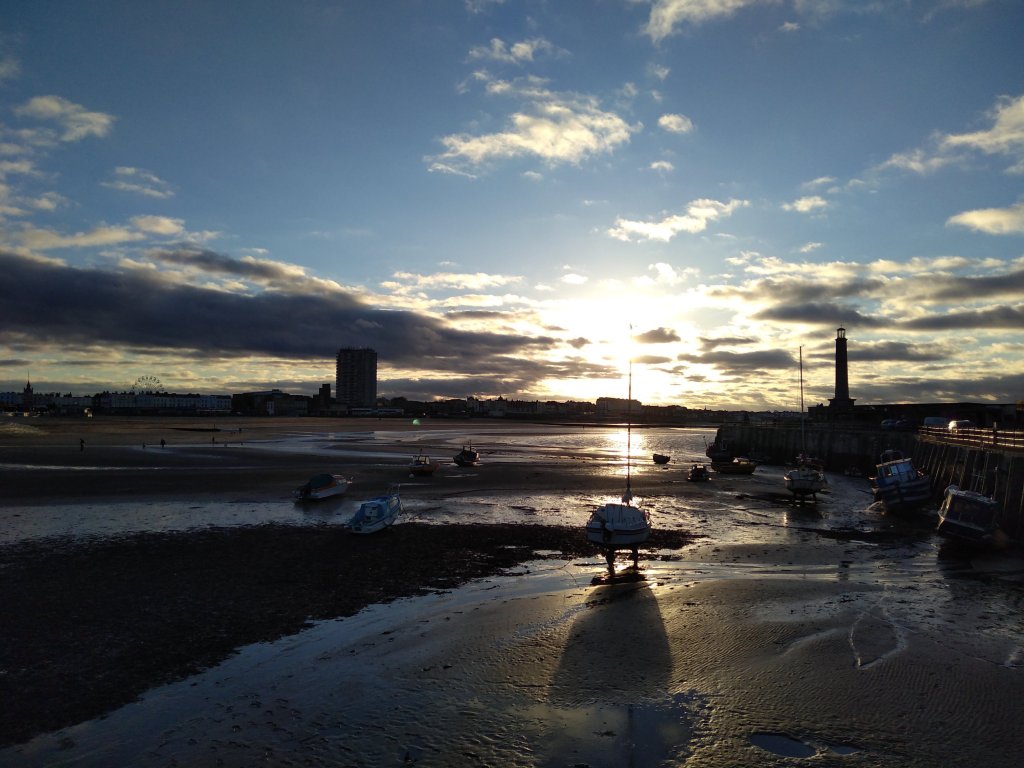
3 years ago: Margate harbour

How cool is that!!

Seems I walk this route quite frequently 😁😁 Lucky me, it is a gorgeous section of the English coast.

One of the most positive aspects for me, doing these challenges keeps me moving towards my goals…as soon as lockdown is lifted I’m finalising my plan to walk The Thames Path. They give me something to dream about, and think about when I’m working, and help to relieve the many boring hours where I’m just cooped up and not walking. Once again I thank my daughter for introducing me to the challenges….

Just over halfway and I made it to Lake Yamanaka, the largest and the last of the Five Lakes. The lake is the only one of the five with a natural outflow, draining into Sagami River. Yamanaka is a popular recreational site for all types of watersports, boating, fishing and around the lake there are restaurants, parks, a small teddy bear museum and even a waterpark.

Back in 1985 aquatic adventurer Lynne Cox, was the first woman to swim across all Five Lakes. A long-distance open water swimmer, as part of her Swim Around the World in 80 Days quest, Lynne undertook a series of swimming challenges of which the Five Lakes was one of them. She is most famous for achieving the first diplomatic swim across Bering Strait (1987) and being the catalyst at opening the US-Soviet Border for the first time in 48 years, accomplishing the swim in 2:06hrs in 38Β°F (3Β°C) water.

There are several parks around the lake but Hana no Miyako Park is a wonderful 74 acres floral park. Every season is a kaleidoscopic display. Imagine tulips in spring; cosmos, zinnia, blue salvias or a field of sunflowers in summer; orange-red-russet colours of autumn; and whilst the soil is resting in the winter preparations are made for spring in the greenhouse.

Grapes are also harvested here to create Koshu wine, a white wine variety. Koshu wine is described as soft, fruity and aromatic with citrus overtones and considered a good match for Japanese cuisine. Yamanashi the prefecture that this Park sits within had the first proper winery established in the late 19th century. Locally grown grapes grew dramatically by the mid-late 20th century, so much so that more than 80 wineries can now be found in Yamanashi, producing 40% of Japan’s domestic wine.

On a clear day Mount Fuji majestically reflects off Lake Yamanaka but right now I am more excited about finally starting the climb up the mountain.

However, before I go here’s a final story. It’s of Kakozaka Shrine that is on the way to the trail. The shrine is dedicated to Lord Fujiwara (Hamuro) Mitsuchika. In the early 13th century the retired Emperor Go-toba had his political manoeuvres blocked by the Kamakura shogunate. Wanting the power he believed was rightfully his, he conspired to overthrow the shogunate by gathering his allies. Lord Hamuro it seems, presented himself to the Emperor ahead of expected time, seeking an audience that was denied. He then decided to write a proposal on how to pursue the regent of the shogunate. The conspiracy was leaked to the shogunate who then launched an offensive and crushed the opposition with the force of his army. Unfortunately Lord Hamuro was captured and executed for his role in the conspiracy. His grave near the shrine has been protected by the people of Subashiri and a memorial service is held every May.

Seems like a good time to go then…in May. Could combine the cherry blossom time with the walk. Apparently the best time to visit is between March-May. I could go for my birthday in April, do the walk and attend the memorial service

Why not join me on one of the challenges https://www.theconqueror.events/r/CE1474 they are excellent motivation to get out and and walk, especially now that our wings are clipped by Covid-19 and lockdown.

Hot on the heels of Stage 1, I received the next postcard. Stage 2 completed and may I say wowww, the history is just amazing. I wish they’d taught us this in school. I would have gone walking rather than marrying….

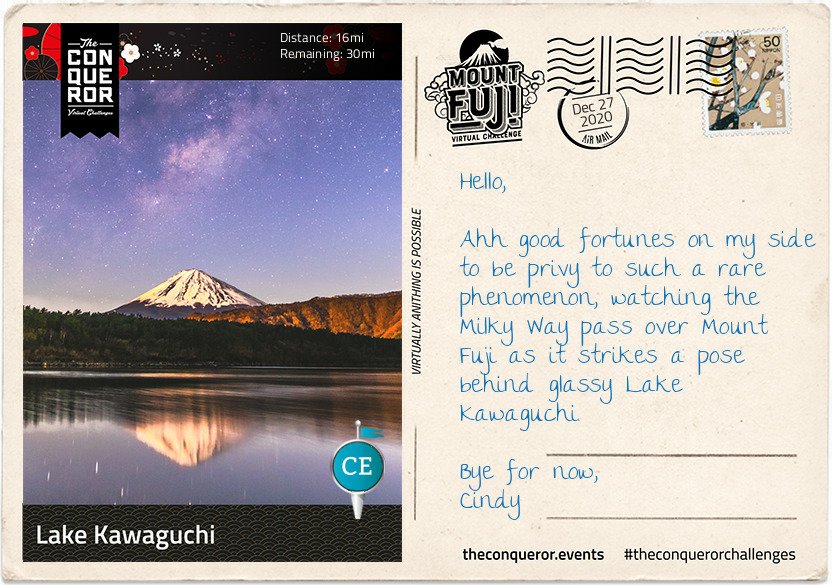
Lake Kawaguchi is the second largest of the Five Lakes and has the longest shoreline of 12mi (19km). It is a popular holiday destination with well-developed resort facilities.

My hike along the southside of the lake began at Koumi Park, a sprawling green space with a narrow promenade, not particularly obvious but nicely maintained, near the shore that led to Shikkogo Park a mile away. Along the way I came across the literary monument of Junichiro Tanizaki, a popular novelist of the mid-20th century. The monument is in the form of an open book with a passage from one of his works carved in his handwriting.

I reached a cape-like place called “Sakuya Aino Kane” which translates as Sakuya Bell of Love. Near the tip of the cape is an arched structure about 13ft (4m) high with a bell hanging in the centre of it. Installed by the city of Katsuya in 2002, the arch was named after “Konohana Sakuyahime” the Shinto goddess of Mount Fuji. In Japanese mythology Sakuyahime is depicted as a blossom-princess in the image of the sakura (cherry blossom) and a symbol of delicate earthly life. It is said that if you ring the bell once love will come true and if you ring it twice your wish will come true. Of course I couldn’t pass it by without ringing it at least once or maybe twice.

Veering off the promenade, I visited Fuji Omuro Sengen Shrine. The original shrine was built around the 9th century on Mount Fuji. Due to the mountain’s frequent eruptions, it burnt down and was rebuilt many times. The current shrine was built on Mount Fuji in 1612 by Torri Naritsugu but in 1974 was moved to its current location for future preservation.

Naritsugu was a member of the Torri Clan, a samurai family and loyal retainers of the Tokugawa Shogunate (dynasty) from the 15th – 19th century. In 1600AD, his father Mototada changed the course of Japanese history when he refused to surrender Fushimi Castle to an oncoming enemy. With a garrison of 2,000 men, he fought valiantly against an army of 40,000, until he was the last man standing. As was custom rather than being taken alive, Mototada performed seppuku (suicide). This final stand gave his Shogun Tokugawa Ieyasu (commander-in-chief) sufficient time to escape. Ieyasu went on to raise an army of 90,000 and successfully won the Battle of Sekigahara, resulting in the unification of Japan and a ruling dynasty for the next 268 years.

Set within a dense old forest at the base of Fuji is “Kitaguchi Hongu Fuji Sengen” shrine complex. Covering 24 acres, the complex is one the largest forest shrines in Japan. The first shrine was built more than 1900 years ago when Yamato Takeru on an expedition to the east came across Mount Fuji and began worshipping Konohanasakuya-hime, Goddess of Mount Fuji. When the Edo Period (17thC) began Fuji-ko (Mount Fuji religion) spread and worshippers would begin their pilgrimage up the mountain from here using the Yoshida Route, one of four trails to the summit. Around the main shrine, trees were selected in each corner to designate the border of the area. About 1000 years old, only three trees remain today. With girths measuring 75ft (23m) the trees are believed to protect the shrine and are classified natural monuments.

Yamato has an interesting story or perhaps more like a legend himself. Born around 72AD he was the second son of Emperor Keiko, the first being his twin brother. He began his military career by first murdering his brother, simply because the Emperor was dissatisfied with his brother for failing to have his meals with the imperial household. At 16 Yamato was sent to quell a rebellious tribe. He succeeded by infiltrating the tribe dressed as a housemaid with a hidden holy sword, one of three Imperial Regalia. Upon his return home, the Emperor sent him on another mission. With his wife in tow, Yamato needed to cross the sea but a storm was hindering the voyage. His wife sacrificed herself to the sea in the hope the storm would die down and according to legend it did. Seven days later her comb washed ashore and a tomb was built around it. Yamato proceeded with his campaign and when the rivals saw his approach they surrendered immediately. Yamato never arrived home. He died of exposure at the age of 30. His aggrieved father built a mausoleum where his son died and it is believed that his soul transformed into a white bird and soared to Heaven.

Truly, reading this makes me want to just go….to Japan and walk the route. And talking of cherry blossoms, that’s something I’ve so wanted to see….so, maybe!! β˜Ίβ˜ΊπŸŒΈπŸŒΈπŸ‡―πŸ‡΅

Why not join me on one of the challenges https://www.theconqueror.events/r/CE1474 they are excellent motivation to get out and and walk, especially now that our wings are clipped by Covid-19 and lockdown.

The problem I have with the Conqueror Challenges is that the routes are so amazing, it makes me want to do the walks in real time, and not just virtually. So to that end, I’ve added them to my list of ‘walks I want to do before I die’ and πŸ™πŸ™πŸ™ the Universe is listening and provides a sponsor so I can go walking instead of working 🀣🀣🀣

I actually completed the Mt. Fuji virtual challenge in 2020, but as usual I got distracted by other walks and places and forgot to share them….so here’s the 1st stage. I’ll post the next few stages over the coming days. I love the information that comes with the postcards and find them absolutely fascinating.

I started the Mt. Fuji challenge on 26 December, immediately after finishing the Great Ocean Road Australia challenge, and because I was not working, managed to complete the challenge in a few days…chop chop as they say.

When I decided to hike Japan’s tallest mountain, Mount Fuji, I pondered the best route that would capture its culture and spirit whilst travelling through its lush green landscape. The result was a 46mi (74km) journey starting at the base of the mountain, leading past lakes, caves, temples, shrines, dense forestry and ending with the final climb to the summit.

Mt. Fuji virtual challenge

Mount Fuji is one of three holy mountains in Japan. At 12,388ft (3,776m) tall, Fuji sits atop a triple junction trench where three tectonic plates meet. Although geologists classify it as active, Fuji is a dormant volcano that last erupted in 1707. At the base it is surrounded by the Fuji Five Lakes which were formed by previous eruptions damming up the rivers with the lava flows.

Mount Fuji is a composite of four successive volcanoes meaning it’s made up of layers. The first two layers were the result of an eruption more than 700,000 years ago known as Sen-Komitake and Komitake Fuji. The next eruption, about 100,000 years ago, engulfed Komitake Fuji and added the second layer creating Old Fuji. The third eruption about 10,000 years ago formed New Fuji and the summit zone producing the near perfect conical shape we know today.

Recognised as a sacred place and considered a symbol of Japan, Mount Fuji is a pilgrimage destination for practisers of Shinto. Each year between July and August, up to 400,000 tourists and pilgrims make the long trek to the summit. In 2013, Mount Fuji was added to UNESCO’s World Heritage List.

Dotted throughout Japan are Shinto shrines and Torii gates. Shinto is the indigenous faith of the Japanese people and the shrines are places of worship and homes of the Kami (Gods). Practitioners come to pay their respects to the Kami or pray for good fortune. The entrance to a shrine is marked by a gate known as Torii and they symbolise the “transition from mundane to sacred”. To enter through a Torii, one enters the world of the Kami (Shinto Gods).

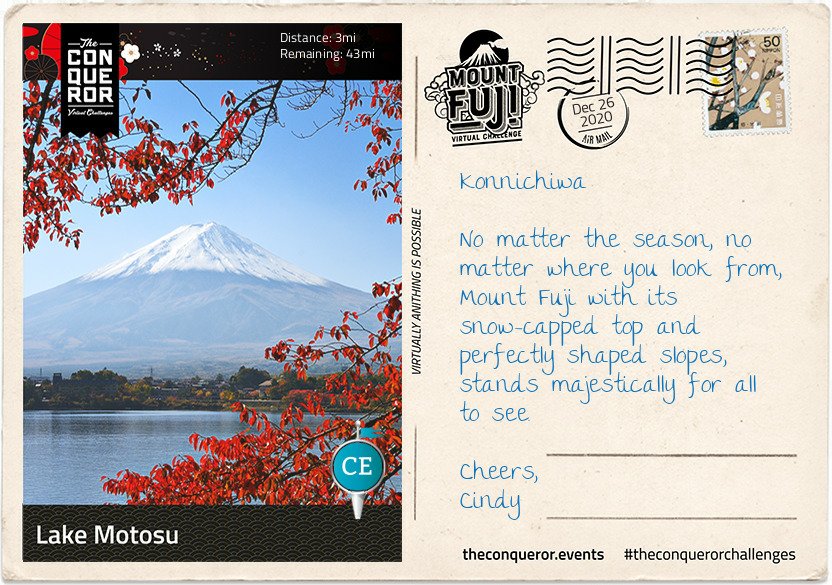
I began my hike at the Yama Shrine near Lake Motosu, one of the Five Lakes. The third largest and deepest of the five lakes, it is subteranneously connected to Lake Shoji and Lake Saiko. Originally one lake, these three lakes were divided by one of Mount Fuji’s enormous lava flows. The water temperature on Lake Motosu never drops below 39 Β°F (4Β°C) and as such it is the only lake of the five that never freezes over winter.

Northward bound, I passed by Lake Shoji, the second and smallest of the Five Lakes. On the left side of the lake you can still see large remnants of the lava flow jutting out of the water. With a greenish hue due to algae and rich in nutrients including plankton, locals can be seen standing on the lava rocks fishing.

My final stop for today was Lake Saiko, the third of the Five Lakes. With no natural outflow an artificial channel was made to connect it to Lake Kawaguchi. Lake Saiko’s banks borders the Aokigahara Forest which I will write about in my next letter.

Don’t you think that’s fascinating? There’s so much to learn about this fabulous world of ours.

Why not join me on one of the challenges https://www.theconqueror.events/r/CE1474 they are excellent motivation to get out and and walk, especially now that our wings are clipped by Covid-19 and lockdown.

Stage 2…to follow shortly.

More than one cap

My client and I were chatting a couple of nights ago about various issues in his life, and at the end he said “I guess that as a Carer you need to wear more than one cap”.

And that got me thinking. I’ve often mused about this at various stages of my career (if you will) as a Carer, considering just how many aspects of life and experiences we’re expected to manage – with aplomb, and make it sound like we know what we’re doing.

Which most times we do, but only with experience gained over time, unless of course the Carer comes from a medical background.

After he made that comment I started thinking, and here are the hats I wear…some more often than others and some every day. I’ll start with saint’hood’ since that is the one cap we need to wear at just about every booking.

Saint’hood’: this is the most vital of all the caps carers wear. Have you ever heard the expression ‘the patience of a saint’? Well, this is one quality every carer needs in buckets full. I’ve been known to go to my room (in whichever house I’m working in) and shove my head into the pillow and scream!! Just to relieve the tension of dealing with an obstreperous and cuttingly rude client. Mostly the women, and invariably someone with mental health issues like alzheimer’s which is a bastard of a disease, and can be terribly hard to manage and cope with. Of course not everyone is affected negatively, and I’ve cared for people with alzheimer’s who are an absolute charm.

Dresser: this is something we do most days. Help to choose clothes, and sometimes accessories like a special brooch or scarf, to ensure that the client looks nice, well turned out and presentable. However, this is no easy task. Again, a client with alzheimer’s will insist that slippers and an evening dress worn with a tatty old gown and a nightie over the top is perfectly acceptable. There’s no point applying reason here, its not going to work. But it sure gets interesting. πŸ€·β€β™€οΈπŸ’ƒπŸ’ƒ

Make-up artist and hairdresser: one of my pet hates to be honest is having to wash and curl someone’s hair. Thankfully!!! I’ve not had to do it too often coz the lady clients mostly have a mobile hairdresser who visits the house. Of course during times of covid, that’s come to an end. Imagine if you will washing the hair of someone who has dandruff. I have become quite adept at finding reasons to avoid having to do that. ‘Ve haf vays and means!! ha ha ha ‘said with an evil grin’. 😁😝😝

Chiropodist and Nail Technician: seriously!! I have been asked to cut toe nails so often I’ve lost count. No! It’s not going to happen. Call the GP Surgery and request an NHS chiropodist or ask your family. The last time I was forced to cut an old person’s toe-nails was when my Mother made me cut my paternal Grandfather’s toe nails when I was a teenager. Thankfully we are not allowed to cut a client’s toe-nails for health reasons. Like an optometrist, a chiropodist is often able to detect underlying health issues by the state of the nails. Thank you Lord. I hated doing it for my grandfather and he was family. Ugh. I have however often been asked to wash, trim, and paint a lady’s nails. Not my favourite thing to do, but I try to make it a ceremony so they can enjoy it. πŸ’…πŸ’…

Launderer: the washing of clothes and subsequent ironing of said clothes. Let be me right up front about this….I LOATHE IRONING!!! LOL I buy clothes that do not need to be ironed and even if occasionally I slip up and buy something that gives directions for ironing….I ignore it, hang the garment so it dries with minimal creases and on it goes. Thankfully my walking pants and tops need no ironing and so I tend to live in them…even at work. I had one lady tell me she didn’t like my clothes. I suggested that I’d love it if she took me shopping at M&S to buy me some clothes she liked. I never heard another word about my clothes again! And I.Do.Not.Iron.Bedding. Except if I am unfortunate enough to land a booking where the lady of the house ‘insists’ the bloody sheets and duvets be ironed. Is there anything that is more a waste of time and the planet’s resources than ironing? One lady I worked for many years ago had satin sheets, and a king-sized bed!! And we HAD to iron the sheets so that there were no creases. Impossible. That’s why we have laundromats. πŸ€”πŸ€”

Seamstress: So often, I have lost count, I’ve been asked to please sew up a dress hem or sleeve, or seam on a jersey, or hole in a sock. I used to say “yes, I can do it”, but I learned real quick that if you give an inch they ask for a yard, and suddenly you’re repairing the last 10 years worth of garments. Now I prevaricate and say I can’t sew to save my life. I suspect the previous 10 Carers have done the same!! Unless I really like the client, and they are respectful of me as a person, then I’ll make a concession. Of course that doesn’t always have a happy ending and the said repair is inspected with a magnifying glass and the result is “that’s not very good you know!”. Whattt?? Fine send it to the drycleaners. Jeez. πŸ™„πŸ™„πŸ™„

Secret shopper: okay not really secret, but shopper yes. One of our duties is shopping, and this is either a pleasure or a pain depending on the financial situation of the client. If the client is well off and has money to spend and likes the finer things in life, then shopping is a pleasure. If not, then you have to turn a sows ear into a silk purse, and try to manage the household on fresh air and pennies. And still produce fine meals. The worst is that your plate gets inspected at meal times and you’re asked “isn’t that rather a lot of food on your plate?” – hmmm. No, not really, because there isn’t a lot of food to put on the plate….again, thankfully, this doesn’t happen too often, and at most positions you are able to buy the food you like. However, mention vegetarian and people spin off into a frenzy of ‘OMG’ your food is so expensive!!! Actually, vegetarian food is wayyyy cheaper than regular food. I only have to do a ‘go.compare’ once and it settles the argument.

Chef & Nutritionist: again let me be very honest here….I loathe and detest cooking hahaha. It’s a complete waste of time imho. You spend an hour putting a meal together and it takes 10 minutes to eat it and then you have to do the dishes and clean up afterwards. urgh. Give me a packet of crisps and I’m happy. 😁😁 Of course I love other people’s cooking (mostly), and I live on take-away fish and chips, or packet noodles (or hot-cross buns 🀫🀫) between bookings. But in my job as a carer I have to provide healthy, well-balanced, nicely cooked meals. That’s the theory. The reality is that most people I’ve encountered have very different ideas about what comprises a nice meal. One lady I looked after many years ago had a slice of white bread, covered with clotted cream (it had to be Rodda’s) and swirled with syrup – for supper, EVERY night! Mind you I tried it out one time, and I concurred…..it was delicious, but not to be eaten every night if you have weight issues. She didn’t. I do. And of course you will encounter clients who, no matter what you make for them, will turn their noses up, or don’t have an appetite and don’t like this or don’t like that. So either your range is very limited or you end up preparing the same thing every night, or my pet horror, it goes into the bin. But if there’s a fox to be fed, I can live with that. No waste. Very occasionally I’ve been to clients who refuse to eat anything else except microwave meals, and boy, does that make me happy!! No cooking = minimal dishes. But give me a client who enjoys their food, and I go out of my way to make it attractive and tasty πŸ‘πŸ‘πŸ‘

Nurse: yes, unbelievably I have had to fulfil the role of nurse, district nurse to be precise. Although thankfully we are not allowed to administer injections. Think diabetes. That’s usually controlled with meds or a nurse will visit. But, anything in-between….and I’m your woman. Of course the expectation is higher than the allowance, because yes, I can fall back on the old ‘we are not allowed to do that’. But last year and previously, I’ve been called upon to wash and dress pressure sores, and ulcerated legs. During the initial covid lockdown in 2020, a client I was looking after had the DN visit every day to wash, cream and bandage her legs. But during the lockdown the nurses were so stretched that I was called upon to attend to that need for 6 weeks. It wasn’t fun, but I took great care and when the DN visited once a week they always commented on how well her legs looked. πŸ‘©β€βš•οΈπŸ‘©β€βš•οΈπŸ‘©β€βš•οΈ

Pharmacist: leading on from the above….I’ve had to offer ‘advice’ on sticking plasters, bandages, dressings and administering medications, paracetamol, laxido (the latter is usually prescribed, but oh my word…are people resistant to taking the stuff). And very often we’re expected to fill dossett boxes. Thankfully that is becoming less and less of a requirement as more pharmacies are required to now produce the dossett box fully prepared. And quite rightly too. Most of the medications we deal with are powerful drugs. One little slip of attention and you could make a bad mistake. In the past I’ve had to administer Oramorph, which is a powerful drug and pain-killer. But now the agency provides us with an indemnity and we carry insurance. Fingers crossed, so far I’ve been fine.

Cleaner: did I ever tell you how much I hate cleaning??? LOL Okay, okay, I know it has to be done. But it’s boring and tedious. I’d rather be out walking. However, it’s listed as part of the job and you have to clean the house. BUT! I don’t dust ornaments. I don’t polish furniture or silver. I don’t wash crystal. I don’t clean chandeliers. I don’t move furniture. I don’t wash carpets or curtains. And I’ve been ‘told’ to do all of those. Sorry, it’s not part of the job. The description says ‘light housework’ and I make sure it’s as ‘light’ as possible. But there’s no getting away from sweeping and mopping floors, hoovering, washing the bath, basins and toilet, making beds, doing laundry, ironing 😝😝😝cleaning kitchen counters et al. I do however LOVE it when the job description says there’s a cleaner who visits once a week. Hallelujah. And if there’s a dishwasher (of the mechanical kind) I get quite ecstatic. And I DON’T wash panties by hand because “they’re expensive”. That’s why God made washing-machines. And yes, I’ve been instructed to do just that; wash her underwear by hand. I didn’t. I used to wait till she was in bed, then toss them into the machine on ‘silk’ and voila…washed and dried by morning. Of course it absolutely killed me to waste so much water using the washing machine, but the alternative…no!!

Mechanic: I’ve been asked to fix TV’s, radios, overhead lights and lamps, heating/radiators, cars, washing machines, you name the household item and the ‘Carer’ is expected to ‘know’ how to fix it LOL And when asked to fix said item, if you say you don’t know how….”what do you mean you don’t know how? You’re a Carer, you’re supposed to know” LOL yeah, that’s me ‘jack of all trades’ and seriously, I’m a Carer not an engineer. But I can change a lightbulb or affix a plug, and clean a drain. Oh and kettles…I cannot tell you how many kettles I have descaled around Britain since I started working as a carer 18 years ago. I loathe chemicals, so good old malt vinegar does the trick (something I learned from my Mother), and it can be reused, doesn’t damage the environment and it works quickly.

Scribe: Besides the daily keeping of notes for each client (required by legislation), we are often required to write letters, or cards for birthdays or special occasions – the client will dictate because their eyesight or handwriting has deteriorated. Fortunately they have no idea how bad my handwriting is. I feel for the person on the receiving end, good luck deciphering that!!! Besides that, we have to write out cheques for the client to sign. And we have to keep a record of petty cash spending.

Accountant: which brings us to the role of accountant. Balancing the petty cash. To the penny! To go to the atm and withdraw cash. Sometimes I’ve been asked to reconcile bank statements if there is no-one else to do it. This is an area that can so easily be abused and of course it has been….by unscrupulous people. And linked to that is filing. It makes my hair stand on end sometimes when I visit a client who has no filing system and papers are piled up willy nilly anywhere there’s a surface or drawer. May the Universe be kind to the person who is left behind to sort that out!!!

Secretary: making appointments, cancelling appointments, diarising outings, medical visits, events in the clients life, noting when the bins go out, when prescriptions need to be collected, OT and physio appointments, whether inhouse or out. Finding cheque books or bank cards, locating handbags etc etc you get the picture.

Gardener: fortunately this only occurs occasionally and only requires plant watering. I refrain from agreeing to do anything else. Mind you I do enjoy ‘dead-heading’ roses LOL. If however, I arrive to find that the house is like a bloody jungle with houseplants, I want to leave by the back door. Gahhhh. I remember the days back in South Africa when I had a house full of bloody plants. What a pain in the ass. But with my job, I have a ‘get out of jail free’ card (excuse/reason) – my responsibility is ONLY to look after the interior of the house and not the exterior. Get a gardener or get over it, I say!! But, once again, every so now and then, you get a job where the description says ‘water the outdoor plants’. There is an advantage to this….although it took me a while to figure that out; it gives you time out the house and in summer a chance to get some sunshine. 🌞🌞 It took a while for the penny to drop, but now I look forward to that…and make the most of being outdoors. “Gosh those plants took an age to drink their fill!!” Meanwhile there’s a flood out the back LOL πŸ’§πŸ’§πŸ’§βš˜πŸŒ·πŸŒ»πŸŒΉ oh and removing spiders πŸ•·πŸ•ΈπŸ˜±πŸ˜±

Dog Walker: apologies to everyone who loves dogs. I hate taking the dog for a walk. Mostly because I hate having to clean up their shit. But, to be fair, the walks are usually nice, invariably in the countryside and gets me out the house. As Dr Demartini always says: it’s about balance. Dog shit vs a walk in the country. Bad and Good. LOL But please Lord do not give me a small yappy dog that pees in the house, chews everything, licks the owners legs incessantly, and barks at every bloody thing because it can’t see. It’s happened, I didn’t go back. That’s not to say I don’t like dogs per se, I love the larger breeds like alsatians, or labradors, or greyhounds…..although of course that doesn’t mean I like cleaning up after them. I usually turn down bookings with dogs. Give me a cat any day.

Driver: yup. My favourite. I love driving and enjoy it when a client has a car and we have to go out. EXCEPT!! Yes, there’s always an ‘except’ – when the client is 91, has cataracts and insists on doing the driving because they’re right precious about their car and the psychiatrist has said to ‘keep driving’. Did said professional think to ask if you have cataracts? What??? Don’t be silly!! And so it comes to pass that you have to concede defeat and pray every time you go out. Thankfully, I’ve only had this situation twice in my career. Mostly I do the driving. I like it even better when we have to use taxis to go places. πŸš–πŸš–πŸš–

Psychiatrist: yes! Talking of said individual, being a pseudo psychiatrist (as in not a genuine professional psycho πŸ˜‰ ), is a key requirement of our position of Carer for the elderly. There are so many aspects to this that I could write a few articles. But suffice to say, we are expected to be able to soothe strained nerves, encourage (whatever you can think of – like getting dressed instead of staying in pyjamas the whole day or drinking sufficient water). You have to try to understand why the person is suddenly fearful of taking their medication, or having a bath, or standing up, or putting on shoes they’ve been wearing for months, or the dark, or being left on their own, and anything else you can possibly think of. The most important key is listening and not judging. It’s about realising that their worlds have suddenly gotten a lot smaller, they no longer have control over anything much (especially if they have a pushy family or children who bully instead of cherish). I have heard stories that make my toes curl, and with dementia especially, their guards are down and they tell you stuff you really don’t want to know, and you have to find a way to distract (which isn’t difficult). Fortunately I have a very bad memory LOL 🀐🀫🀫

Repository of memory: (is there such a thing?) I know that sounds strange, but following on from memory, we as Carers are expected to remember every little conversation that transpires…in case the subject comes up again. Especially when the client has dementia…conversations or events and occasions disappear into the mist, and we need to try and remember as much as possible. Also, and especially with dementia, people live in a world of their own and they imagine things have been said or done that actually haven’t. You sometimes have to be on your toes with that because of the tall tales sometimes told…I have learned to write those episodes down while they are fresh in my memory, so that I can fall back on it when I get a concerned call from a family member.

And last, but not least…..

Priest’hood‘ : I’ve left this to last, because it really is the ‘last’ as far as our clients are concerned. They are on the last stretch. Their days are not going to last much longer. And they are fearful. I get embroiled in a whole heck of a lot of religious discussions…mostly with clients who are still cognisant and can hold a conversation. But on the whole, it’s mostly about holding the hand of a little old lady who is terrified of dying, has dementia, doesn’t understand what is happening, why no-one comes to visit (the son or daughter left 30 minutes, or even 5 minutes ago), and their worlds have shrunk to 4 walls. And everything ‘out there’ is frightening. I’m not in any way religious. I lean more towards the spiritual. So it’s not always easy to be ‘the last priest’ and I’m always grateful when there is a Priest involved. Usually Catholic, and they visit once a week for confession. But it’s the inbetweeners that are the most tricky to deal with. I have had to shut down so many conversations because of the things that get said. But so long as it doesn’t stray into ‘gossip’ or reveal family secrets, then I’m prepared to listen.

Finally, and this has only happened once in my time as a Carer, and to be honest it was a genuine privilege – to ‘lay’ a person out. I was working for a wonderful family, had only been there a week when the gentleman died in his bed; a beloved husband and father. His wife and son were at his bedside. His daughter was out getting medication that arrived too late. She was desperately sad she hadn’t been there at his passing. After discussion the family decided they wanted him to stay in the house till the next day….but they wanted him to look presentable. So his daughter and I did the ritual of ‘laying the body out’. We undressed him, washed his whole body down, dressed him in his finest pyjamas and gown and even socks….and laid him out in the bed, slightly propped up by pillows and covered him with clean sheets and cover. That I think has been one of the most profound of all the many things I’ve been asked to do. And the family were truly grateful, and able to spend just a few more hours with him and finding solace in not having him rushed off. Makes sense to me.

And there you have it. If I gave this any more thought, I’m sure I could think of a few more ‘caps’ we Carers have to wear. We really are expected to fulfil so many roles and to do them well. And yet, when it comes to taking our minimal 2 hour break in the afternoon…I’ve been asked “why do you need a break, you haven’t done much all day”. Hah!!! I’ve learned over the years to be militant about taking my breaks. It’s my time. Do not bother me. Fortunately now with my walking I have the perfect excuse to get out the house for the 2 hours. And to be fair, it’s not everyone who resents you taking time off.

So, that’s me…wearer of many caps; IT expert, clock changer, chief cook and bottle wash!! 🀣🀣🀣 I have to be honest and say that occasionally I get a booking where there’s a cook and housekeeper, and boy do I relish that. πŸ˜ƒπŸ˜ƒπŸ˜ƒ Oh and when there’s a TV in the Carer’s room…my delight knows no bounds. Otherwise we seldom get to watch anything we’d like to see. Mind you, having said that…I was introduced to Countryfile and Spring Watch in about 2008 thanks to a client, and yes….my favourite of all ‘Strictly Come Dancing’ – there are benefits πŸ™‚

However, you know that lovely sunny image that’s used on the front of brochures; you know the one…where you have a Carer kneeling next to a little old lady sitting gracefully in a chair, and they’re both smiling sweetly and drinking tea…don’t believe it. It is an illusion. The reality is way way different and whilst there are occasions where you do have a similar situation, they are fleeting and hard to come by.

In closing, I love my job. I get enormous satisfaction out of caring for people, even the difficult ones, but there are days when I question my own sanity, and I sometimes tease my clients and say ‘it’s your turn tomorrow’…

I was watching a programme on Blaze this morning; Ancient Aliens, and they were talking about the discovery of a place called Gobekli Tepe. It was fascinating, so I decided to do a bit of research, and found this article.

https://www.smithsonianmag.com/history/gobekli-tepe-the-worlds-first-temple-83613665/

I find I simply have to share it, its so amazing. Archaeology is such a fascinating career and I often wish I could be reborn as an archaeologist πŸ˜„πŸ˜„

Maybe my next life eh!!

Meanwhile, I often wonder what we would find if we just dig up everything. If you take London for instance, its an ongoing treasure trove.

Self Propelled

Self propelled adventures through life; blogging on cycling, touring, micro-adventures, general shenanigans, and environmental news

johnelsewhere

Thoughtful wanderer in search of virtual meaning

Things Helen Loves

TRAVEL, WALKS & EVERYDAY ADVENTURES

Short Walks Long Paths

Wandering trails around the coast of Wales

Port Side Travel By Jill

My travels, photos, tips/tricks and anything else I think of!

Wonderwall

My 360: wonderwalls,theatre, travel, Sheffield, books...

Robyn's Ramblings

My Thoughts. Expressed.

Graham's Long Walk

Graham King's long walks around Britain

The Lawsons on the Loose

Philip & Heather are making memories through their travels.