Feeds:
Posts
Comments

Archive for the ‘cities and towns of the UK’ Category

The weather in north east Wales has been pretty grim recently; much of what you’d expect mid-winter really…..but still hard to deal with LOL We’ve been pelted with rain, sleet, hail and even snow on the crest of the Berwyn’s. The problem with the rain is that it’s a bit like the April showers you get in Ireland…it showers down, clears, you get excited and think okay I can get out now, and by the time you put your shoes on, it starts raining again. I’ve given up and decided just to get on with planning my September pilgrimages. and writing this blog.

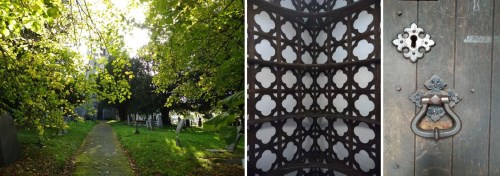
Even though I haven’t been out much, I have managed to slip in a couple of walks, one of which caught me out; the skies had cleared, bright blue so I quickly put my shoes on, grabbed my poles and set off. Whilst stopped at the post office for envelopes it started to rain again URGH!! So cutting the walk short, instead I popped into St Nicholas Church; always worth a visit.

st nicholas church montgomery, welsh countryside, war memorial montgomery, places to see in wales,

St Nicholas Church, Montgomery, Powys, Wales from October 2017

A Grade 1 listed 13th century (circa 1227) Norman Church with additions from the 15th and 19th centuries, the church contains an example of a pre-reformation rood screen brought from Chirbury Priory together with the rood-loft and the stalls with their misericords after the Dissolution of the Monasteries.

st nicholas church montgomery, welsh countryside, war memorial montgomery, places to see in wales,

Pre-reformation Rood screen St Nicholas Church, Montgomery, Powys, Wales

Within the church is the ornate tomb of Richard Herbert (d. 1593). Herbert was the lord of Montgomery Castle, and father of the poet and cleric George Herbert. Also buried here is Richard, 2nd Baron of Chirbury, who died in 1655, the last of the Herbert family to live at the castle. The tomb is rather extravagant as they mostly were and the effigies are ornate and quite lifelike, the features of the encumbents clearly detailed.

st nicholas church montgomery, welsh countryside, war memorial montgomery, places to see in wales,

Memorial tomb of Richard Herbert and wife at St Nicholas Church, Montgomery, Powys, Wales

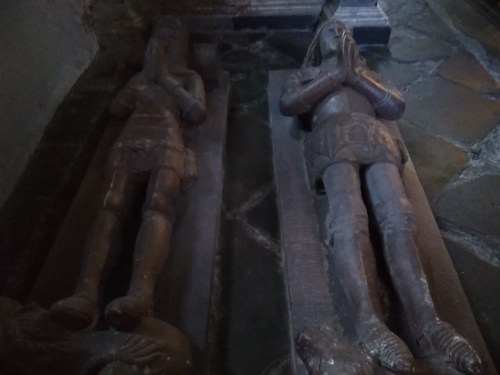
At the foot of the tomb are the effigies of 2 knights. Quite marvellous. I haven’t been able to find much information about these effigies.

st nicholas church montgomery, welsh countryside, war memorial montgomery, places to see in wales,

Knight effigies in St Nicholas Church, Montgomery, Powys, Wales

The stained glass windows are absolutely beautiful. I love visiting old churches, they contain ever so much history.

The 2nd walk I manage to get in without getting too wet was just before the new band of weather hit us. I was intent on reaching the castle but on impulse I decided to walk up to the War Memorial on Town Hill that I had been urged to go and see…apparently the views from there are stupendous.

welsh countryside, war memorial montgomery, places to see in wales,

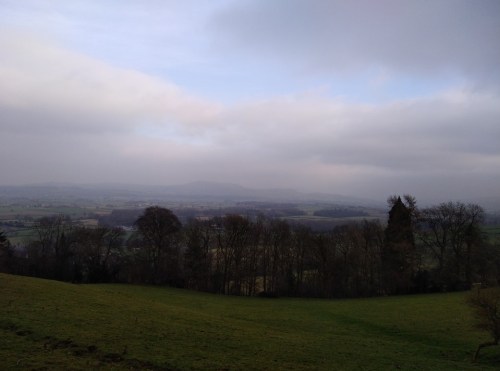
half way up; fabulous views across the Welsh countryside looking east towards Shropshire

So turning off the road I slipped through the kissing gate just before the castle entrance and headed up the steep incline , steps provided by knotted tree roots and stones. Thankfully this was before the rain, but even so the ground was muddy and mucky and my shoes squelched noisily as I plodded uphill. I finally reached the road (muddy track) that takes you right to the top of the hill…elevation 1050 feet above sea-level, as I discovered when I got there. I walked and walked for ages, not having realised just how far it was from the road….funny how folks don’t tend to tell you those kind of details….”Oh, it’s just up the hill from the castle”. Hmmm. As I climbed and climbed two ladies jogged past…I was astounded…the slope was very steep and the ground totally squelchy. How do they not slip and fall. I just take my eye off the ground for a second and I’m over. As always I was ever so grateful for my walking poles. The description on the website I located says:

  • Going: Medium difficulty. Climbs steeply to a high local hilltop. Slippy in damp conditions.

Noooo kidding!!!! After 15 minutes of climbing, by which stage I was beginning to get out of breath, I finally saw the monument.

welsh countryside, war memorial montgomery, places to see in wales,

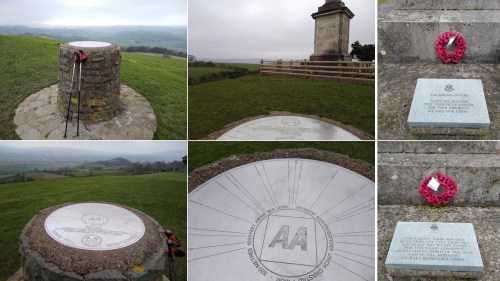
War Memorial Montgomery, Powys, Wales and an ordnance survey triangulation station

It’s enormous and wayyyyy bigger than I anticipated. But finally I was there, and the views were as spectacular as I had been told. There’s a viewpoint stone with a disc on the top and directional markings showing where and how far places are from that point. It reminded me of the marker I saw on the Malverns I climbed …oh gosh…..ages ago.

welsh countryside, war memorial montgomery, places to see in wales,

War Memorial Montgomery, Powys, Wales and distance marker – 1050 feet above sea-level

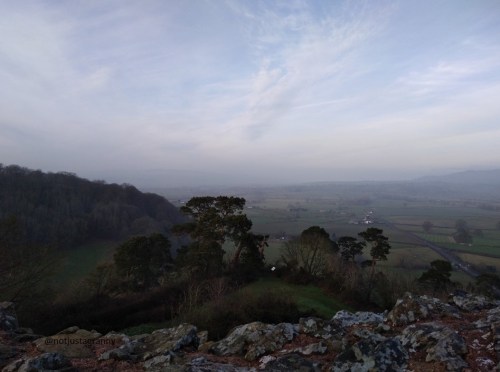
Although the weather was overcast and cloudy I could still see for miles and miles. The distant mountain peaks various shades of blue and grey, as they disappeared into the distance, the hovering clouds tinged pink by the setting sun.

welsh countryside, war memorial montgomery, places to see in wales,

fabulous views across the Welsh countryside looking west

From down the valley I could hear sheep bleating and the occasional roar of a car rushing by on the Kerry Road. Thankfully I didn’t meet any cows. It was fairly breezy and with scant vegetation or trees to break the flow of wind it got quite blustery, but not so much that it spoilt my visit. The crest of the hill is bereft of much else besides a massive expanse of grass and a couple of small stands of wind-blown trees.

The memorial is quite enormous and I wonder why they felt the need to plant it so high up. I’m sure it must be visible from miles away. The neighbour across the road very kindly showed me a newspaper cutting of the unveiling on 23.04.23….it’s been up there for 95 years,can you imagine that!!! Weirdly my birth day and month (but not year…. DUH!!)

War Memorial Montgomery, Powys, Wales, welsh countryside, war memorial montgomery, places to see in wales,

War Memorial Montgomery, Powys, Wales,

Apparently it’s made of Portland stone and was transported to Montgomery by train and then taken up to the crest by horse cart. My heart aches for the poor horses…that stone is big and heavy. It’s also quite weird to look at the photo and realise that all the people in the image are dead by now. We are all so transient and yet these memorials we raise are still there and last way longer than we do. You have to be dead to be remembered.

There are not many more trees now than then. In all I walked 4.09 kms/2.56  miles with an elevation gain of 139 meters…

I look forward to the weather clearing a bit before I leave next week…I’d like to walk another section of Offa’s Dyke and possibly walk as far as the river – which I still haven’t seen.

For more about Montgomery’s War Memorial, I located this website which offers further information on how to get there and what you can see.


Read Full Post »

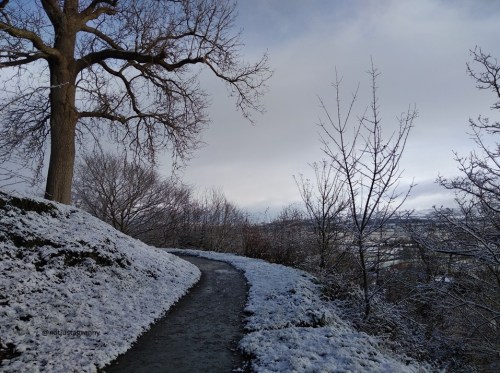
Yesterday’s Camino 2018 practice walk took me up to Montgomery Castle. I hadn’t been up for a fair while; snow and frost. Well mostly frost, since the snow was so last year 😉 and I have actually been up once since I arrived here on the 3rd…

I’m trying to get in at least an hour of walking every day now. I remember training most days for at least 2 hours over 18 month for my previous Camino, but I’m hoping some of that fitness still lingers and that 9 months of training will be sufficient this year. It’s not a far distance, but it is all uphill and that final stretch sure stretches my lungs LOL My legs too complain loudly by the time I reach the ridge.

Although not as substantial as some of the castles we get in Wales and the rest of the UK, Montgomery Castle is stupendous, albeit just ruins and a fraction of what it used to be. I love the history attached and wish the walls could talk. The English considered it to be the Key to the Kingdom; the kingdom being Wales, since the border with England (Shropshire) is just a stones throw away and easily accessible with a fair walk.

montgomery castle, montogomery, key to the kingdom, castle of the uk, welsh castles, travel diaries, walk 1000 miles, castles in wales,

Key to the Kingdom; Montgomery, Wales

Built more as a defensive position than a luxurious palace, it played a key role in many turning point dates in the history of the UK…from Offa’s day till the 17th century, when in 1643 the castle was surrendered to Parliamentary troops in the Civil war by Edward Herbert, 1st Baron Herbert of Chirchury.

map my walk, montgomery castle powys wales, castles of the uk, castle ruins, welsh castles, walk 1000 miles, travel diaries, walks in the uk, country walking,

The Battle of Montgomery 1644 – map my walk

Originally a motte and bailey (a fortification with a wooden or stone keep situated on a raised earthwork called a motte and accompanied by an enclosed courtyard or bailey), it was eventually rebuilt in stone. Rebuilding commenced in the late summer of 1223; the 16th birthday of Henry III of England. The castle was eventually reduced to a backwater prison and later demolished by order of Parliament.

montgomery castle powys wales, castles of the uk, castle ruins, welsh castles, walk 1000 miles, travel diaries, walks in the uk, country walking,

Montgomery Castle, Powys Wales

montgomery castle powys wales, castles of the uk, castle ruins, welsh castles, walk 1000 miles, travel diaries, walks in the uk, country walking,

Montgomery Castle, Powys Wales; the ruined gatehouse to the inner ward seen from the south

montgomery castle powys wales, castles of the uk, castle ruins, welsh castles, walk 1000 miles, travel diaries, walks in the uk, country walking,

Montgomery Castle, Powys Wales; imposing walls built of stone

One of my favourite things to do when I get up to the castle is to sit on the ruined walls and just enjoy the quiet and the stupendous views. I can clearly see Offa’s Dyke from there as well as the Berwyns (range of Welsh Mountains). I believe there are number of Roman camps and mottes dotted about the country and it’s really frustrating to not be able to get to see them. I shall have to include a visit to this area when I have my motor home. A misty kind of day, in the distance you can see the promised cold front approaching.

montgomery castle powys wales, castles of the uk, castle ruins, welsh castles, walk 1000 miles, travel diaries, walks in the uk, country walking,

fantastic views across Wales and Shropshire from Montgomery Castle

Before leaving I took a walk right around the perimeter of the castle – looking up at the rocks on which the castle is built I am awed at the workmanship that went into this imposing edifice.

Distance walked: 1.86 miles (2.98 kms) – not much as far as distance goes and certainly not anywhere near the distances I covered during my breaks last year, but it’s building. At the moment I have quite a few projects I’m working on so have to split my 2 hour break between walking and working 🙂


Read Full Post »

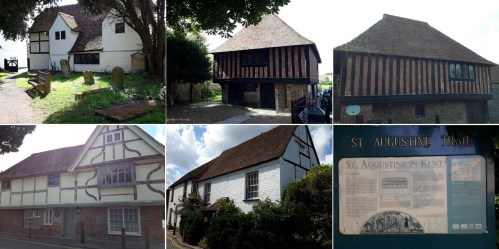
After completing my first Camino de Santiago in September 2017, I realised that the camino ‘bug’ had well and truly bitten…..at the time I was sorely tempted to cancel my flight and head off to start another route instead of returning home…. I didn’t of course but oh my, how I would have loved to be able to do just that. Prior to this, as mentioned in my previous blog I had completed 2 ‘caminos’ in the UK; Chaucer’s Canterbury Tales route from Southwark to Canterbury and The Way of St Augustine from Ramsgate to Canterbury…both of which I can highly recommend, although be warned the Chaucer route is mostly now on busy traffic routes, so not as scenic or tranquil as the St Augustine route which is mainly through fields and alongside rivers, and taking in quaint English villages till you reach the outskirts of Canterbury.

the way of st augustine

Fordwich; a Domesday Book village on the Way of St Augustine. The Town Hall is awesome! loved the houses

Camino meaning: way, path, journey, good way.

I love walking (also mentioned before 😉 ), and although I’m not in any way religious, the idea of ‘pilgrimage’ appeals to me greatly. I’m happy to take random training walks, especially when I’m working and have limited time, but there is nothing quite like having a specific destination in mind. There are hundreds of fantastic walks in the UK and I plan to walk as many of them as possible, but it’s the long-distance pilgrimages/walks that appeal to me most. I love the idea of the routes linked to saints….they all have a fascinating link with history and since I find the history of the UK absolutely fascinating 😉 these are the routes I’ll focus on first.

Since I’ve decided to walk at least 1 new route of the Camino de Santiago every year for the next 6 years (or more). Researching the different routes has been fascinating. My planned route for September 2018 is the Camino Inglés, frequented by pilgrims from northern Europe, Ireland and the UK as a short easy route to Santiago. I’m also planning to do at least 1 long-distance pilgrimage/walk in the UK each year. So since there is a link between the UK and the Camino Inglés, I’ve decided to precede that walk by following the Pilgrim’s Way from Winchester to Canterbury…many roads lead to Canterbury 😉

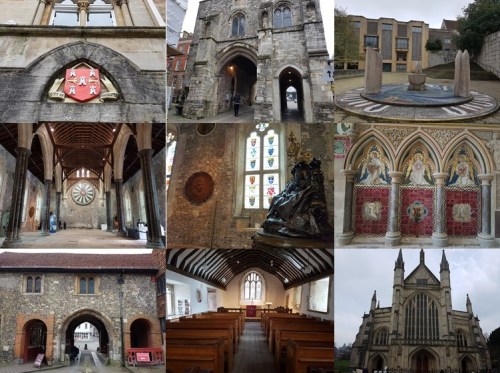
Winchester

Winchester

The Camino Inglés. “Sometimes called in Spanish the Antiguo Camino Real, the Camino Inglés provided a short, direct route from Ferrol or A Coruña to Santiago and was therefore used by pilgrims of various nationalities from northern Europe, who had travelled to Galicia by sea”. Ref Confraternity of St James

The Pilgrims’ Way is the historical route taken by pilgrims from Winchester in Hampshire, to the shrine of St Thomas Becket at Canterbury Cathedral in Kent.

To that end, planning my pilgrimage has begun. Google has as always been a trove of information and I found this fantastic website; pilgrims way uk, that not only gives you lots of information about the route, but has a fantastic map highlighting accommodation options, restaurants and shops, points of interest like memorials, historical sites/ruins, monuments and statues and points of interest, but most importantly it highlights churches along the way where you can get your passport stamped. This is VIP!!

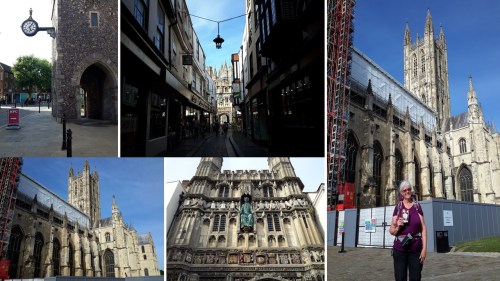
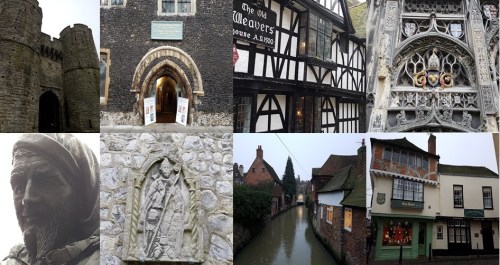
canterbury cathedral way of st augustine

Finally through the city walls and so to Canterbury Cathedral

Canterbury, Kent

Canterbury, Kent

From there I’ll leave the next day for A Coruña in Spain and make my way to Ferrol for the start of the Camino Inglés to Santiago de Compostela. I had planned on taking the ferry from Plymouth where they have a ‘pilgrims start’ to Santander and then make my way to Ferrol over a few days, but when I did the pricing it was over £300 for the trip…so that’s off the list….I guess I’ll just have to stick with flying. A shame really as I wanted to make the trip as authentic as possible.

pilgrimage to santiago de compostela, the way of st james,

the body of James being taken by sea to Padron in Galicia Spain before being taken to Santiago

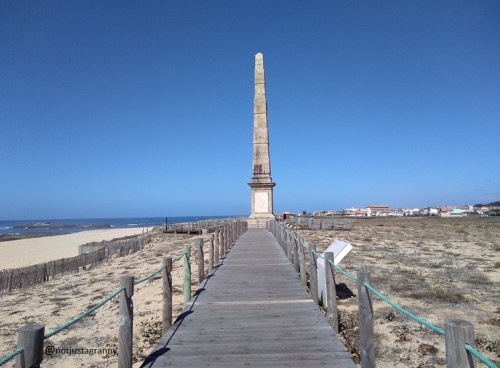
It has been widely accepted that over the centuries ‘the way’, whether here in the UK or indeed even in Europe, has undergone numerous alterations, diversions and even obliteration, depending on the era and which king was on the throne…think Henry VIII who was incredibly destructive. So in effect there is no ‘absolutely real’ pilgrim’s way, but rather an extension or addition of routes that over time have become ‘the way’. There are of course the ‘purists’ who are hell bent on ‘proving’ that one way or the other is the ‘correct way’ but even they, the learned scholars of pilgrimage, cannot agree on which was the ‘original’ way…regardless of the route (someone I knew from a few years ago springs to mind….his arrogance in his ‘certainty’ of the real route was breathtaking…in fact I cut him out of my life due to his bullishness. And he wasn’t even an expert but rather someone who dabbled in the history). Even as I write, the Camino Inglés has undergone a reroute to accommodate the pilgrims who don’t want to follow the previous route over some mountains on day 2…because they have to exert themselves. So ‘the way’ is really dependent on which country you’re in, where you start and your intentions whilst walking. In centuries past, most pilgrims, especially in Europe simply stepped out their front doors and walked to Santiago. When I walked my Camino in September 2017 I followed the Portugues route as marked by the yellow arrows and markers, but since much of the way in Portugal, from Porto to Caminha, is now along recently built boardwalks above the beach, you can be sure that was not the original way.

31 days of gratitude, camino de santiago, walking the camino, portuguese coastal route,

Keep the ocean on your left and head north…

The Pilgrims’ Way is the historic route apparently taken by pilgrims from Winchester to the shrine of St Thomas Becket at Canterbury Cathedral in Kent. The route closely follows a pre-existing ancient track-way generally dated by archaeological finds to around 500–450 BC. The prehistoric route followed a “natural causeway” east to west on the southern slopes of the North Downs, probably in existence since the stone age.

along the pilgrims way north downs

along the Pilgrim’s Way on the North Downs near Oxted

I loved my Camino, I enjoyed every single day despite the pain and exhaustion I endured on some days, but in all honesty, planning the walk is the part I most enjoy. The research unearths some fascinating and often surprising information and of course anything to do with the Roman and earlier eras piques my interest no end and I end up following links across the internet…it’s almost a journey of its own. The frustrating aspect of this research is that I am not able to follow through on much of what I learn and have to bypass the places I discover. If not, I’d be walking forever….the history linked to the various routes is extraordinary, and I’m hard put to not get too enthusiastic about following links. I also get really frustrated because of course I’d like to see it all….but time does not allow.

I was sorting through my possessions in December, in the process of downsizing, and found a book; The Pilgrim’s Way – Nellie Kirkham (published 1948), that I acquired somewhere along the way (sorry for the pun 😉 ). I immediately started reading it and was soon totally absorbed, my desire to walk the route now becoming urgent rather than just a desire. So many fascinating places to see enroute. I wonder how much will have changed since she walked.

After I discovered the Pilgrim’s Way UK website, I immediately set about planning my days. There are so many amazing places and points of interest. Although I’ve been to both Winchester and Guildford a couple of times, I’m pretty keen to explore them again in my capacity of a pilgrim….I’ll have to try find out more about places that pilgrim’s of old would have known….like the castle ruins in Guildford and of course the cathedral in Winchester…which by the way is an amazing place to visit if you’re ever thinking of heading that way.

Meanwhile the route planning continues and next on the list is packing for pilgrimage in the UK, and the route in Spain.

Here are a couple of websites you may find interesting.

http://www.pilgrimswaycanterbury.org/history-of-the-pilgrims-way/

https://www.csj.org.uk/planning-your-pilgrimage/routes-to-santiago/routes-in-spain/the-camino-ingles/

Have you walked any of the Camino routes or pilgrimage routes in the UK? I’d love to hear from you; if you have, please do leave a comment. 🙂

In case you missed the Camino 2017 blog posts; the start of my camino Porto to Vila do Conde

Read Full Post »

2018 did not get off to as good a start as 2017…..it was wet and cold and frankly, just miserable, ergo I didn’t get to start my #walk1000miles challenge till 3rd January. Thankfully the day dawned bright and I woke early. I had been longing to get out for a nice long walk but didn’t fancy walking in cold rain. 😉 It’s one thing walking in rain on a hot day, but cold? No thanks.

I didn’t manage a very long walk after all due to the fact that not only was I due to be leaving for Wales just after lunch time, but I moved house (within a house) and was in the process of sorting through my possessions…..I’m currently downsizing and oh my gosh have I accumulated a LOT of stuff since arriving in the UK in 2001. Truly??? Insane. Although to be fair to myself it is mostly travel mementos, travel diaries, a LOT of postcards (whyyy???), plenty of mugs from places I visited over the years, some clothes and a lot of books. It’s been quite difficult really deciding what to keep and what to throw away.

So putting the sorting and packing aside I set off just after 7.30am for a brisk walk and to watch the sun rise. It’s been ages since I got to watch the sunrise and I was longing to enjoy that feeling of joy as it rises above the horizon….a new day and I was still alive….what a privilege. Viking Bay looked absolutely gorgeous, the tide far out, the beach virtually deserted and the sky a palette of pastels.

walk 1000 miles, winter walks, sunrise, broadstairs, capturing britain

Viking Bay, Broadstairs, Isle of Thanet

With a brisk wind at my back I strode purposefully along the promenade to Louisa Bay and down the slipway to the beach. The tide was out and made walking along the crispy sands an absolute must. Cold, crispy, fresh sea air blew vigorously around me whipping my hair into my face and bringing tears to my eyes with the chill of it.

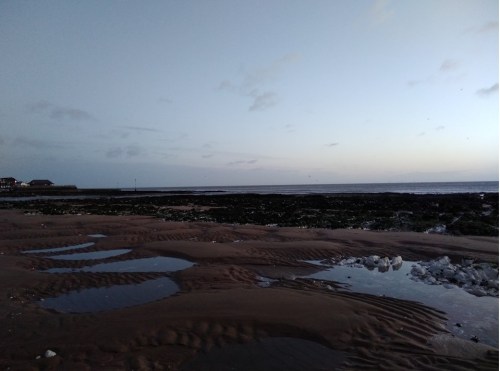
The beach looked like an alien landscape; deep swirled holes potted the beach, carved out by the crazy seas after yesterday’s storm.

walk 1000 miles, winter walks, sunrise, broadstairs, capturing britain

Louisa Bay; an alien landscape

I watched as I walked; the sky lightened and turned a soft pastel pink, that delicious colour you get during early winter mornings. Slowly the colours changed as the sun rose higher and then to my delight it started to peep above the horizon….up and up it rose, slowly brightening the sky till the disc of gold was full in the sky…..time to go home.

walk 1000 miles, winter walks, sunrise, broadstairs, capturing britain

Sunrise 03.01.2018

I had by then walked a fair distance and out along a spit of stones and rocks right out beyond the shore line. I had noticed the tide slowly creeping closer and as soon as it touched my toes I turned to return to the shore….I did not fancy being cut off by the tide closing in behind me.

Going back was a little quicker as the wind had picked up and was pushing hard at my back. Now I could truly not see much with my hair slapping against my cheeks, flying about above my head like a dervish. The wind skimmed vigorously along the beach whipping the sand into a frenzy and blinding the unwary as it flew into the air. White horses crested the waves that were now rising higher and higher with the wind pushing from behind.

Dogs and owners scurried along, dogs chasing leaves and debris, owners chasing their recalcitrant pets.

Looking back, the sun shone like a golden disc above the choppy seas, a shiny gold path reflecting on the wet beach.

walk 1000 miles, winter walks, sunrise, broadstairs, capturing britain

a golden path

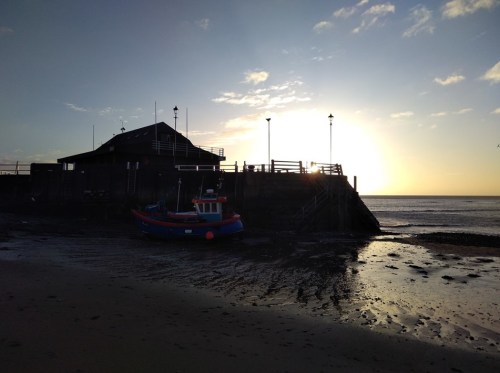
I walked across the sands at Viking Bay towards the little boats sheltered in the harbour. As I neared the curve in the beach a sudden gust of wind lifted me off my feet and sent me flying across the sands…..Mary Poppins where are you now?

walk 1000 miles, winter walks, sunrise, broadstairs, capturing britain

Broadstairs harbour, Viking Bay, Isle of Thanet

I do so love the winter months despite the wet, cold, grey days; but it’s those clear days I look forward to most – days when the sky is painted soft pastel greys, pinks and lilac as the sun rises on a new day.

I managed to get in just 4 kms/2.5 miles although not anywhere near what I would like to do each day, I only need to walk 2.74 each day to reach 1000 by 31.12.2018……997.5 to go!!


Read Full Post »

I was chatting to my daughter yesterday and remarked that I had been particularly blessed this year. Usually when you get to the end of the year you kinda feel like there is more that could/should be done before the year ends (well I do), and the last few days of December are spent cramming in just a few more activities. But this year I can truly say that I have had a year jam-packed with adventures, and for that, I am truly grateful.

inspirational quotes

Die with memories, not dreams

So to that end I decided to list my 2017 adventures, and was astounded at how much I had actually done, and how many places I have actually been to besides all my Camino 2017 practice walks that took me to some fantastic places. So this is my final blog for 31 Days of Gratitude – Day 31 – 2017 in review.

January

New Year’s Day swim 01.01.2017 Broadstairs Beach, Isle of Thanet, Kent

New Year's Day, Broadstairs

New Year’s Day, Broadstairs

Wedding Dress shopping with my daughter

wedding dress shopping with my daughter

wedding dress shopping…so much fun

Isle of Wight, Hampshire, England

visit the isle of wight

A visit to the isle of Wight

Places I went while I was there; Nettlestone (1086 Domesday Book village),20170116_144130-01 Bembridge Windmilll, Brading Roman Villa, Carisbrooke Castle, Cowes, Ryde, rode on a Hover craft, The Needles and Quarr Abbey.

And Osborne House


Magic Lantern Festival – Chiswick Park, London

Canterbury, Kent

Canterbury, Kent

Canterbury, Kent

February
Oxted, Surrey – the Greenwich Meridian runs through the town

Oxted

A closer look at Oxted

Limpsfield, Surrey – a Domesday Book village

Down House – home of Charles Darwin

Down House; home of Charles Darwin and his family

Down House; home of Charles Darwin and his family

Tatsfield, Surrey – a Domesday Book village

tatsfield surrey

South East England’s highest village; Tatsfield. Ref wikipedia: “In Anglo-Saxon England, Tatsfield lay within Tandridge hundred. In 1086 it was held by Anschitill (Ansketel) de Ros from the Bishop of Bayeux. Its Domesday assets were: ? hide. It had 2 ploughs. It rendered 60 shillings (£3) to its feudal overlords per year.”

Tandridge & Crowhurst, Surrey

Tandridge & Crowhurst

Tandridge & Crowhurst

Dublin, Ireland


Trim Castle & Trim, Ireland

March
City of Winchester, Hampshire, England

Winchester

Winchester

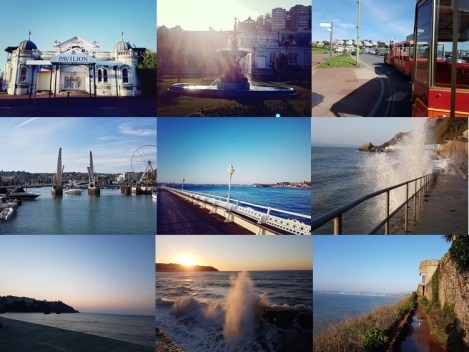
Torquay, seaside resort – Devon

torquay

Torquay

April

Pisa, Florence, San Gimignano, Poggibonsi, Sienna, Lucca – Italy


May

Newcastle, Co. Wicklow, Ireland

Newcastle, Ireland

Newcastle, Ireland

Belfast, Northern Ireland


Giants Causeway, Northern Ireland


Dark Hedges – Game of Thrones, N. Ireland

the dark hedges northern ireland

The Dark Hedges – scenes for Game of Thrones were shot in this area

Sevenoaks, Kent, England


June
Tonbridge, Kent, England

Ironbridge, Shropshire, England – UNESCO World Heritage Site

Lenham, Kent, England

Lenham

Lenham

July
Chaucer’s Canterbury Tales route – Southwark to Canterbury

Battle of Britain Airshow, Headcorn

St Augustine’s Way – Ramsgate to Canterbury

August
Arundel, and Arundel Castle, West Sussex, England

Bromham, Houghton House with my lovely friends Lynne & Tim and Elstow (birthplace of John Bunyan) – Bedfordshire, England

Bronham, Houghton House, Elstow

Bromham, Houghton House, Elstow

Zip Line with Zip World in London with my daughter

September
Walked the Caminho Portuguese – Porto, Portugal to Santiago, Spain 240 kms – Both UNESCO World Heritage sites

Coimbra, Portugal – UNESCO World Heritage Site

Barcelona, Catalunya, Spain

Barcelona, Catalunya, Spain

Barcelona, Catalunya, Spain

October
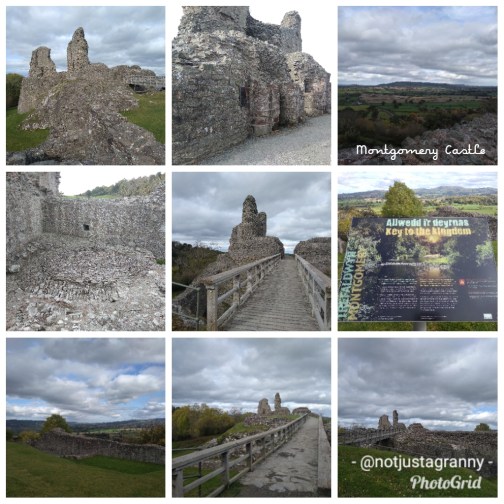
Montgomery Castle, Montgomery, Wales

Montgomery Castle, Montgomery, Wales

Montgomery Castle, Montgomery, Wales

November
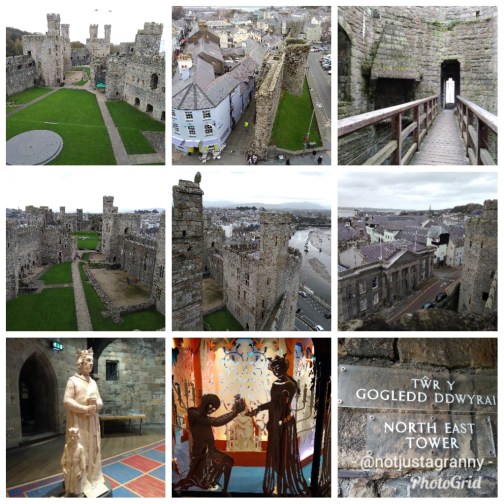
Caernarfon Castle, Wales – site where Prince Charles was crowned Prince of Wales

Caenarfon Castle, Wales

Caenarfon Castle, Wales

Ffenistogg Railway Line Train ride; Caenarfon to Portmadogg through Snowdonia

Ffenistogg Railway line Caenarfon to Porthmadogg, Wales

Ffenistogg Railway line Caenarfon to Portmadogg, Wales

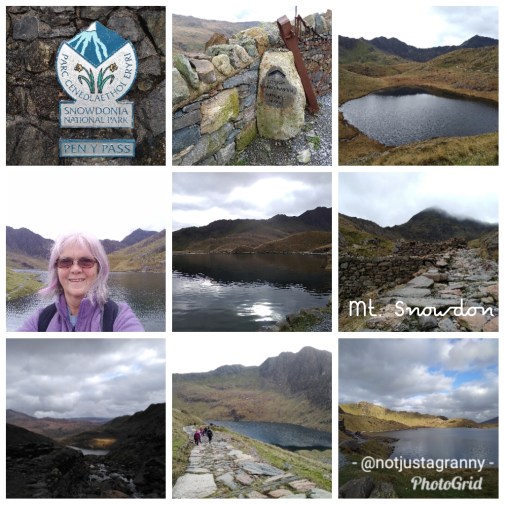
Climbed Mount Snowdon, Snowdonia National Park, Gwynedd – highest mountain in Wales

Mount Snowdon, Wales

Mount Snowdon, Wales

Montgomery, Powys, Wales – The Treaty of Montgomery was signed 29 September 1267 in Montgomeryshire. By this treaty King Henry III of England acknowledged Llywelyn ap Gruffudd as Prince of Wales.

Montgomery, Wales

Montgomery, Wales

December
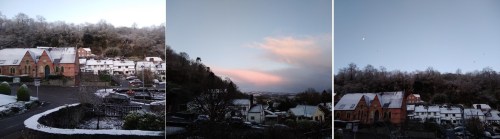
Snow in Wales

Snow in Wales

Snow in Wales

Christmas in Broadstairs, Isle of Thanet, Kent

xmas 2017

Christmas 2017 with my delightful family

And in total, between 01.01.2017 & 31.12.2017 I have walked well over 1100 miles.

What an extraordinary year; 2017.IMG_20171231_100927_404

p.s. Days 14-30 Days of Gratitude will follow shortly….I eventually ran out of time 😉

Read Full Post »

31 Days of Gratitude and today I’m grateful that I live in the Northern Hemisphere.

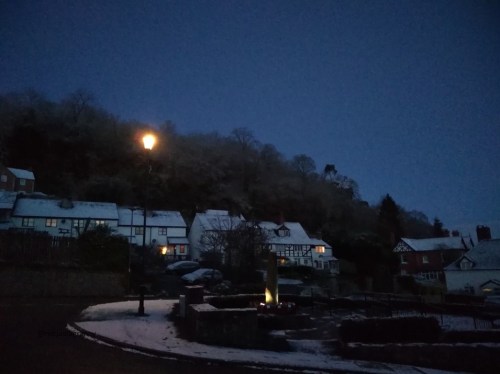
Last night I went to sleep in Wales, this morning I woke in Narnia. Yessss, it snowed during the night. hoorah!!!! I couldn’t believe my eyes when I looked out the window this morning. Our neighbours later commented that they had seen me out in my gown and slippers running down the road to take photos at 7:30am LOL I guess that’s a first in the neighbourhood.

31 days of gratitude, winter in the uk, snow in the uk, snow in wales, not just a granny travels

Hello from Narnia 07:30

As a kid and later as an adult I remember we had snow in South Africa, but except for one year as a kid when I was about 7 or 8, and one exceptional year in 1982 when we had blizzards of snow, the most we saw of snow was on the high mountains of the Drakensburg or the peaks of the mountains in the Western Cape. They usually had snow in the hinterland or in Lesotho, but we seldom had it in the suburbs.

So when I moved to first Ireland and then the UK, I anticipated seeing snow on a regular basis. In my first year of working in the UK I remember it snowed close to Christmas. My excitement knew no bounds and whilst it hasn’t snowed every year, we have certainly had some fantastic snowfalls.

I was in transit from London to Oxford one year; 2010/2011, on an assignment and I recall with clarity that just about the whole of the UK was covered with snow….just the far south of Cornwall escaped. One year too when I was home in London we had a fantastic snowfall and my daughter and I walked all the way from St John’s Wood to Hyde Park (January 2007) to play in the snow; snowmen, snow angels, snowballs…..we had an awesome time. Another year (2010) we had and exceptionally high snowfall in London. We were living near Alexandra Park and again we traipsed, knee-deep through the snow, through the park and up the hill to the crest of the hill where we spent an hilarious few hours playing in and relishing the snow. I borrowed a sled from some kids and proceeded to make a complete ass of myself sledding….not very successfully as you will see LOL

and then as if once wasn’t enough…”I want to go again”…LOL

Too much fun. We laughed so much that day. I eventually had to give the sled back to the kids I borrowed it from, but not without regret 🙂 We did go out and buy our own sled, but as fate would have it, it never snowed like that again!!! Certainly not in our area of the hood. We eventually gave the sled away during one of our many house moves.

I was really hoping that since I’d be working up in Wales this year that I’d see snow, and this morning my wish was granted. It was thrilling beyond words to wake up to a winter wonderland.

31 days of gratitude, winter in the uk, snow in the uk, snow in wales, not just a granny travels

at tad later 8:15

It was magical. As soon as I had woken my client and got him up, dressed, fed, dishes done, beds made, laundry in, cat fed and house tidied, with his permission I donned my shoes, jacket, hat and gloves and with poles in hand I walked up to the castle.

31 days of gratitude, winter in the uk, snow in the uk, snow in wales, not just a granny travels

walking up to the castle

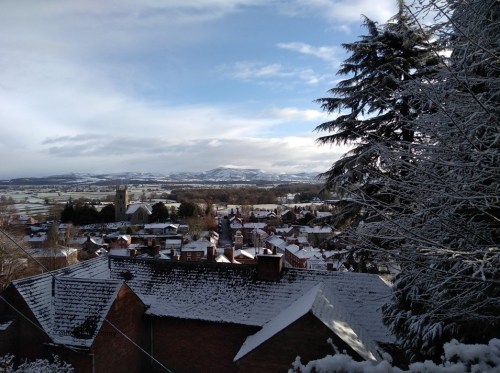
The views are under normal circumstances just breath-taking, but with snow in the trees, on the verges and covering the landscape as far as the eye could see…..it was magical. It felt like Narnia.

31 days of gratitude, winter in the uk, snow in the uk, snow in wales, not just a granny travels

the village

How lucky am I!!!! 🙂

Today I am grateful that I live in the Northern Hemisphere and I am grateful that I got to see the snow 🙂 I could very well be at home and not seen any at all LOL

31 Days of Gratitude – Day 7

Read Full Post »

I thought it was apt that today’s day of gratitude should be about my job. In this capacity I get to meet people from a very wide spectrum of humanity and I get to travel the country, mostly for 2 weeks at a time and sometimes for a longer stint…currently I’m at a 31 day position in north west Wales.

I have a love/hate relationship with my job; as a Carer for the elderly. Sometimes the assignment I am allocated is amazing, and sometimes its just plain awful – you never know which it will be till you get there. One thing I have learned in this job is that there are so many very unhappy people in the world, and there are some lovely folk who are a daily pleasure to be with.

In my capacity as a Carer I get sent all over the UK and sometimes even to Ireland. Its a fantastic way to see the country and mostly I don’t mind the travel, even though occasionally it takes anything up to 8 hours to get to a place from home; door to door. Fortunately I have social media to keep me occupied and every now and then I pull out my knitting and knit a few more squares for my motor-home blanket.

I’m grateful that I am able to visit some of the most historic, quirky and amazing places in all 4 countries that make up the UK. It was during a visit to the Isle of Wight that Project 101 really took off….when one day while out walking I noticed the village sign board; Nettlestone 1086 🙂 wowwwww a Domesday Book village.

31 days of gratitude, domesday book villages, nettlestone 1086, travel the uk, working as a carer for the elderly, not just a granny travels, project 101

Nettlestone 1086; a Domesday Book Villages

Intrigued, I decided to see how many of these I had already visited over the last 16 years. Before then I had merely been counting the islands I visit with a goal of 100, but since I saw that sign I decided to find out how many Domesday Book villages, towns or cities I had visited….currently it’s 107!!

I was astounded and that got me to thinking about other places I had been, and so Project 101 was born.

I am grateful too that I have work. During uncertain times, it is in fact a bonus to have a job, especially a job that I mostly enjoy. I’ve been with the same agency now for 10 years and in that time I have travelled to just about every county in England, a good few in Scotland (I worked in a castle once!!), 1 county in Ireland and currently I’m in Wales.

31 days of gratitude, domesday book villages, nettlestone 1086, travel the uk, working as a carer for the elderly, not just a granny travels, project 101

some of the many, many places I have worked in the UK

It’s not always an easy job and sometimes I leave after 2 weeks absolutely drained; emotionally, mentally and physically. Old people can be very challenging, on all 3 levels mentioned. But I have learned some fascinating stories…when someone is prepared to talk about their lives, you hear some extraordinary tales. I often wish they would put their stories into a book. Especially when it relates to WW2. So many personal accounts of life during the war are lost and we’re left with the ‘official’ accounts.

I am grateful for my job because it allows me to satisfy my highest value; travelling. I get to meet interesting people, see fantastic places, and steep myself in the amazing history of this country. And at the same time, I can pay my bills LOL 💸💸💸💸

I’ve also learned to be extraordinarily patient, to create interesting and colourful meals and occasionally I get to enjoy an assignment that is so lovely, that I got back again and again.

31 days of gratitude, domesday book villages, nettlestone 1086, travel the uk, working as a carer for the elderly, not just a granny travels, project 101

preparing nutritious and colourful meals

I also get to meet all manner of pets, and now and then I fall in love with a real beauty.

I also get to meet all manner of pets, and now and then I fall in love with a real beauty.

a beautiful little boy


Read Full Post »

I shared 3 photos on instagram yesterday and titled it ‘the changing landscape of my life‘ featuring places I had been on the 18th of the previous 3 months. 

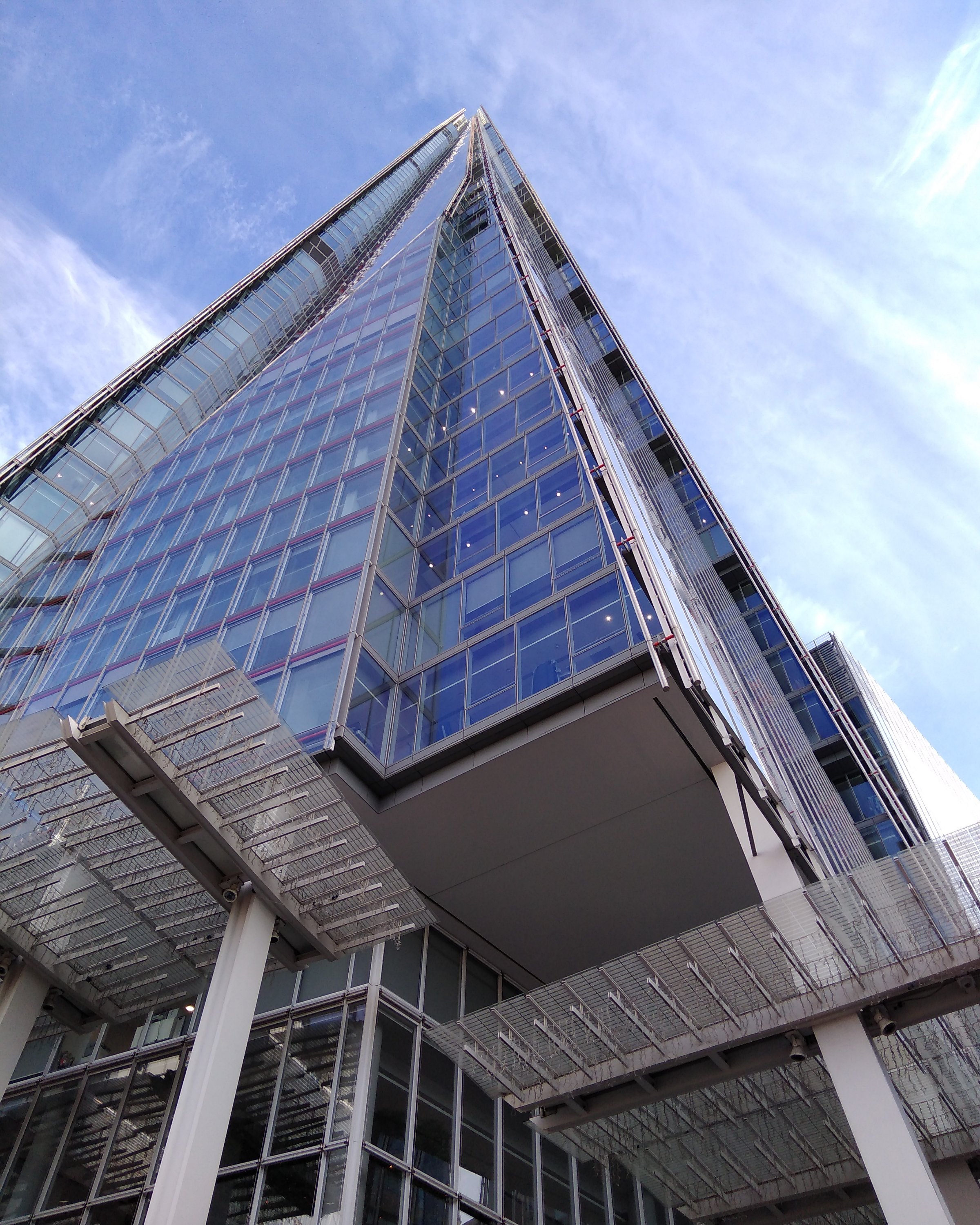
So I thought I’d drop in and post a photo of my travel diaries for today ; once again in transit from home to work. I am fascinated by this building; watched it being built,  and over the years I have photographed it countless times. The Shard London. Again 😉 


Read Full Post »

I remember the first time I saw Arundel Castle in the distance from the train. I nearly fell off my seat in excitement. Just a quick look as we whizzed past was enough to make me foam at the mouth…I HAVE to go there. That was about 6 or 7 years ago LOL Meanwhile life got in the way and work prevailed and I had so many other places to go to too! But finally, as part of my current Project 101, I set the date and squeezed in a few days between assignments. The market town of Arundel was finally on my horizon.

the Market Town of Arundel; a Domesday Book village

the Market Town of Arundel; a Domesday Book village

Oh my gosh, my excitement as we chuffed into town knew no bounds. I had booked accommodation via AirBnB and my host very kindly collected me from the station…huge suitcase and backpack…we only just managed to squeeze it all into her car!! I had arrived quite late in the day, having come straight from an assignment so even though it was too late to visit the castle, it wasn’t too late to go see it. 🙂 My host directed me towards the riverside and before too long I was on my way.

The River Arun heading upstream towards Arundel Castle

The River Arun heading upstream towards Arundel Castle

Arundel Castle is truly a fairy-tale castle. It is beautiful; turrets, and towers, hidden corners, a moat and all thin windows; you could almost expect to see Rapunzel let down her hair…it is exactly that type of castle. It also reminded me very much of the Disney castle in Florida. Just a different colour. 😉 Just wow.
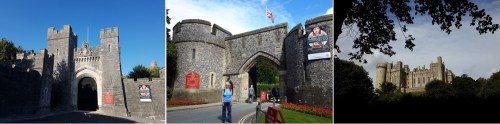
arundel castle

Arundel Castle

As I walked along the River Arun drawing closer to the town the castle loomed large on it’s rocky promontory, towering over the village and river below. You can believe that it would have been an intimidating sight for travellers of old. How I longed to be able to sail into the town on a boat…how awesome that would be. The River Arun is a tidal river which I didn’t at first realise. As I walked along the riverbank I remember thinking how interesting it was that it flowed so fast….what I didn’t realise at the time was that the tide was going out. Later on after my walk I checked the mapmywalk app and that’s when I realised it flowed into the English Channel at Littlehampton and is tidal as far inland as Pallingham Quay, 25.5 miles (41.0 km) upstream from the sea. A series of small streams form its source in the area of St Leonard’s Forest in the Weald, West Sussex. It’s the longest river entirely in Sussex.
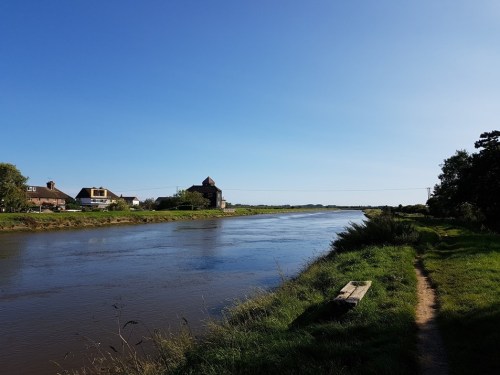
Te River Arun

The River Arun

Within 10 minutes I was in Arundel proper 🙂 whoo whoo. Oh my gosh the houses are lovely. I passed the oldest pub in Arundel; The King’s Arms C1625 wow. I popped in for a quick look but sadly it’s fairly dull with no outstanding features beyond it’s age.
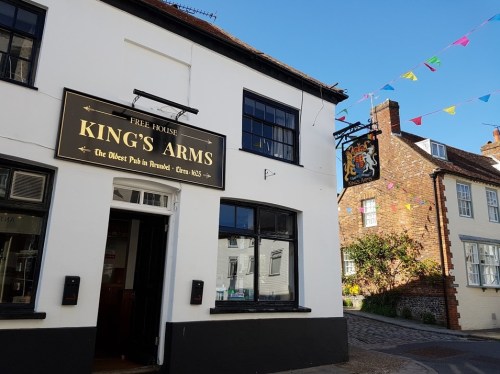
King's Arms, Arundel

King’s Arms, Arundel

I decided to walk up the hill; Kings Arms Hill which is clearly a medieval street with marvellous cobblestones from top to bottom.

Kings Arms Hill, Arundel

Kings Arms Hill, Arundel

At the very top on the hill I could see what to me was an utter surprise….the cathedral!!! I seriously had not see it before..or perhaps I did but was so enchanted with the view of the castle it didn’t register at the time. But oh my word, did it ever register now!!! It is fantastic and reminds me ever so much of the Notre Dame in Paris with pointed arches, steep-sloping roofs and fancy carvings. Gorgeous!!!
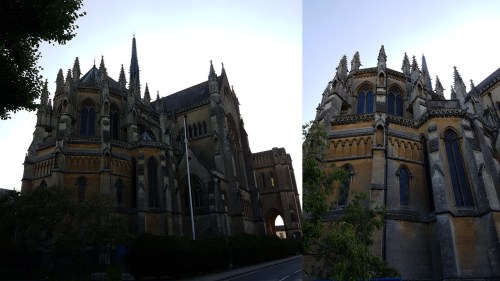
Cathedral in Arundel

Cathedral in Arundel

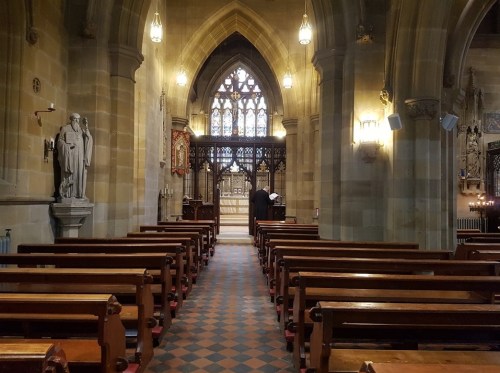
The architectural style is French Gothic (hence the reason it reminded me of the Notre Dame), and the interior is simply stunning. I had no idea what to expect, but when I stepped in through the door I stopped dead in my tracks, my mouth agape and all I could say was wow wow wow. Not one of my finest descriptions!! LOL It is so beautiful that you can’t quite believe what you’re seeing. Not overly ornate as some cathedrals tend to be, it’s better described as exquisite….the cream stone arches soar heavenwards to a vaulted ceiling, light streaming through the windows captured dust motes dancing like delicate fairies on the sunbeams in the otherwise still air.
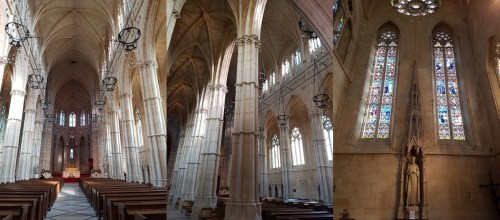
Cathedral in Arundel

Cathedral in Arundel

I wafted around in sheer bliss just absorbing the elegant stillness and admiring the gentle beauty of the arches and niched sculptures and the large rose window adorned with exquisite stained glass. The Lady Chapel can best be described as serene.
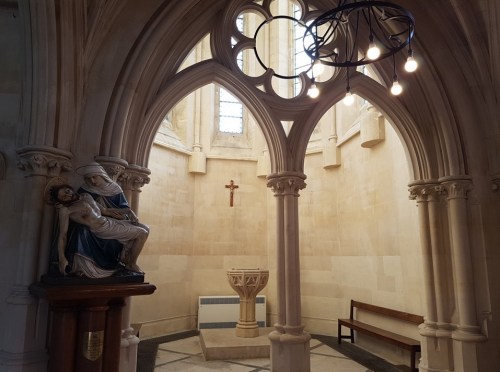
The Lady Chapel, Cathedral Arundel

The Lady Chapel, Cathedral Arundel

I love these churches. So simple, so elegant, so beautiful. I stopped at the shrine to St Philip Howard. Quite an extraordinary story.
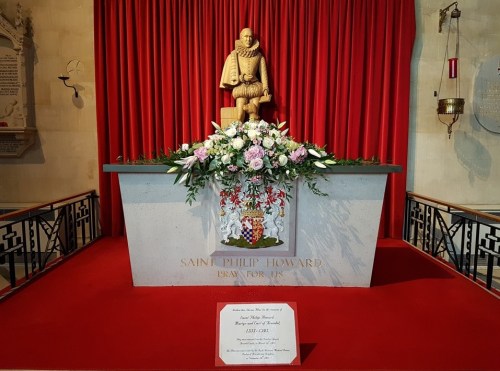
St Philip Howard, Arundel Cathedral

St Philip Howard, Arundel Cathedral

I could have stayed for hours, but I had a castle to see….I was saving my first glimpse, savouring the anticipation 🙂

During my walk I noticed a fantastic 14th century church; The Parish and Priory Church of Saint Nicholas Arundel…although the church proper was closed at that time I did explore the churchyard and planned to visit the next day.

The Parish and Priory Church of Saint Nicholas Arundel

The Parish and Priory Church of Saint Nicholas Arundel

I meandered the streets, slowly making my way towards the castle. I passed a divine little cottage; the Bakers Arms Cottage, at the junction of Maltravers Streets and Bakers Arms Hill, is a British listed building with a pitched tile roof, is timber-framed and fronted with red brick. Absolutely fabulous. There are so many wonderful old houses in the town ranging from 15th – 19th century, many of which are British listed buildings. The history in those houses is just phenomenal.

Bakers Arms Cottage, Arundel

Bakers Arms Cottage, Arundel

I stopped to marvel at the Town Hall – just an amazing building that looked more like a medieval gate than a town hall.
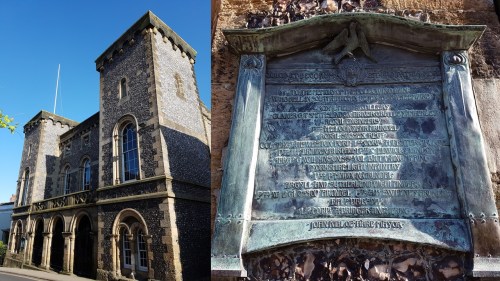
Town Hall, Arundel

Town Hall, Arundel

The High Street is home to a darling array of wonderful old buildings, one of which had sections cut out of the facade exposing the original flint wall and beams behind. Amazing!!! I loved the configuration at the end of the street forming a V with a tiny island that played host to an amazing War memorial. I was so pleased to note that there were few of the usual High Street chains; Tesco, Starbucks, Sainsburys and so on. Although there were a few charity shops mostly it was artisan bakers or antique stores, a local butcher and a few bookshops and of course a number of antique stores.
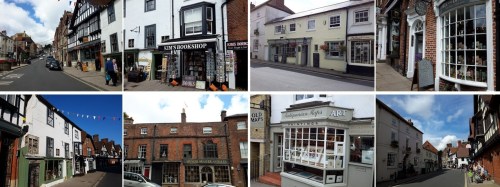
High Street shops in Arundel

High Street shops in Arundel

From there I made my way over to the castle entrance….To my intense disappointment the castle gates were already closed but I did walk along the avenue of trees on the perimeter and managed to get a fantastic image of the silhouette with the sun setting behind. My daughter was due to visit and spend a night with me in a couple of days and we agreed to visit at that time; wow, what an extraordinary place.

Arundel Castle, Arundel

Arundel Castle, Arundel

I crossed over towards the river and noticed that it was now flowing in the opposite direction….ahhh, a tidal river 🙂 I explored the remains of the Dominican Friary and then crossed the old town bridge.
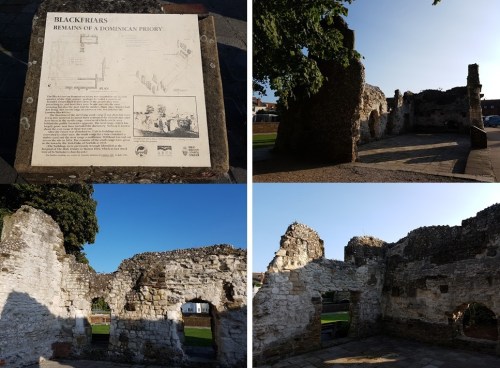
Blackfriars Dominican Priory, Arundel

Blackfriars Dominican Priory, Arundel

Arundel was registered as a port in 1071 and by the mid 19th century the Arun was linked by canals to London and Portsmouth. By the early 20th century the port was moved to Little Hampton. On another day, when the tide was way out, I noticed the remains of the wharves sticking up out the mud. Intriguing.

Arundel Bridge and the River Arun

Arundel Bridge and the River Arun

On the other side of the bridge I noticed a now well-recognised wooden stake with a couple of discs nailed to it…hah! On closer inspection one of them hinted at what looks like a brilliant walk (?) The Monarch’s Way – a 615 mile walking trail following the escape of Charles II after the Battle of Worcester in 1651. oh my gosh. I need another lifetime LOL The Monarch’s Way is one of the longest of all English long distance footpaths. The Way follows the path taken by Prince Charles II as he fled to France following the sound thrashing of his army at the Battle of Worcester in 1651 in the English Civil War. At my current pace I should be able to walk that in ….oh maybe 41 days or 2 months. Hmmmm

I had a fab view of the castle as I crossed the bridge. On my way back to the B&B I noticed the Arundel coat of arms on the riverbank ‘Antiqua Constans Virtute‘ – Steadfast in ancient virtue. In case you’re interested here is a link to the details of the coat of arms.
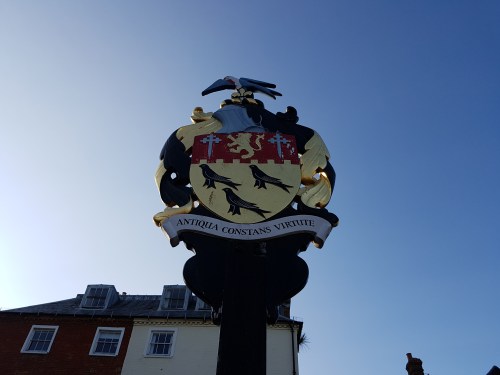
Arundel coat of arms

Arundel coat of arms

I waked along Tarrant Street and noticed a fabulous old building; Belinda’s 16th Century Restaurant. A friend of mine on instagram, Pete and I had arranged to meet the next day for tea and cake…this seemed like the perfect venue, and so it was. We enjoyed a delicious tray of scones with jam and cream and a large pot of tea.

Belinda's 16th Century Restaurant, Arundel

Belinda’s 16th Century Restaurant, Arundel

I had the most perfect weather that evening so decided to walk downstream along the river to the town precincts where I had earlier notice an intriguing looking house and then home to bed.
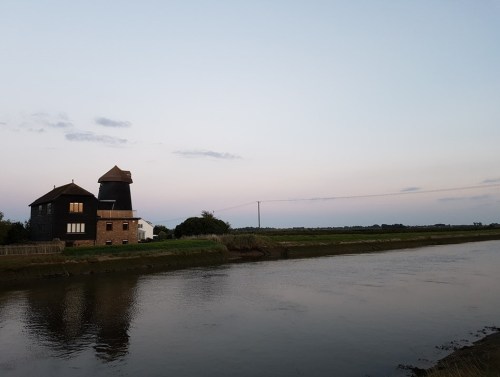
River Arun Arundel

River Arun Arundel

After a bit of a lie-in the next day, I made my way back along the river into town and enjoyed a most wonderfully relaxing day meandering around the town, taking hundreds of photos, popping in at the antique shops, the Castle Chocolate shop where I bought some delicious chocolates and met Clive with the lovely smile, then over to the castle (seriously I could not wait to visit), then made my way over to the fabulous Swanbourne Boating Lake.

Swanbourne Lake, Arundel

Swanbourne Lake, Arundel

I had just intended a brief walk, but it was so beautiful out and the lake looked so lovely, the shady green trees inviting and since I had much time on my hands I decided to walk right around the whole lake….I’m glad I did, it was wonderful. ‘Amidst a backdrop of chalk cliffs & trees you’ll find Swanbourne Lake which has been in existence since pre-doomsday and is home to waterfowl of many varieties.‘ Apparently in 1989 when the lake dried up one summer, they discovered the remnants of a WW2 plane that had been shot down over Arundel. A German Ju88A01 was shot down on 13th August 1940 at 6.30am. Two of the airmen baled out and survivied, one baled out but die and the 4th baled out but was mortally wounded and died of his wounds a couple of days later. If you’re interested here are some facts about Arundel.

After my lakeside walk I crossed over the road and decided to walk back to town along the riverbanks. From the river, across the fields of green, you have the most amazing view of the castle on it’s hill with the town nestling at the foot.
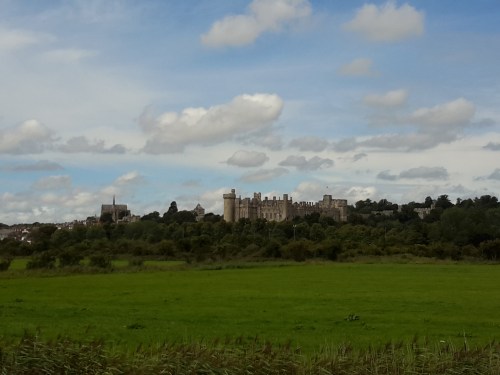
Arundel Castle West Sussex

Arundel Castle West Sussex

I met up with Pete in the early afternoon and we had that most enjoyable tea and a lovely conversation at Belinda’s after which I walked him back to his car….for which I was rewarded with a lift back to the town 😉 After saying goodbye I set off downstream of the river once again and walked and walked, leaving Arundel far behind…such a gorgeous day.

Looking back upstream towards Arundel Castle

Looking back upstream towards Arundel Castle

After a very late start on the 17th I set off once again to explore the town and to visit the 14th century church; the Parish church of St Nicholas. Phenomenal. I’m always amazed that these places survive for so long and often remain a hive of activity in the community. The church was hosting a number of sculptures when I visited; part of a week’s events with sculptures around the town – a trail you could follow. The Priory Alms Houses next door were stunning and I was dying to get behind the gates and into one of them to see!! The Domesday Book records that a Church, dedicated to St Nicholas, existed during the reign of Edward the Confessor between the years 1042 – 1066.
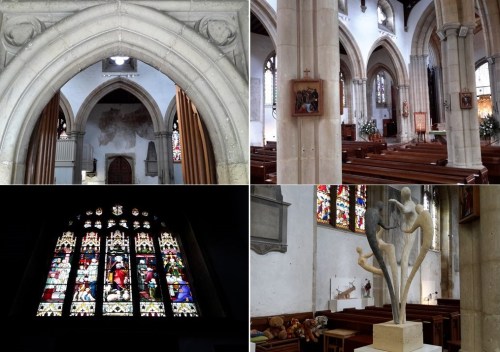
Parish Church of St Nicholas, Arundel

Parish Church of St Nicholas, Arundel

I spent a fascinating 30 minutes exploring the church. There are remnants of some fabulous medieval paintings on the walls, which like many others I’ve seen in the churches on my Southwark to Canterbury walk, are quite simply amazing.
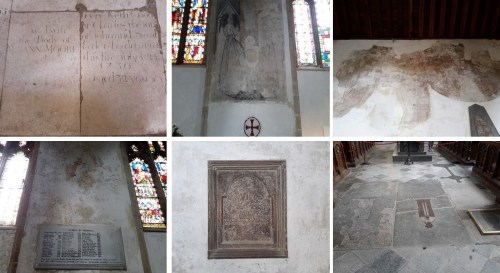
Parish Church of St Nicholas, Arundel

medieval paintings and brasses Parish Church of St Nicholas, Arundel

It’s incredible that they have survived at all. From inside the church you can see through a full-length glass wall into the The Fitzalan Chapel which is only accessible via the castle grounds and wherein are buried family members of the Dukes of Norfolk and Earls of Arundel. (we visited that side of the church during our visit to the castle).
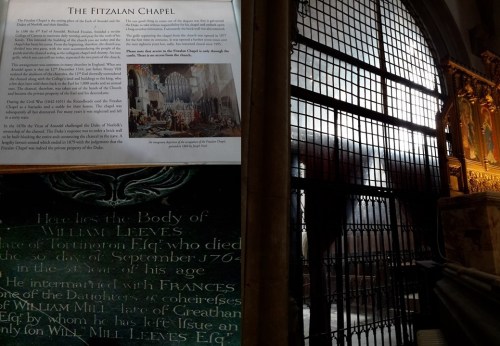
Parish Church of St Nicholas, Arundel and the Fitzalan Chapel

Parish Church of St Nicholas, Arundel and the Fitzalan Chapel

My daughter arrived later that night and after a cup of tea and a chat we went into town for supper. It was so much fun having her there with me. We visited the castle the following day and bought the Gold ticket which gave us access to the gardens, the Norman keep, the Castle and the bedrooms.

Arundel Castle in one word : amazing!!! Sadly we were not allowed to take photos inside the castle, but I managed to slip in one or two before being told off LOL The grounds of the castle are huge with incredibly beautiful gardens you can lose yourself in.
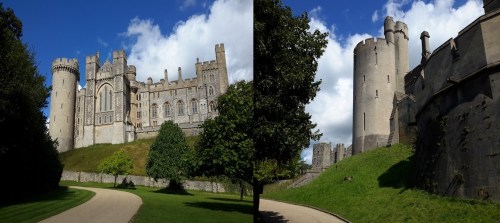
Arundel Castle, West Sussex - home to the Dukes of Norfolk and Earls of Arundel

Arundel Castle, West Sussex – home to the Dukes of Norfolk and Earls of Arundel

We saw a most extraordinary sight in one of the formal gardens; The Collector Earl’s Garden – conceived as a light-hearted tribute to Thomas Howard, 14th Earl of Arundel (1585-1646), known as ‘The Collector’ who died in exile in Padua during the English Civil War, the gardens are beautifully laid out with the grand centrepiece a rock-work ‘mountain’ planted with palms and rare ferns to represent another world. This supports a green oak version of ‘Oberon’s Palace’, a fantastic spectacle designed by Inigo Jones for Prince Henry’s Masque on New Year’s Day 1611. Flanked by two green oak obelisks, the rock-work contains a shell-lined interior with a stalagmite fountain and gilded coronet ‘dancing’ on top of the jet.
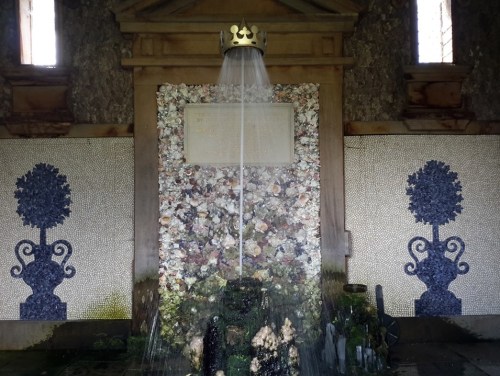
Oberon's Palace and the Dancing Crown, Arundel Castle

Oberon’s Palace and the Dancing Crown, Arundel Castle

Arundel Castle has been the seat of the Howard’s ancestors since 1102. A snippet of interest: Queen Victoria and Prince Albert stayed in Arundel Castle from December 1 to 3, 1846. Victoria notes in her diary for December 2 that year: “After breakfast, Albert and I sallied forth by a back way and walked along a path below the castle, commanding an extensive view, which put us in mind of the slopes at Windsor. The garden is very pretty and full of evergreens, which made Albert extremely jealous for Osborne House.”

We spent a few hours meandering around the gardens, visited the Fitzalan Chapel, the Norman keep,

views across West Sussex from the Norman Keep of Arundel CAstle

The Norman Keep, Arundel Castle

where you have the most amazing views across the castle grounds, the town, the river and far across the fields. Stunning.

views across West Sussex from the Norman Keep of Arundel CAstle

views across West Sussex from the Norman Keep of Arundel CAstle

The castle is still home to the Duke of Norfolk and most of the rooms are used on a daily basis…except when visitors are about. The private chapel is absolutely astounding, the library was incredible and some of the bedrooms just fabulous. We even saw the bed and bedroom where Queen Victoria slept during her visit. The halls and rooms are filled with paintings, statues, a Faberge sculpture, magnificent tapestries and some of the most interesting artefacts. There is a photocopy of a letter from Elizabeth I and some absolutely fabulous treasures.
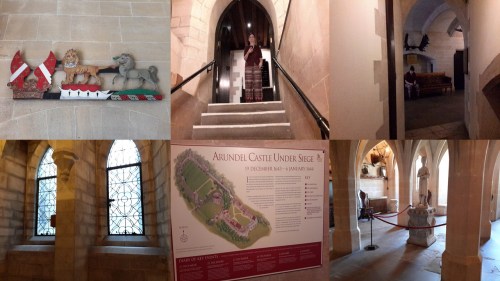
a peek inside Arundel Castle

a peek inside Arundel Castle

Although not very big, and easily managed in a day’s sightseeing, Arundel is chock a block with oodles of history and you must set aside at least 3 hours for a visit to the castle, there’s so much to see.

And thus endeth my journey to Arundel to see a castle. With this trip I have added to 4 categories on Project 101; which now brings the totals to : Castles: 39 Cathedrals: 27 Rivers: 39 and Domesday Book villages: 106. 🙂

I’ll write more about Arundel Castle, the Fitzalan Chapel and The Parish Church of St Nicholas at a later stage. I’m preparing for my Camino 2017 and must focus on that.


http://www.british-history.ac.uk/vch/sussex/vol5/pt1/pp10-101

Read Full Post »
Before setting off on my adventure I did some research into the history of St Augustine and the journey between Ramsgate and Canterbury. It has been super fascinating to find out more about Augustine and the era he arrived in England, and of course the walk itself revealed so many amazing places…I long to just do it again. The churches in particular are just fantastic.

About St Augustine: Augustine was born in the first 3rd of the 6th century and probably died 26 May 604. He was a Benedictine monk who, in the year 597, became the first Archbishop of Canterbury. Augustine was the prior of a monastery in Rome when Pope St Gregory the Great chose him in 595 to lead a mission, aka as ‘the Gregorian mission’, to Britain to convert King Æthelberht and his Kingdom of Kent from Anglo-Saxon paganism to Christianity. After many dangers and difficulties by land and sea Augustine landed at last on the shores of Richborough near Ebbsfleet on the Isle of Thanet in AD 597. Successful in his endeavour, his legacy is with us still today throughout art, culture, legal systems, music, and more. He is considered the “Apostle to the English” and a founder of the English Church. The church in Ramsgate, built by Augustus Pugin, is also the shrine of St Augustine of England. The shrine at Ramsgate houses a relic of St Augustine’s bone.

The Isle of Thanet and the Wantsum Channel.

The Isle of Thanet and the Wantsum Channel.

As you can imagine, thelandscape has changed dramatically since 597 when Augustine landed at Richborough. For one thing the Wantsum Channel, after silting up and becoming un-navigable has since been covered over and is now just a small stream. If I’d had to walk from Minster to Canterbury then, I’d have gotten my feet rather wet LOL

About the shrine and Pugin: Augustus Welby Northmore Pugin (1812-1852) had a particular fascination with St Augustine after whom he was named. In 1843 Pugin bought a cliff-side property in Ramsgate nearby Ebbsfleet – ‘close to the spot where blessed Austin landed’. He first built a family home, ‘the Grange’, and then a personal church dedicated to Augustine. Augustus Pugin and his family are buried in the church.  In 1848 it was the venue for the first High Mass on Thanet since the Reformation.

The Shrine of St Augustine in Ramsgate

The Shrine of St Augustine in Ramsgate

More about the route: 19.1 miles – usually comfortably walked over 2 days. It can be done over one day; but certainly NOT by me!!!

Domesday Book villages along the way: 3 – Minster, Stourmouth, Fordwich and of course Canterbury…although I’ve visited there a number of times so I didn;t count it in for this walk. So 3 new places to add to Project 101. 🙂 There are quite a few other Domesday Book villages nearby the route but despite my intentions I didn’t get to visit…frankly…after walking all those miles I was absolutely NOT interested in diverting and adding more miles….so those places will have to wait for when I have access to a car!! Habitations in most areas of the late 11th century England followed an ancient pattern of isolated farms, hamlets and tiny villages interspersed with fields and scattered over most of the cultivatable land. Domesday Book

Stop 1. St Augustine’s Shrine – Ramsgate – the Shrine of St Augustine built by Augustus Pugin, this magnificent personal church and burial place is dedicated to his patron St Augustine. On 1st March 2012, the church became the official shrine commemorating the coming of the Gospel to the Anglo-Saxon peoples. Augustine and his group of forty monks were invited to Canterbury and through their holy lives, miracles and preaching converted 10,000 souls, as well as King Ethelbert who allowed Augustine to build a monastery and establish a cathedral church.

Stop 2. St Augustine’s CrossCliffs End stands close to the site at which an important meeting between St Augustine and King Æthelberht of Kent is said to have taken place nearly 1,500 years ago, and preached his first sermon to our own countrymen. The 19th century cross of Saxon design marks what is traditionally thought to have been the site of St Augustine’s landing on the shores of England in AD 597. Accompanied by 30 followers, Augustine is said to have held a mass here before moving on. Thus he happily planted the Christian faith, which spread with speed throughout the whole of England.

Stop 3. Minster Abbey, Minster – It was just a short distance from the present site of Minster Abbey, that within a few years of Augustine’s arrival on the shores of Thanet, Christianity had spread throughout southern England, and monastic life began to flourish. St. Augustine became the first Archbishop of Canterbury and together with his monks established a monastery there.

Minster was a royal foundation; its foundress and first abbess was Ermenburga or Domneva, a great-granddaughter of King Ethelbert of Kent.
The name Minster is derived from the first “mynster” or monasterium/ monastery built on the site of the Parish Church of St.  Mary the Virgin by Domneva in 670 AD.  Her daughter Mildred became the second Abbess.  She was one of the best loved Anglo-Saxon Saints and patron of Thanet. The monastery was repeatedly attacked and eventually destroyed during Viking raids of the 9th & 10th Centuries, the foundations of which were uncovered during excavations in the late 1930’s.

An East grange was built to accommodate guests and those on pilgrimage to the shrine of St. Thomas of Canterbury, while the south wing of the Abbey was added within a 100 years of the Norman Conquest in 1066, this “Norman Wing” also remains standing. Minster Abbey is considered to be possibly the oldest inhabited house in the country, and home to the monks for over 500 years. During the reformation the monks were forced to leaveand it passed into private hands. The Benedictine community of St Walburga in Bavaria, re-established Monastic Life at Minster Abbey in 1937 and once again the Abbey became a place of prayer and dedication to God.

Stop 4. St Mary’s Church, Minster – St. Mary’s Church, known as the ‘Cathedral on the marshes’ founded in 670AD was originally both a monastic and a parish church, and is the mother church of western Thanet. In bygone days the sea would have come up to the Churchyard wall which acted as a barrier during high tides. The turret may have served as a watch tower for shipping. The first Church was probably built of mud and wood. The oldest part of the present building was built just after the Norman conquest with work continuing for about 100 years. The Chancel is Early English in style. The nave has stood in its present form since about 1150.
The Church has a set of 18 mediaeval monks stalls (Misericords), which is one of the finest in the south of England.

I absolutely loved this church, so beautiful and serene it seems to float above the trees….quite apt since it was known as the cathedral on the marshes.

Stop 5. All Saints, West Stourmouth – A Grade I listed building, the church stands in the settlement of West Stourmouth, some 4 miles (6 km) north of Wingham. The main fabric in the church is Saxon with alterations made in the late 12th century. The church was damaged in an earthquake in 1382, and subsequently rebuilt. In the chancel there’s a brass dated 1472!! Windows were replaced in the 14th and 15th centuries and the church was restored in 1845, when the seating was reorganised. The royal arms of George III can be seen in the church. It has been redundant since 1979.

Another stunning little church, I spent a very happy hour there just enjoying the serenity. It was also raining so the shelter was most welcomed.

I stayed overnight at The Rising Sun Inn Stourmouth. “Originally a bakery owned and worked by the Monks of the Diocese of Canterbury, the first part of the building was erected in 1372 during the reign of Edward III. An absolutely wonderful location in the heart of the Kent countryside.

Stop 6. Stodmarsh Nature Reserve – The name Stodmarsh is derived from the Saxon words “stode”, meaning mare, and “merse”, a marsh, demonstrating its former use of pasture for cattle among the marshes.
This was probably one of my favourite sections of the walk….mile on mile of marshlands beneath blue skies and fluffy white clouds floating above. It was incredibly peaceful and I saw about 5 people in the whole time it took to cross. The reserve has the largest reed bed in the south east of England, which supports a range of specialised birds and insects. The reed beds are an excellent sanctuary for migrating birds such as swallows and house martins in the summer and starlings in the winter. Bittern, marsh harrier, kingfisher, great crested grebe, coot, moorhen, reed bunting, bearded reedling can all be seen. The reserve supports a large variety of invertebrates (including dragonflies and moths) and rare plants. It also has a strong population of water voles. Stodmarsh has over 6 kilometres of footpaths, including a circular walk around the whole site. There are short and long easy access ‘sensory’ trails at the Stodmarsh end of the reserve.

Stop 7. St Mary’s Church, Stodmarsh – The church, dedicated to St Mary is small and consists of a single aisle and chancel; first built in the 12th and 13th centuries. Originally part of the possessions of the abbey at Canterbury, it remained so until 1243, when the abbot Robert, at the insistence of archdeacon Simon de Langton, granted it to the hospital of poor priests in Canterbury, together with four acres of Stodmarsh, on the condition that they should not demand in future any tithes from the abbey. 

Stop 8. Church of St Mary the Virgin, Fordwich – The church, dating from the Norman era, stands near the centre of Fordwich, some 3 miles (5 km) northeast of Canterbury. There is some Saxon material in the nave, while the chancel and north aisle were added in the 12th century. During the 13th century the chancel was extended and the west tower was built. In the 14th century the windows in the south wall of the church were inserted and box pews were added in the 18th century, and the church floored with tiles. Sadly the church closed in 1995, but it is open for visitors. In the north aisle is a large block of limestone standing about 5.5 feet (1.7 m) high, carved to give the appearance of a tomb. Dating from about 1100, it is considered to be the former shrine of a saint. It is not known how long it had been in the church but it was moved from the church to Canterbury Cathedral in 1760, and subsequently returned to Fordwich in 1877. It is considered that it may have been part of the shrine of Saint Augustine of Canterbury.

Stop 9. St Martin’s Church, Canterbury – the first base of St Augustine when he came to Canterbury in 597. The Church of St Martin in Canterbury, England, situated slightly beyond the city centre, is the first church founded in England, the oldest parish church in continuous use and the oldest church in the entire English-speaking world. Oh my gosh, I can’t believe that I managed somehow to end up visiting this church. Although it was securely locked, I did get to walk around the grounds for a few minutes and rested there before my final push into Canterbury.

St Martin’s Church was the private chapel of Queen Bertha of Kent in the 6th century before Augustine arrived from Rome. Considered to be the oldest Church in the English speaking world still used for worship, and has been for over 1,400 years. It was here that Queen Bertha welcomed Augustine, who with his 40 companions, set up his mission when he arrived from Rome in 597AD to convert the Saxons. Here they remained until King Ethelbert granted him the land for the abbey and the cathedral which, with St Martin’s, now form the Canterbury World Heritage Site. For this reason it is sometimes called the first church of the Anglican Communion, and forms part of the Canterbury World Heritage Site. Shortly before 1844, a hoard of gold coins which may date from the late 6th century was found in the churchyard, one of which is the Liudhard medalet, which bears an image of a diademed figure with a legend referring to Liudhard.

The other two parts are Canterbury Cathedral which is where my walk ended and St Augustine’s Abbey, which I am yet to visit.

http://www.martinpaul.org/architecturalhistory.htm

Stop 10. Canterbury – Cathedral

Canterbury Cathedral is the destination for those who travel along the pilgrim paths from Winchester and Rochester. It is also the beginning of the route to Santiago de Compostela in Spain and the Via Francigena to Rome.

The Way of St Augustine

The Way of St Augustine

Medieval pilgrimage: a pilgrimage is a journey to a holy place connected with the stories of the bible. People have made pilgrimages for centuries and thousands still do so today, but it was especially popular in the medieval period. Early churches were built over the tombs of saints. The bodies and relics of saints, famous miracle-working images and statues , and holy wells, all attracted pilgrims. Apart from major holy cities such as Rome and Jerusalem, there were many thousands of major and minor pilgrimages sites across Europe and hundreds in England.

Why is Canterbury so important?Canterbury is where St Augustine, who reconverted parts of southern England to Christianity founded his cathedral in 597 AD. The cathedral always attracted pilgrims as a special holy place, but it was only after the murder of Archbishop Thomas Becket in 1170 that large numbers of pilgrims began to come to Canterbury. Canterbury has one of the largest collections of holy relics; bones, clothes and other items associated with saints in England. Most pilgrims only visited Canterbury once in their lives, so it was important to make it as memorable an experience as possible. Pilgrims, then as now, liked to take a souvenir of their journey, and Canterbury had many different badges that could be bought in the town, and which would identify the wearer as a pilgrim to Thomas Becket’s shrine. 

St Augustine’s Abbey: Although I didn’t get to visit this particular site due to the fact that I somehow ended up on the Roman Road into Canterbury and thus visited St Martin’s Church instead, I am planning to visit at some stage after my Camino de Santiago….so more on that later. I have however visited in the past, but the next visit will have more meaning after having done the walk.

St Augustine’s Abbey was a Benedictine monastery in Canterbury, and marked the rebirth of Christianity in southern England. Founded shortly after AD 597 by St Augustine, it was originally created as a burial place for the Anglo-Saxon kings of Kent. For two centuries after its founding, St Augustine’s was the only important religious house in the kingdom of Kent. It is now part of the Canterbury World Heritage Site, along with Canterbury  Cathedral and St Martin’s Church. The abbey functioned as a monastery until its dissolution in 1538 during the English Reformation

The Conduit House at St Augustine’s Abbey; dates from the mid-12th century. A roughly octagonal masonry tank is now divided by an 18th century chalk and brick wall. Four tunnelled openings and three smaller ducts, which collect water from springs, lead into the tank. Water was delivered from here to the abbey by a lead pipe 75cm (3 inches) in diameter running from the western side of the structure. The pipe may have led to a water tower at the abbey, which would have fed smaller tanks in the kitchen, infirmary and other parts of the monastic complex.

Thanks for reading this far…I hope you’ve enjoyed learning more about one of England’s many saints. 😉

To read more about my walk

Day 1 The Way of St Augustine Ramsgate to Stourmouth 

Day 2 The Way of St Augustine Stourmouth to Canterbury

Read Full Post »

« Newer Posts - Older Posts »

Self Propelled

Self propelled adventures through life; blogging on cycling, touring, micro-adventures, general shenanigans, and environmental news

johnelsewhere

Thoughtful wanderer in search of virtual meaning

Things Helen Loves

TRAVEL, WALKS & EVERYDAY ADVENTURES

Short Walks Long Paths

Wandering trails around the coast of Wales

Port Side Travel By Jill

My travels, photos, tips/tricks and anything else I think of!

Wonderwall

My 360: wonderwalls,theatre, travel, Sheffield, books...

Robyn's Ramblings

My Thoughts. Expressed.

Graham's Long Walk

Graham King's long walks around Britain

The Lawsons on the Loose

Philip & Heather are making memories through their travels.