Feeds:
Posts
Comments

Archive for the ‘Historical’ Category

On Sunday 6th November we were treated to a private tour of the famous WW2 Ramsgate Tunnels in Ramsgate!

the ramsgate tunnels

The Ramsgate Tunnels

The tour was conducted by ‘Mr Ramsgate’ the father of my daughter’s boyfriend…..he is apparently the most knowledgeable about the history of the town and has the ‘Freedom of the Town’. Quite cool. It was also ‘meet the parents’ day…she had met them, and he had met me…now it was time to put the two parties together and see how we get on. In all it was a great way to meet, and we all got along really well.

the ramsgate tunnels

from left to right…Simon, Jean, me and Ralph

The tour was fantastic and before you read further I can say up front that it is a brilliant tour and highly recommended.

IMAG4936 - walk to ramsgate The entrance and the initial part of the tour is located in what was once the original and now defunct Victorian Railway station.
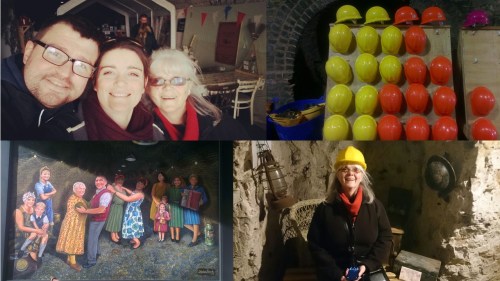
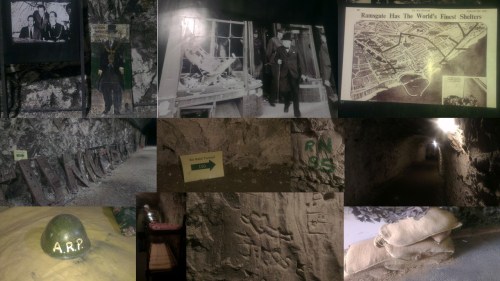
After saying our hellos and introductions done we, so as not to upset the elves who manage safety, put on our helmets and off we went.

the ramsgate tunnels

the three of us at the entrance to the tunnels and me in my hard-hat

Prior to the clouds of war that descended over Britain and Europe this tunnel was abandoned and unused. The then Mayor of Ramsgate; one Mr A.B.C. Kempe, as a far seeing citizen who foresaw that things were going to get a tad tricky, thought it would be a good idea to build tunnels to protect the residents of his town. The plan was rejected as insane, he went ahead and after 3 years of planning the tunnels were started in March 1939. The first section was completed by 1st June 1939. Miles of tunnels in the chalk cliffs. Many people thought the tunnels were an expensive luxury and would probably never be needed.

the ramsgate tunnels

The Ramsgate Tunnels

When war was declared, Ramsgate was in the front line as the Battle of Britain began and in 1940 the town became the first casualty of the Blitz; on 24 August 1940 the sirens sounded and the citizens of Ramsgate took cover in the deep cover shelters. The town was bombarded with 500 bombs in the space of 5 minutes.

“Then, as the Battle of Britain raged in the skies above, the town gained another claim to fame on August 24, 1940. It was a relatively quiet Saturday lunchtime when the air raid sirens suddenly wheezed in to life. Moments later, Ramsgate became the first place in Britain to experience the full force of the Luftwaffe’s ‘Blitzkrieg’.

In the space of five minutes, a formation of Junkers Ju88 bombers dropped more than 500 bombs in what elderly locals still call ‘the murder raid’.

Even after the bombs were dropped, fighters returned to machine gun any survivors they could find, including the firemen struggling to douse the flaming gasworks.

Fireman Edward Moore would later receive the George Medal from the King for his heroics. More than 1,200 homes were destroyed. American correspondent Hubert Knickerbocker called it ‘the worst raid in history’.

No one is entirely sure why Ramsgate was singled out. One theory is that the Germans were en route to bomb nearby RAF Manston when an armed trawler in the harbour shot down the leading aircraft and the enemy turned on Ramsgate instead.

Yet the civilian death toll amounted to just 29. The tunnels had very quickly proved their worth.”

Then his plan was lauded as heroic.

the ramsgate tunnels

World War 2 – Ramsgate was in the front line during the Blitz of 1940

During the war, the tunnels became home from home for some residents whose homes had been obliterated by bombs and they made themselves comfortable in a space where they could shelter in complete safety. Many took up permanent residence and lived in relative comfort.

the ramsgate tunnels

Home from Home

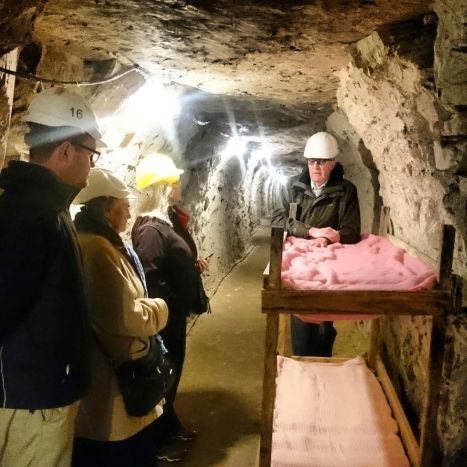
Today you can go on a guided tour through some of the tunnels. The makeshift accommodation set up as it had been during the war. Some people really made themselves at home. The beds that were used for the children are still in-situ.

the ramsgate tunnels

beds line the tunnels…pretty much as it would have been during WW2

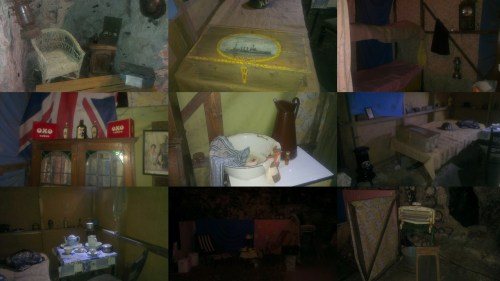
with a wonderful array of artefacts from that era and beyond. It was quite something to learn that most of the artefacts used in the displays belonged to Simon’s grandmother…..(Simon is the daughter’s boyfriend).  My daughter found it quite extraordinary that they have such an amazing and tangible link to their family history.

the ramsgate tunnels

this trunk belonged to a family member

After exploring the tunnels as far we were allowed to go, we went back to the main entrance and viewed an air-raid shelter; these flimsy metal flat-pack shelters that had to be built and installed by the residents in their own back-yards.

the ramsgate tunnels

Imagine how chilling it must have been to hear the air-raid sirens and know that an air-attack was imminent

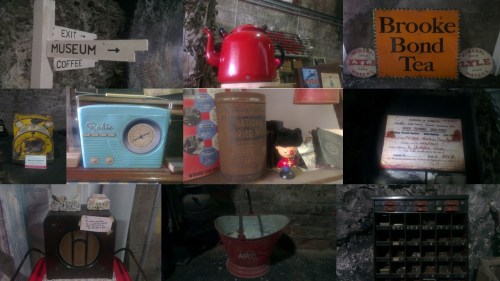
Besides that there are some amazing props and rusting bits of this and that that have been used as props through out the tunnels.

the ramsgate tunnels

some wonderful props make the area most interesting

Not sure what era this fellow is from but he sure looks good 😉

the ramsgate tunnels

….a horse and carriage for a marriage perhaps? 😉

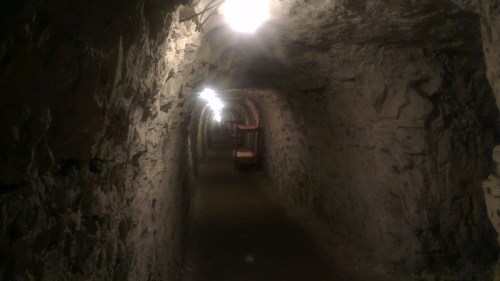
The bomb-proof deep shelter tunnels were dug in less than 9 months. More than 1,000 people erected makeshift homes in the vast 150 year-old railway tunnel.

the ramsgate tunnels

2 miles of tunnels could accommodate 60,000 people.


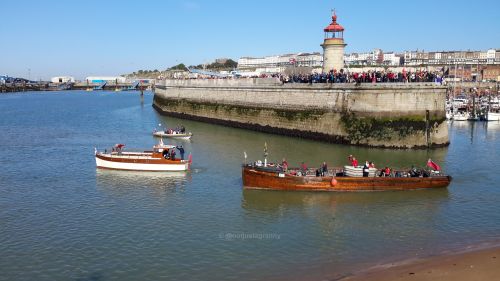
I can highly recommend a visit to the Ramsgate Tunnels; a unique opportunity to take a glimpse into Ramsgate’s heritage and ability to survive through the darkest period of World War II….. Ramsgate is a Royal Harbour and located on the east coast of Kent, on what was once the Isle of Thanet.

20150521_080936 - walk to ramsgate

Ramsgate Harbour for the Dunkirk little ships anniversary event in 2015

Read Full Post »

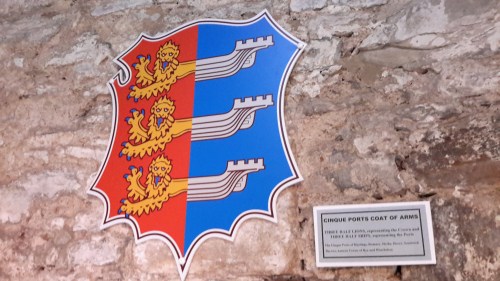
My sister thought it would be a great place to celebrate her birthday, her first in the UK and it was on my list of places to go in my quest to visit all the Cinque Ports; Dover, Hastings, Hythe, New Romney and Sandwich and their ‘7 surviving limbs’: Deal, Faversham, Folkstone, Lydd, Margate, Ramsgate and Tenterden.

Rye, now classified as an ‘ancient town’ was once a Cinque Port as was the ancient town of Winchelsea (of those listed, I have yet to visit those not highlighted)…. Places to go 😉

As mentioned in an earlier post my sister’s initial plan had been to visit the Isle of Wight but after reading an article about Mermaid Street in Rye, the decision was made to spend a few days in this ancient of towns. The first thing we discovered is that the cobbles in Mermaid Street were laid in the 1600’s!!

why go to rye

imagine all the history these cobbles have seen….

History that’s right up my street, so to speak 😉 How could I not want to go there. And so our plans were laid.

Initially there were meant to be four of us, but my sister’s two friends pulled out and so it was just the two of us…that reminds me of a song….LOL But let me not digress, Rye awaits.

We decided to arrive the night before so as to be in the town on her birthday…great idea! I had the hotel tie balloons to her chair for breakfast and persuaded them to put candles onto her breakfast plate!

Where will we put the candles they asked? Oh stick them in the sausage, I replied (as I crossed my fingers and hoped she ordered a full-English) – she did and to her surprise the breakfast arrived with 5 flaming candles!!! accompanied by a fantastic rendition of ‘Happy Birthday’, if I may say so myself 😉

So those were our reasons; here are the reasons you should go!

Ancient history: Rye’s history dates back to before the Norman Conquest at which time it was a small fishing village almost surrounded by water. Since then, the sea has retreated and although there is still a small harbour and a river, the town now lies 2 miles from the sea. Fascinatingly the river is affected by the tides, so it’s fun to watch the ships and boats moored alongside rise and fall on the incoming and outgoing tides. I know – it’s the little things that please me!

why you should go to rye

old fishing boat in Rye Harbour on the Rother

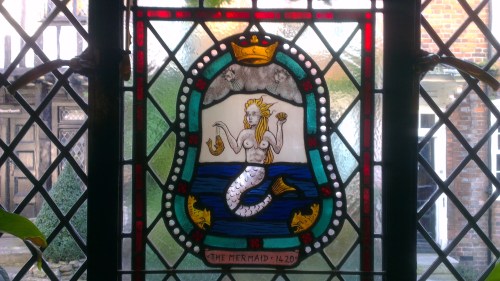
Mermaid Street: listed as one of the prettiest streets in Britain, this quintessentially English street is lined with amazing architecture; the Mermaid Inn, a Grade II* listed building – one of the oldest inns in Britain; restored in 1420 (hello!! note it was ‘restored‘ in 1420!!),

why go to rye

The Mermaid Inn, Rye – restored in 1420

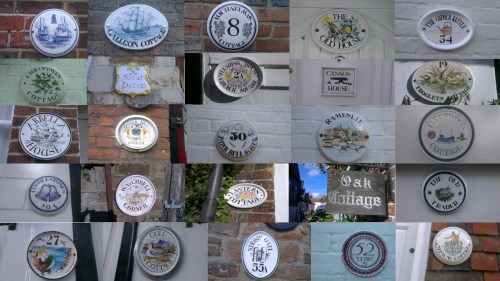
sits comfortably alongside extraordinary Tudor Houses, gorgeous Georgian Houses and a mix in between, bearing some of the most quintessential house names you could imagine, in fact the house names in the whole town were just wonderful.

why go to rye

House names in Rye

We found the street utterly enchanting and spent ages photographing just about every house. The cobbles lend a charming aspect to the atmosphere of stepping back in time and you feel as if at any time a pilgrim could come slowly by, followed perhaps by a knight on his horse or maybe a royal entourage on it’s way to the inn….talking of which, you simply must step into this gem of a building. Oh the history!! It’s extraordinary and I would love to spend a few nights there!!

why you should go to rye

Mermaid Street in Rye

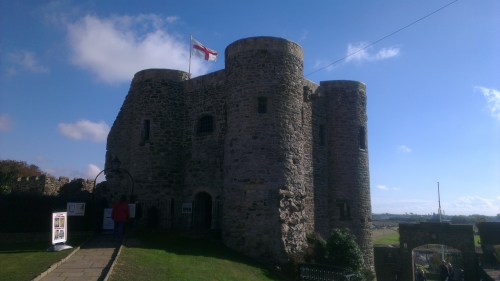
Rye Castle Museum and Ypres Tower: there is something quite spine-tingling when you turn a corner and discover a castle!! My jaw dropped…just wow!!

why go to rye

Rye Castle; Ypres Tower

Thought to have been built in the early 14th century, Ypres Tower (Rye Castle) was part of the town’s defences and the 2nd oldest building in Rye. Although not as big as some castles I have visited before, Ypres Castle is beautiful. Explore the building to discover the Tower’s role through 9 turbulent centuries. Climb to the battlements for a view of the salt marshes and the remains of what during the 16th century was one of the largest and 7th busiest port in England. The views are to die for!!

why go to rye

the view from the battlements of Rye Castle

Head below ground to the dungeons and try your hand at archery! It’s not as easy as it looks in the movies and the swords are rather heavy!! There are some helmets you can try on for fun 😉 We made ourselves look quite silly. while you are there be sure to visit The Women’s Tower; a 19th century prison (believed to be the only women’s prison to survive unaltered from the 1800’s to the present day), the Medieval Herb Garden and the gun garden.  At 3 East Street in Rye and just a short walk from the castle is the Museum where you will find an eclectic and fascinating collection of relics from Rye’s past; costumes, toys, pottery, shipbuilding, an ancient fire-engine and so very much more.

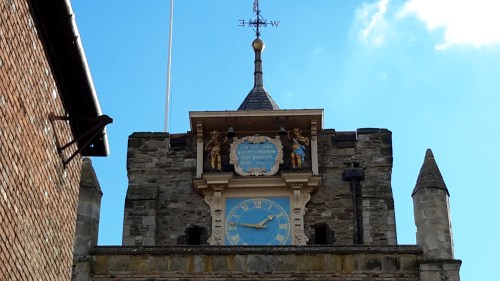
St Mary’s Church; the oldest building in Rye; the Parish Church of Rye has, for 900 years, dominated the hill on which this ancient town stands. Sometimes called the ‘the Cathedral of East Sussex’ the building of the present church was started in the 12th century.

why go to rye

The fantastic 16th century clock at St Mary’s Rye

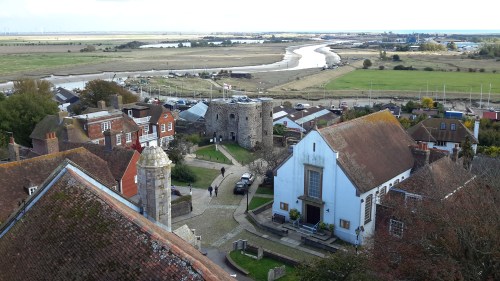
In 1377 the town was looted and set on fire, the church suffered extensive damage causing the roof to fall in and the looters carried the bells off to France – not taking this lying down, the following year, the men of Rye and Winchelsea set sail for Normandy, set fire to and raided two towns and thus recovered the bells. Today you can climb the battlements and be amazed at the fantastic views of the surrounding town and countryside  and Romney Marshes from the tower.

why go to rye

view of Rye Castle and the River Rother from the battlements of St Mary’s

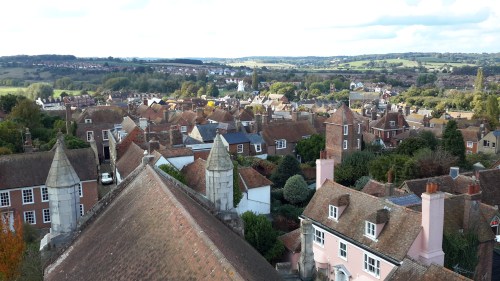
20161022_140709

view across the roofs of Rye and the windmill in the distance

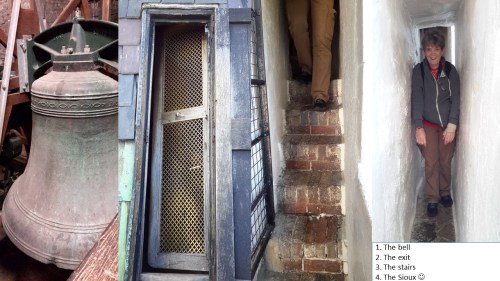
On your way up, beware the bells – they bong on the hour and could damage your ear drums (ask my sister who stuck her head above the parapet just as the bells gonged the hour for 2pm!! She nearly fell off the steps in shock. One of the oldest church turret towers in the country still functioning, the ‘new’ clock made by the Hugenot, Lewys Billiard, was installed in about 1561/2. You can see the pendulum swinging as you enter the church. Do note that the stairway leading to the tower’s viewing platform are VERY narrow!! LOL.

why go to rye

Sioux and The Bell!!


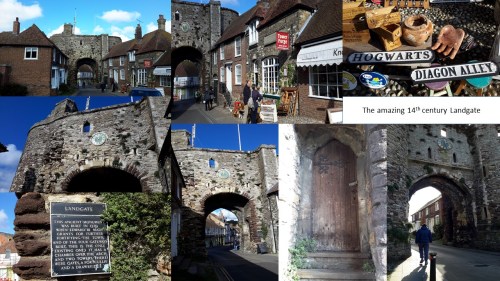
The Landgate Tower: What a startling discovery!! I had seen it listed on the town map the hotel gave us, but that didn’t prepare us for the reality. Again we stumbled upon this ancient treasure quite by accident whilst meandering the streets and couldn’t forsake a closer look. After the French attacked the town in 1339 burning 52 houses and a mill, the Mayor and town corporation decided to build town walls and gates. They received a grant from the King; Edward III and got busy building walls and 4 gates.

why go to rye

The Landgate

The Landgate dates from about 1340. Of the original 4 gates, this is the most complete remaining. Touching the stones that make up this amazing structure gives me goosebumps. Just think about the history and the people this gate has seen…as they say: if walls could talk. There’s a delightful antiques shop right next to the gate and just beyond the gate is ‘Crepes on the Corner’ – the best crepes in town..and they were. I had Nutella and banana…delicious!!  There are glimpses of one of the other gates; Strandgate, incorporated into the Old Borough Arms Hotel at the bottom of Mermaid Street.

The Windmill:  We had seen this marvellous structure the previous day and on our way to Mermaid Street we decided to ‘pop in’ and have a look. I adore windmills, they add such a sense of history and mystery to a place….you feel almost compelled to go have a look. The distinctive and famous Rye Mill is a Grade 2 listed building and has been the inspiration for artists and photographers throughout the centuries. It occupies an historic site in Gibbet’s Marsh where a windmill has stood, in one form or another, since at least the sixteenth century. The Symondons map of Rye created in 1594 shows an illustration of a windmill in the exact spot where today’s mill now stands.  Now a B&B, we had a quick peek at one of the rooms. Located over the railway line and right next to the river, it’s charming and I can assure you that I am so going to stay there some day in the future.

why go to rye

The Rye Windmill

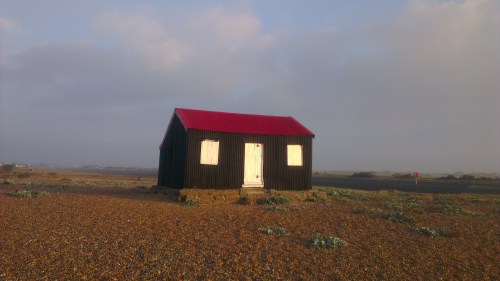
Rye Harbour: classified as a village, this tiny cluster of houses, jetty’s and buildings relative to a harbour are a delight to see. One of the most recognised images is an abandoned fisherman’s hut; black walls, a red tin roof with white painted windows and door that look like a face, stands almost halfway between the harbour and the river mouth.

why go to Rye

the old fisherman’s hut in Rye Harbour Nature Reserve

Rye reached the zenith of her power during the 16th century and at any one time there could be 200 ships anchored near the Strandgate – handling every kind of cargo from around the world. The largest and busiest port on the south coast during Tudor times due to it’s proximity to the continent, Rye’s harbour was more important than Portsmouth or Southampton. Although still a busy fishing harbour, today there are but just a few glimpses left of the original Rye Port, and to reach anything that resembles a harbour requires a short drive from the town to Rye Harbour – a drive well worth taking.

why go to rye

Rye Harbour

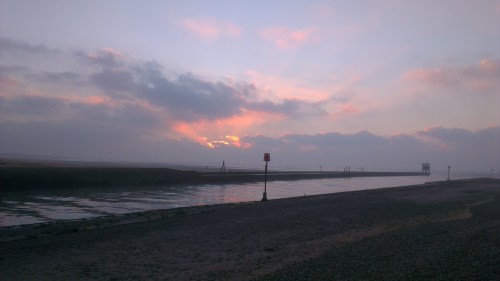
The harbour borders onto the nature reserve which is marvellous to walk through of an early morning.  The decline of Rye’s harbour was ultimately caused by the silting up of the river. Silt carried by the incoming tides stayed and settled in the bottom of the river leaving a film of silt which finally made the river un-navigable for ships. Today you can walk along the gravel road that runs between the salt-marshes and the river to the pebbled beaches. Perfect at sunrise.

why go to Rye

The River Rother flows down to the sea…

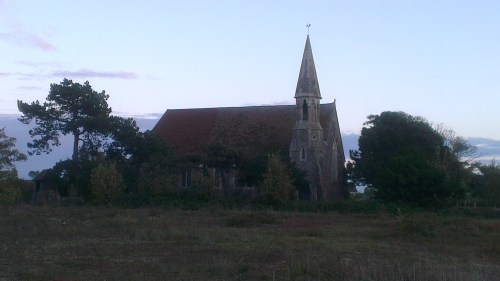
Rye Harbour Church: as you drive towards Rye Harbour and Nature Reserve, look to your right for a glimpse of this beautiful little church. Built in 1849 in the gothic style, the church of the Holy Spirit was designed by Samuel Sanders Teulon and constructed of local blue stone and Caen stone. Support for the construction of the church came from local estate owners; Mr & Mrs William Lucas Shadwell. In the churchyard is a memorial commemorating the 1928 Mary Stanford Lifeboat tragedy when 17 crew members lost their lives.

why go to Rye

Rye Harbour Church

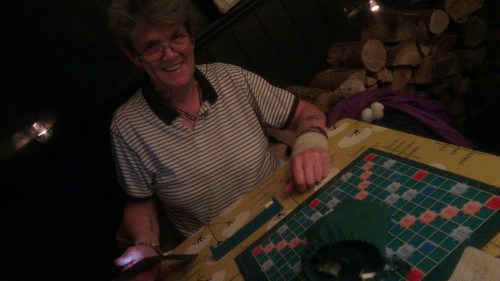
Pubs: as with all towns like Rye there is always a church and those quintessential essential necessities of community life; the pub!  😉  We managed to eat at two and have drinks in one. On our first night in Rye, after exploring the lower reaches of Mermaid Street and surrounding area, we stopped at the Ship Inn for a yummy meal. A congenial location we enjoyed the atmosphere so much we tarried awhile and played a game of scrabble.

why go to rye

a game of scrabble at The Ship Inn

I love how you can do that. The pubs in the UK (and Ireland) are more like family gathering places than drinking houses.  For our 3rd night in Rye we booked to eat at the Ypres Castle Inn, a 17th century pub nestled at the foot of the castle! Accessed down a steep flight of steps the lamps cast an inviting pool of light for a weary, hungry traveller. As you walk down the steps you will find an ancient set of ‘stocks’ used for the naughty people of Rye LOL. We enjoyed a most delicious meal there; for my sister it was the Lamb Hot Pot and for me Battered Cod (the biggest piece of fish I have ever been served), delicious chips and mushy peas.  Although we didn’t tarry for long, it wasn’t due to the ambiance which was lovely. We had in fact both walked ourselves stupid that day exploring every corner and Lydd, and were exhausted by the time we had our meal. The staff were lovely.

why go to rye

the history of 4 inns in Rye

The streets of the medieval town: Rye is quite simply the picture perfect place to meander.  We set off just after breakfast on Saturday to explore and photograph Mermaid Street more fully…..5 hours later and we were still meandering.

why go to rye

Rye architecture

What an extraordinary array of cobbled streets, lanes and alleyways leading hither and thither, quaint houses line the cobbled streets up and down, each an enchanting delight. Every corner we turned opened up to more delights; with an “oh my gosh”, or “ooooo look there!” from me and a laugh of bemusement from my sister as my constant “okay, just one more corner” eventually turned out to envelope almost the whole town.

why go to rye

Rye, a gem of South East England

There are 15th century inns, Tudor houses, the Vicarage where John Fletcher, the Jacobean dramatist, was born in 1536, the Old Rye Grammar School erected in 1636, the old water tower next to the church and so very much more to see.

And last but not least: the three rivers – Rother, Brede and Tillingham.

why go to rye

Three rivers of Rye

The River Rother flows down to the sea….This is the river along which we meandered in the morning and the evening for photos. Used for navigation since Roman times, the river is navigable by small boats as far as Bodiam Castle. With it’s source near Rotherfield and it’s mouth in Rye Bay, the river flows for 35 miles through the English counties of East Sussex and Kent. Its mouth was further to the east at New Romney prior to 1287, but a great storm blocked its exit to the sea and changed its course to flow via Rye.

The River Tillingham rises from two springs near Staplecross, a small settlement in the Parish of Ewhurst in East Sussex and joins the Brede and Rother at Rye.

The River Brede takes its name from the Village of Brede which lies between Hastings and Tenterden. It flows into Rock Channel which is the tidal section of the River Tillingham and joins the River Rother at Rye.

With tales of sailors’, smugglers, storms, ships, seas and derring do, of pilgrims and kings, heroes, dramatists, writers, and a nursery rhyme, you simply must visit Rye!

Little Bo Peep has lost her sheep! – According to legend, this well-known nursery rhyme derives from the deeds of smugglers in the town of St Leonard’s.  West of Burtons St. Leonards is the area known as Bo-Peep which was once a tiny village renowned for smuggling in bygone days:

why go to rye

One of 4 Smuggler gangs that operated in the area of Rye

           Little Bo-Peep has lost her sheep and doesn’t know where to find them;                                                      leave them alone, And they’ll come home, wagging their tails behind them

Little Bo-peep fell fast asleep, and dreamt she heard them bleating;
but when she awoke, she found it a joke, for they were still a-fleeting.
Then up she took her little crook, determined for to find them; she found them indeed, but it made her heart bleed, for they’d left their tails behind them.
It happened one day, as Bo-peep did stray into a meadow hard by,
there she espied their tails side by side, all hung on a tree to dry.
She heaved a sigh and wiped her eye, and over the hillocks went rambling,
and tried what she could, as a shepherdess should, to tack each again to its lambkin.

Rye is a real gem of England; playing a very important role in the history of the country, remnants of which can still be seen today.   It’s pictureque, charming and an absolute delight to explore. We loved it!

why go to rye

Originally, the Cinque Ports (pronounced ‘Sink’ Ports) were a confederation of five harbours, Sandwich, Romney, Dover, Hythe, and Hastings plus the two Ancient Towns of Rye & Winchelsea. Grouped together, for defence purposes, by Edward the Confessor, they supplied the Crown with ships and men.


Interesting links:

What are Cinque Ports?

http://www.ryemuseum.co.uk/home/ypres-tower/

http://www.faversham.org/history/maritime.aspx

Read Full Post »

My daughter and I went to Bleak House on Saturday afternoon for a Cream Tea and to tour the Smugglers Tunnels beneath the house…Bleak House was once known as Fort House and Broadstairs was a hotbed of smuggling with many notorious smugglers once captured,  being deported to Australia.

smugglers tunnels and afternoon tea at Bleak House

If you wake at midnight and hear a horse’s feet, Don’t go drawing back the blind, or looking in the street…

In 1723 Daniel Defoe wrote of a visit “Broadstairs is a small fishing village of 300 souls, of which 27 follow the occupation of fishing…” You can surmise therefore that the rest were gainfully ’employed’ in other businesses…..in fact, beneath much of Broadstairs is a warren of smugglers tunnels, mostly closed off now. Oh how I’d love to have access to those tunnels 🙂

afternoon tea and smugglers tunnels at bleak house

This chap had been ‘redcapped’ for being an informer, as lucrative a business as smuggling, with the possibility of a £500 reward for information.

‘Redcapping’ – A Revenue Spy who broke the smuggler’s unwritten law were dealt with in different ways. The Informer would be staked out on the beach at low tide with a RED LANTERN by his head. The smugglers would then watch to see that the spy was not released till the lantern had gone out.

Broadstairs is located on the east coast of Kent on what is/was known as the Isle of Thanet; an island 2 miles out to sea – the water separating the island from the mainland known as the Watsum Channel. After the channel silted up, the land which includes Margate, Broadstairs and Ramsgate is now part of Kent  County.

The Romans considered the Watsum Channel very important and built forts at Reculver and Richborough to protect it. In 449 The Vikings (after which the little bay is now named), under Hengist, landed at Thanet, rowed up the Watsum Channel and attacked Canterbury.

Broadstairs is just filled to the brim with history. Since Roman times and the Vikings Broadstairs has seen the likes of Wellington’s troops camped out and Napoleon’s Standard was presented here in 1815 after the British won the Battle of Waterloo. Charles Dickens lived in Broadstairs on numerous occasions and one of the most well-known is Bleak House where he wrote much of David Copperfield. As part of the tour we were able to visit the study where he sat and wrote while gazing out the windows across the English Channel.

smugglers tunnels and afternoon tea at Bleak House

the desk where Charles dickens sat and wrote David Copperfield

Previously known as Fort House, Bleak House, as it looks now, was remodelled in 1911. We’ve been there a number of times for Cream Tea but this time we decided to explore the smugglers caves beneath. Absolutely awesome.  I’m guessing that since the land is chalk it was pretty easy to tunnel away and create the caves and Smuggler’s tunnels. The chalk cliffs extends all the way from the Thames estuary as far as the White Cliffs of Dover and thence to the Isle of Wight.

smugglers tunnels and afternoon tea at Bleak House

smugglers tunnels and a cream tea at Bleak House

The Cream Tea (which is what we normally have) is delicious and the scones are fresh and yummy. I can recommend a visit to Bleak House for tea and do be sure to include the tour of the tunnels and Dickens’ study…at £4 per person for the tour, it’s a steal 😉  Although you can order the Cream Tea on a whim…NB if you wish to partake of the Afternoon Tea at Bleak House you would need to book in advance.

Read Full Post »

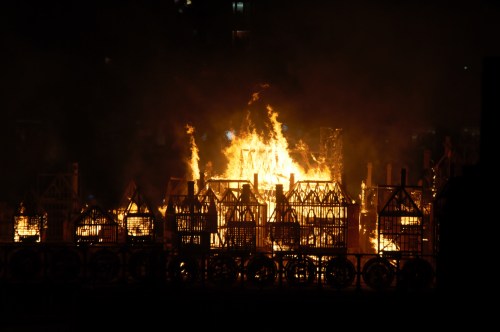
….could there have been a more terrifying way to waken, on what was perhaps a chilly autumn morning, that day, September 2nd, 1666 than to the words of Fire! Fire!! London’s Burning

OLYMPUS DIGITAL CAMERA

autumn

– except perhaps to the news that the French were invading…..or was it the Roman Catholics….

20160903_132935-copy

The French

20160903_133852

or perhaps Roman Catholics

“The ignorant and deluded mob, who upon the occasion were hurried away with a kind of frenzy, vented forth their rage against the Roman Catholics and Frenchmen, imagining these incendiaries (as they thought) has thrown red hot balls into the houses.” William Taswell.

…..they weren’t; it was just a rumour!

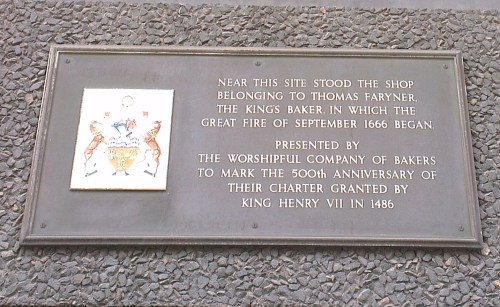
In the early hours of September 2nd, on Pudding Lane, at the premises of the Baker to the King; Thomas Farriner, an untended coal flared up…perhaps teased by a whisper of a breeze, just enough to kindle the embers of the bakers oven.

1-plaque

Pudding Lane

Within a few hours the fire had built and all too soon, while Londoner’s and foreigner’s slumbered still, the flames jumped and ran….

From the Diary of Samuel Pepys – Sunday 2nd September 1666

About seven rose again to dress myself, and there looked out at the window, and saw the fire not so much as it was and further off. By and by our Jane comes and tells me that she hears that above 300 houses have been burned down to-night by the fire we saw, and that it is now burning down all fish-street, by London Bridge. So I made myself ready presently, and walked to the Tower, and there got up upon one of the high places, and there I did see the houses at that end of the bridge all on fire, and an infinite great fire on this and the other side the end of the bridge. So down, with my heart full of trouble, to the Lieutenant of the Tower, who tells me that it begun this morning in the King’s baker’s house in Pudding-lane, and that it hath burned St Magnus’s Church and most part of Fish-street already. So I down to the water-side, and there got a boat and through bridge, and there saw a lamentable fire. Everybody endeavouring to remove their goods, and flinging into the river or bringing them into lighters that layoff; poor people staying in their houses as long as till the very fire touched them, and then running into boats, or clambering from one pair of stairs by the water-side to another.

A trivial beginning that soon turned into a raging inferno, the city was soon ablaze and word went out that London was burning. The Mayor of London, one (fairly dimwitted) Thomas Bloodworth was unperturbed and reckoned ‘a woman could piss it out’….his words came back to bite (burn) him in the bum and by the time the hapless creature realised the extent of the inferno, it was too late to save the city!

Samuel Pepys climbed the steeple of Barking Church (All Hallows by the Tower) to view the fire.

“There was the saddest sight of desolation that I ever saw. Everywhere great fires. Oyle-cellars and brimstone and other things burning. I became afeared to stay there long, and therefore down again as fast I could.” Samuel Pepys.

Alerted by Samuel Pepys as to the extent of the disaster unfolding, by 3pm on that fateful day, King Charles II, accompanied by his brother, James, Duke of York, sailed down the Thames to observe the fire, and immediately gave orders to “pull down buildings to create a fire break.”imag9178

From that luckless Sunday till the following Thursday the flames leapt and bound from dark narrow lanes to streets and courts,

“The streets full of nothing but people and horses and carts loaden with goods, ready to run over one another, and removing goods from one burned house to another.” Samuel Pepys, describing the city on the Sunday evening.20160904_151911

fanned by an east wind….torching wooden houses and stone buildings.

20160902_170756

John Evelyn; 3 September 1666

And as it burned the flames destroyed 13,200 houses, 44 Livery Halls, numerous warehouses along the banks of the Thames crammed with combustible materials; coal, tar, pitch, hemp, rosen and flax (ropes), Baynard’s Castle, the Great Conduit

and four bridges within the city as well as razing 87 medieval parish churches to the ground. Weirdly, the house of Samuel Pepys in Seething Lane remained standing….

Much terrified in the nights nowadays, with dreams of fire and falling down of houses. Samuel Pepys.
copyright John Yabbacome

Samuel Pepys’s house perchance? copyright belongs to John Y

Even that most holy of churches was not left unscathed, and St Paul’s, which had stood at the heart of London life for over 500 hundred years, the 4th cathedral to stand on this spot since 604AD,

20160902_171404

Old St Paul’s Cathedral – the medieval church destroyed by the Great Fire of 1666

was consumed in the inferno, it’s roof melting in the heat,imag7697 causing molten lead, “glowing with fiery redness” to run in streams down Ludgate Hill. On Tuesday, September 4th, a combination of factors caused the building to burn with great ferocity; which catastrophic blaze consumed the cathedral….

copyright John Yabbacome

Old St Paul’s Cathedral – copyright belongs to John Y.

“Thus lay in ashes that most venerab[l]e Church, one of the [antientest] Pieces of early Piety in the Christian world, beside neere 100 more.” from the Diary of John Evelyn; September 7th 1666

….little did he know it then, but up and coming architect, Christopher Wren was just about to be given the biggest opportunity of his life….the rebuilding of the City of London churches, and St Paul’s Cathedral, his masterpiece that took 35 years to build!


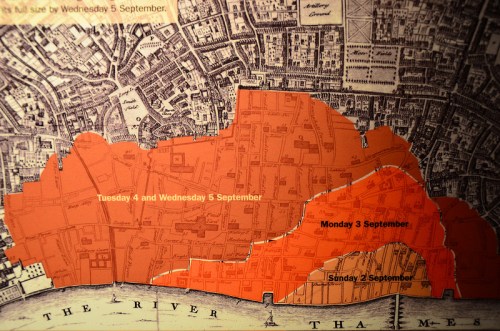
The fire burned for just under five days, devastating the City, from Tower Hill in the East to Chancery Lane in the north, it swept westwards as far as Inner Temple Hall on the 4th day, which burned to the ground, and by some miracle it burned out before consuming Temple Church.


From the diary of John Evelyn – Tuesday September 4th, 1666

The burning still rages, and it was now gotten as far as the Inner Temple; all Fleet-street, the Old Bailey, Ludgate Hill, Warwick lane, Newgate, Paul’s chain, Watling street, now flaming, and most of it reduced to ashes; the stones of St Paul’s flew like (grenades), the melting lead running down the streets in a stream, and the very pavements glowing with redness, so as no horse nor man was able to tread on them, and the demolition had stopped all the passages, so that no help could be applied. The eastern wind still more impetuously driving the flames forward. Nothing but the almighty power of God was able to stop them, for vain was the help of man.
copyright John Yaddacome

London’s Burning

Lost to the inferno were countless treasures; art, books and documents, many of which were held in the Livery Companies Halls – 44 of which were completely destroyed; amongst which were the Cutlers Hall, Mercers Hall, Merchant Taylors Hall, Saddlers Hall, Brewers Hall, Coopers Hall, Drapers Hall, Dyers Hall, Fishmongers Hall, Innholders Hall, Pewterers Hall, Stationers and Newspaper Makers Hall, Tallow Chandlers Hall

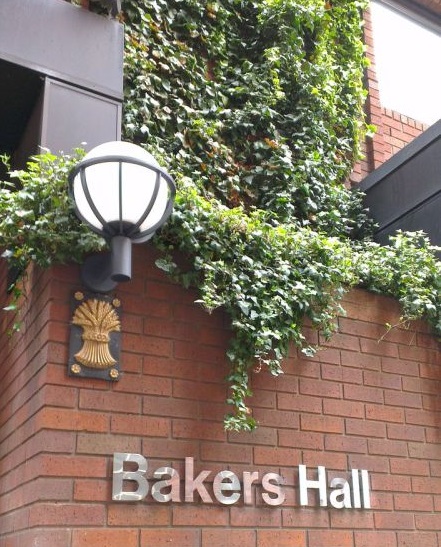
and to add a touch of irony; the Bakers Hall!! city-of-london-livery-companies-bakers-hall-2
“We walked and walked and found nothing but heaps of stones and cellars still full of planks and smouldering beams.” Francisco de Rapicani.

Only 8 Livery Company Halls survived the fire; Armourers, Bricklayers, Carpenters, Cooks, Glovers, Ironmongers, Leather-sellers, and the Upholsterers…..others were partially damaged or destroyed by the fire and some were rebuilt, only to be destroyed during WW1 and WW2.


After the 6 centuries over which the Medieval city of London had slowly built up, and just five days after a small fire which began in that bakery on Pudding Lane,

20160904_152318

Pudding Lane

the City of London stood in ruins, almost completely destroyed, and as he explored the ruined streets of London, John Evelyn described how the ground was still almost too hot to walk upon, how water in fountains still boiled, and how the iron bars and gates of prisons had melted.

20160904_152250

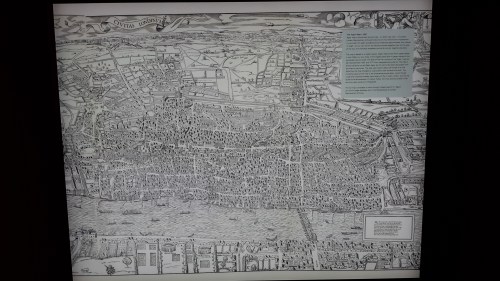
The Medieval City of London – Agas map

6 months later, on March 16th, 1667 – Pepys recorded “I did see smoke remaining, coming out of some cellars from the late great fire now about six months since “.

20160902_170554

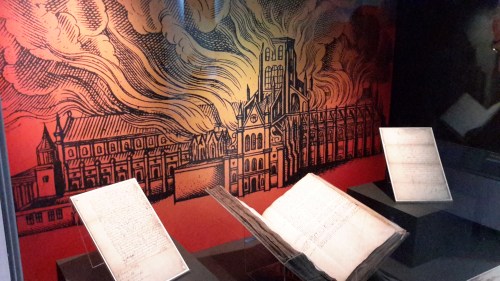
Great Fire of London 1666

By 1680 London’s first Fire Brigade came into existence, funded by the insurance companies, and the first publicly funded fire service was created in 1861, following the Tooley Street fire.imag7849

The Great Fire of 1666 was not by any means the first fire to rage through the streets of London, it was however the most devastating, and has perhaps the most detailed recordings by way of the diaries of Samuel Pepys, John Evelyn and others.

20160902_170634

Great Fire of London 1666

copyright John Yabbacome

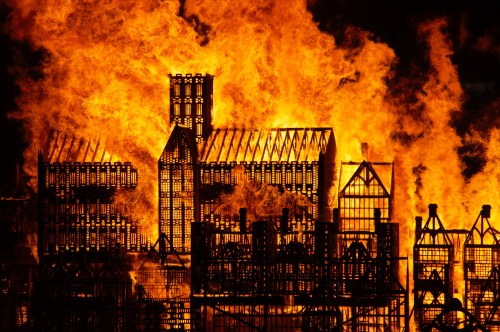
1666 – 2016 The Great Fire of London 350th anniversay

Below is a map showing the extent of the Great Fire of London 1666the-photo-at-the-top-of-this-article-is-by-ben-sutherland-used-under-creative-commons-2-0-license-attribution-it-is-a-map-prepared-by-the-museum-of-london

Footnote: The majority of the photos in this blog are mine. A young man, John Y, whom I met at the burning of the effigy on Sunday kindly sent me some copies of his photos…I have noted them as such. Furthermore, for the purposes of this blog I have ‘borrowed’ a couple of graphics and a map from google images.

Read Full Post »

20160423_161749 - 23.04.16 Dover Castle & Road Trip

Dover Castle and St George’s Day 2016

Having my birthday on the same day as St George’s Day certainly opens it up for attending amazing events.  No less this year.  Since I wasn’t in the mood for the long train journey to London to watch the Morris Dancers at Leadenhall Market, or attend the St George’s Day Festival at Trafalgar Square, (as well as which I’ve done that before a few times), I decided instead to head over to Dover Castle for the St George’s Day Festival. It also helped that I have an English Heritage membership 😉20160423_154929 - 23.04.16 Dover Castle & Road Trip

Dover is not too far from Broadstairs by train, so early on the morning of Saturday 23rd I hopped onto the train and made my way there. I’ve visited the castle before and ohmyword, it is extraordinary. England’s biggest castle, the size of the place leaves you breathless, both with wonder and physically! It takes a good few hours to explore all the nooks and crannies and walk the perimeter.  And there is so much to see.

20160423_115012 - 23.04.16 Dover Castle & Road Trip

The Constables Gate, Dover Castle. constructed 1220-1227

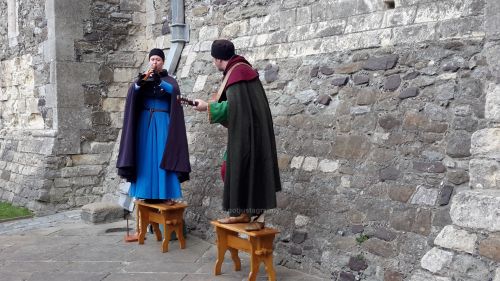
The blurb promised an action-packed knight vs dragon festival.  It didn’t disappoint. Starting at 10am the events ranged from horsemanship, swordsmanship and medieval music,

St Georges Day Festival Dover Castle

medieval musicians

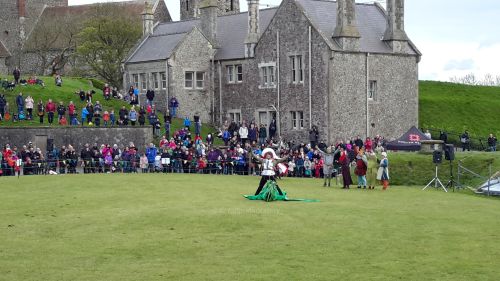
to a mock up village with craftsmen and women going about their medieval business.  We were treated to live cooking demonstrations, archery, swordsmanship displays, medieval music and jesters plying their trade.

I got there really early and made my way into the castle grounds, this time approaching from the top of the cliffs via bus, rather than walking up like I did the previous visit (insane idea).  Have you any idea just how high those cliffs are? You can see France from the top…hello!!!!

20160423_161448 - 23.04.16 Dover Castle & Road Trip

across the English channel to France

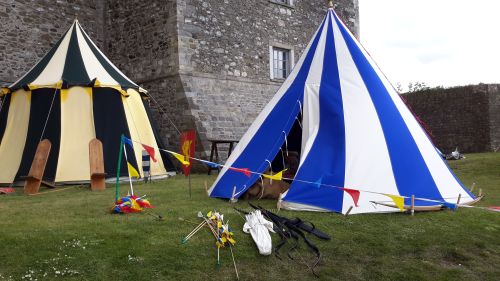
A cluster of medieval tents were set up here and there, and the villagers were chatting to visitors and demonstrating their trade and crafts. A colourful medley of sounds and colours – although I’m sure it smelt a lot more fragrant than it did during medieval times.

20160423_122613 - 23.04.16 Dover Castle & Road Trip

…medieval streets were most certainly not paved with gold!

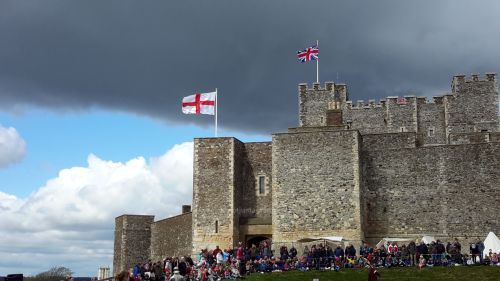
The costumes were beautifully done, flags flapping gaily in the ever present wind – which at times can almost blow you off your feet.20160423_123748 - 23.04.16 Dover Castle & Road Trip High above the castle keep, the flag of England with the cross of St George flapped wildly in the wind alongside the Union Jack.

20160423_121623 - 23.04.16 Dover Castle & Road Trip

St George’s Day Festival at Dover Castle

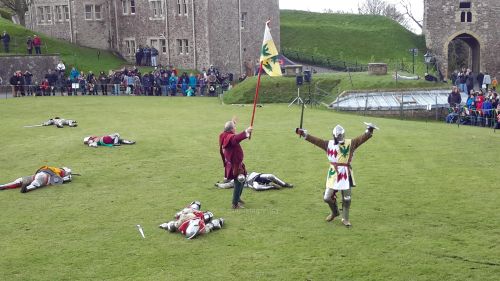
I meandered here and there, exploring the interior and precincts of the castle enjoying the different displays before settling down at the west end of the green to watch the displays of swordsmanship as knights in their armour valiantly fought one another.  They are marvellous, although it does look awfully tiring.

20160423_123605 - 23.04.16 Dover Castle & Road Trip

the knight’s fight

Afterwards I made my way to the jester’s encampment for what was to be an hour of sheer and unadulterated fun and silliness.  Whoever they were, they were fantastic. A lot of the quips were definitely aimed at the older generation, but the visuals and tricks appealed to all ages…I was laughing so much at one stage I could barely hold the camera still as I was recording.

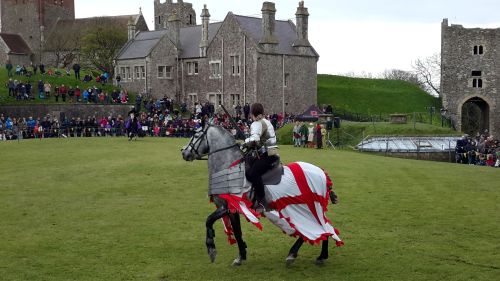
Then the coup de grace and finale; a titan battle between St George on his sturdy mount

St Georges Day Festival Dover Castle

St George on his trusty steed

and the fearsome dragon!!! LOL – right???!!!

This epic display filled the spectator stands (wet grass) as we waited breathlessly while St George fought off the evil Black Knight on his stallion….

St Georges Day Festival Dover Castle

The Black Knight and St George do battle

….before tackling the effervescent dragon. St George is his eagerness to slay the dragon raced up to the horrible green creature intent on murder!! His not so sturdy mount objected to the sudden halt, skidded on the wet grass, and reared up so high that St George’s rump met the ground with a thump!!

St George's Day festival at Dover Castle

St George lands on his rump with a thump!

The horse was retired, and on foot St George raced after the dragon, his armour rattling, wielding his mighty sword to rescue the virgin, and slayed the fearsome creature.  Hoorah! The battle was won.

St George's Day festival at Dover Castle

…and so the dragon is slewed!!! LOL

The weather as usual managed to provide 4 seasons in one day and we had a mix of sunshine, howling gales, a shower of rain and heavy black clouds that hung menacingly over the castle….threatening to lash down but not quite getting there. All we needed was a smattering of snow (not unheard of) and hail and we would have had a typical spring day in the UK. LOL

In all a brilliant day and superb way to celebrate my birthday. Thanks St George 😉 nice to have you on board.

I can highly recommend a visit to Dover Castle. It is by far one of the most awesome castles I have visited to date.  Mind you, to be fair, most of the castles I have visited are amazing…..all in their own special way.

Visit Dover Castle

St George is the Patron Saint of England

The horses used during the events were Atkinson’s Action Horses

You can reach Dover Castle via car, on foot (if you have the oomph to climb the hill), by bus from the city centre. The station is Dover Priory


Read Full Post »

I went to Windsor to see The Queen! 🙂  Yesterday was Queen Elizabeth II’s 90th birthday, and as soon as I discovered she was due to do a walkabout in Windsor I made my way there double quick.  Well not quite….I slept over in London at the YHA the night before 😉

IMAG3051 - HB QEII 21.04.2016

Chelsea Bridge and the Albert Bridge in the distance

I set off for London on the 18:57 train to Victoria Station, slept over at the Earls Court YHA, up and about by 6am on Thursday….and by 07:38 I arrived in Windsor. Thrilling stuff.

20160421_073826 - HB QEII 21.04.2016

The Queen: A full-scale replica of the GWR Achilles built in 1894. No examples of these locomotives survive and were withdrawn from service in 1912. This model is located on the platform of the station at Windsor Central

The reason I got there so early was to ensure I found a good space at the front…these events fill up pretty darn quick, but to my surprise there were only about 40 people ahead of me! I wandered about for a bit, checking out this spot and that, and then finally made my decision: it had to be facing the castle and it had to be in shade and I was hoping Her Majesty would walk down my side of the road….
20160421_074812 - HB QEII 21.04.2016

Not yet much of a crowd, but a few stalwarts were there as well as a group (the ladies in pink with the big pink 90 balloon) from Cardiff, who apparently left their city at 6am

I settled in and quickly made friends with the people around me. We chatted and swopped stories, where we were from and why we were there etc. We also had a very entertaining couple of hours people watching.
20160421_105601 - HB QEII 21.04.2016

See the lady directly in the middle with the British Flag glasses! She held court and entertained the crowds….an American lady, she was loud, forward and hilarious!!

One of the first people I saw was Carol Kirkwood doing a piece to camera for the BBC News

20160421_074639 - HB QEII 21.04.2016 - HB QEII 21.04.2016 (2nd set

our lass Carol Kirkwood doing a piece to camera for BBC News with a Town Crier watching on – this was at 07:46 in the morning 😉

and then Terry Hutt; one of The Queen’s lifelong fans.  When I saw Terry’s outfit I realised I need to up my game…. LOL

As the crowds swelled and the time drew near the level of excitement escalated. Suddenly we saw Joey!!! The horse from the play War Horse. That was an added thrill to the day.

20160421_100931 - HB QEII 21.04.2016

Joey; War Horse joins the celebrations

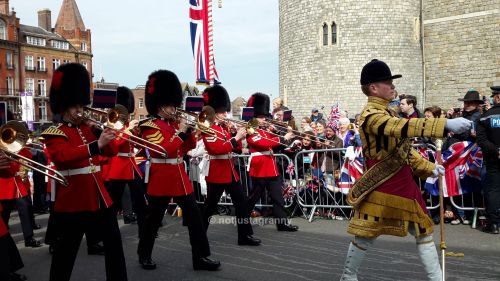
Then just before 11am the Coldstream Guards arrived for Changing the Guard in the castle grounds.

20160421_105747 - HB QEII 21.04.2016

The Coldstream Guards – Changing the Guard at Windsor Castle

They marched them up the hill, then marched them down again…..to just beyond the gates where they made themselves comfortable and played some stunning pieces of music…they really are very good.

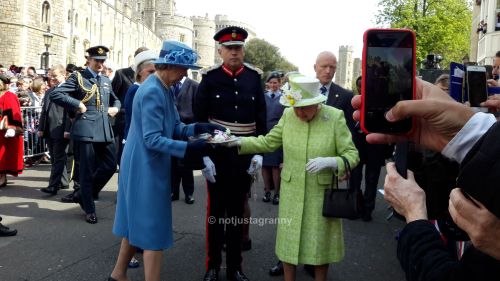
Then at 12noon and without further ado Her Majesty Queen Elizabeth II arrived in her smashing Bentley and stopped just before the welcome party. After being greeted by the Mayor(ess) and assembled guests, to my absolute delight I saw that Her Majesty was walking down our side of the road!!! OMG!!! Hoorah.

Then I started praying that she wouldn’t do her zag before she got to where we were standing, which would have given me the zig!!!

But she didn’t and I did get to see her – from just two feet away. If I wasn’t filming I swear I would have swooned with sheer excitement…..but you can’t interrupt a good opportunity to film The Queen by passing out in the street. LOL

20160421_120553 - HB QEII 21.04.2016 - HB QEII 21.04.2016 (2nd set

Looking fresh and sprightly in spring green – I loved her hat!!!

However, I did almost lose my footing….as she got near the crowd behind swooped forward and I was nearly knocked off my feet, almost dropping my camera in the process…the barrier suddenly felt very flimsy as it swayed with the weight of the crowd. It was a little bit scary, and I wasn’t impressed with that at all. However, we managed and my word the roar of excitement when she arrived…fantastic.

20160421_120550 - HB QEII 21.04.2016

the crowd surges forward….

She looked absolutely stunning in her spring green outfit with a perfect hat perched on top of those lovely grey curls, a gorgeous smile on her face for the whole time. Amazing woman.

20160421_120600 - HB QEII 21.04.2016 - HB QEII 21.04.2016 (2nd set

Her Majesty; Queen Elizabeth II born this day in 1926 at 21 Bruton Street in Mayfair

As soon as she made her zag to the opposite side of the road,

20160421_120610 - HB QEII 21.04.2016 - HB QEII 21.04.2016 (2nd set

The Queen makes her zag and away she goes to the opposite side of the road

my companion (someone I got chatting to whilst waiting), and I ran down the side alleys to the Guildhall hoping to spot the birthday girl before she left on her ride around the city.  While at the Guildhall she met other people who were 90…how cool is that!  Mind you, in comparison to some of my clients, many of whom are a lot younger than HM, she is blooming marvellous and certainly very sprightly.We were in luck, the crowds hadn’t yet swelled to bursting point and I had a great view of the steps where she was due to walk down to her open-topped car.

20160421_123236 - HB QEII 21.04.2016 - HB QEII 21.04.2016 (2nd set

Standing in their open-top car they set off for the car route through the city

We were all amazed to see The Queen and Prince Philip actually standing in the car as they set off.  They waved and smiled as the car pulled out and then we ran helter-skelter to the back entrance of the castle, again ahead of the crowds and had a fab view of them returning. They had by that stage sat down in the car, but I still managed one final photograph…..

20160421_124521 - HB QEII 21.04.2016 - HB QEII 21.04.2016 (2nd set

arriving back at Windsor Castle by a rear entrance

What a splendid day. I have seen the Queen a number of times, but always from afar. Usually at Trooping the Colour or other such events, and once we saw her up close and personal in Cape Town the last time she visit South Africa in the 1990’s. At that time she also went walkabout, but did her zag just three people before she reached where we were standing and I remember how devastated I was then that I hadn’t got to shake her hand…she still used to shake the hands of people in the crowd in those days….but sadly I didn’t and although I didn’t get to shake her this time either, she was so close I could have kissed her!!

20160421_135730 - HB QEII 21.04.2016

Wishing Her Majesty a wonderful 9oth year, and Long May She Reign!!

20160421_132536 - HB QEII 21.04.2016God save our gracious Queen!
Long live our noble Queen!
God save the Queen!
Send her victorious,
Happy and glorious,
Long to reign over us,
God save the Queen.


Other people I got to see on the day

After the event I went walkabout myself and had the luck of seeing the band returning to base

Then it was a quick trip back to Broadstairs (3.5 hours!!) to watch one of 1,000 beacons lit in the U.K. and around the world in honour of her birthday.

The Queen lit hers at Windsor Castle at 7p.m.

20160421_130327 - HB QEII 21.04.2016

The first beacon to be lit by The Queen at Windsor Castle

In all a fantastic day……I guess I am a confirmed Monarchist…and a Royalist. Fact: I love The Queen. She has been the one constant in an ever changing world. She is a great example of a good Monarch. I just read this terrific article you may enjoy.20160421_133700 - HB QEII 21.04.2016

Read Full Post »

Last weekend on one of my breaks I had the use of the car…..since I’m working tantalisingly near to Hampton Court Palace, I simply had to visit. It really is my absolute favourite palace in London and despite having visited dozens of times in the last 5 years, I never get tired of another.

IMAG2097 - hcp 2016

how can you fail to be impressed

It gives me a thrill to walk through the halls and along passageways where people like Wolsey, Cromwell, Henry VIII, Anne Boleyn, Elizabeth I, George I to name but a few of history’s famous and notorious characters walked centuries before.

IMAG2176 - hcp 2016

in the footsteps of history…

IMAG2099 - hcp 2016

the first thing you see as you enter through the main gate

IMAG2104 - hcp 2016

Base Court

IMAG2113 - hcp 2016

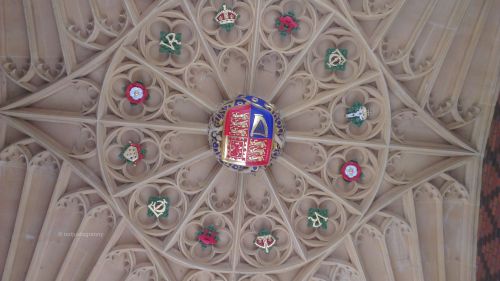
the magnificent ceiling above The Queen’s Staircase

IMAG2120 - hcp 2016

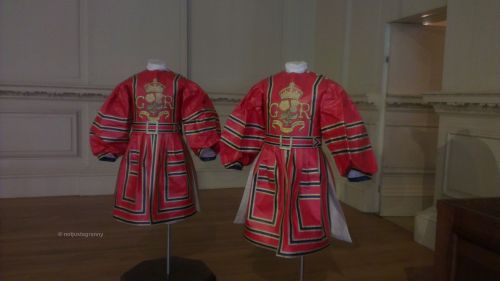
Yeoman Warders uniforms

IMAG2122 - hcp 2016

fine dining with the Georgians

IMAG2127 - hcp 2016

exquisite fashions of the Georgians

IMAG2134 - hcp 2016

the ceiling of Queen Caroline’s State Bedchamber

IMAG2157 - hcp 2016

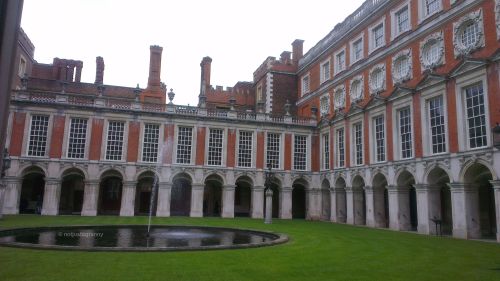
Fountain Court; the Tudor Palace peeks above the Georgian Palace built by Christopher Wren

IMAG2179 - hcp 2016

The Moat. I remember a couple of years ago when we had those terrible floods, the moat was full of water. It looked quite amazing actually.

Hampton Court Palace is a treasure house.

Read Full Post »

On the cusp of my Naturalisation as a British Citizen I have stopped to take stock of the places I have been in my life as a Carer since 2007.

IMG-20160213-WA0014 IMG-20160213-WA0015

The places have been as varied as the clients. I have travelled far and wide in the UK; the places shown here do not include the many many other countries, cities, towns and places where I have been on holiday, since I arrived in 2001.

One of the benefits of my job as I’ve mentioned before is that I get to travel around the country…not just in England but Scotland and occasionally Wales too. Since 2007 I’ve travelled east, south, north and west of the UK with the current agency.

z cities

Cities I have worked in

In that time I’ve pretty much been to nearly every county in England (21 at last count), and 3 in Scotland and over the border, then out again, but never yet worked in Wales. I’ve yet to work in Northern Ireland although I have been on holiday. I haven’t included in my list the countries/counties/places I’ve been to on holiday that would just be too long…..but those listed below are all the places I have been since 2007. I’ve created a video out of some of the photos I’ve captured in the last 8 years+, albeit not all the places I’ve been to; I’ve worked for almost 300 clients, so that would be a tad too much!!

z london

London! I always jump at the chance to work in my favourite city

At my current assignment I’m working in East Sussex, not for the first time, but in a new place. I was chatting to my client just yesterday while we were sharing travel stories (she’s also quite well travelled), and just for fun I had a look at the map of Britain and listed all the counties I had either worked in, or travelled to during the course of my job…..i.e. some clients enjoys driving so we get to travel far and wide. Needless to say I do the driving 😉

z seaside towns  2

seaside towns I have been to and worked in

I’ve worked on farms and been to villages so small that they don’t even have a Post Office never mind a traffic light or stop street, where the evening traffic jam is sheep going home! I’ve worked in numerous towns, and quite a few cities…namely London of course…I always jump at the chance to work in London although I’m not sure why since my breaks are so short I seldom get time to do much exploring…but still it’s a constant thrill to me to wake up in the city that never sleeps. (most areas I’ve worked in London were with the first agency I worked for).

z farms

farms I have worked on…as a Carer 😉

So, heading round the country, these are the counties I have worked in and travelled to:
ENGLAND
Norfolk, Suffolk, Essex, Cambridgeshire, Hertfordshire, Buckinghamshire, Shropshire, Herefordshire, Gloucestershire, Wiltshire, Somerset, Devon, Cornwall, Dorset, Hampshire Oxfordshire, Surrey, West Sussex, East Sussex, Kent and Greater London
SCOTLAND
Inverness-shire, Fife and Ross-shire and Cromartyshire

z scotland

working in Scotland

On studying the map, I have noticed that there are still quite a few counties to go, particularly in the Midlands…I’m guessing I need to ask for more assignments up that way!! Perhaps I’ll see you there 😉

z seaside towns 1

seaside towns I have worked in or visited while working

One of the most advantageous aspects of this job of mine is that I go to places I would probably never have considered, simply because they’re not on the ‘Visit England’ tourist trail so to speak. However, these places invariably have a fascinating history and if you visit the one thing you will find in every hamlet, village, town or city…..the church!

OLYMPUS DIGITAL CAMERA

deceassed the 12 of May 1570 – Grinstead

Reading the epitaphs and headstones, you gain a fascinating insight to the history of the area. I’ve even been into a church where there are marks on the entrance where knights of yore used to sharpen their swords!!! Mind-blowing. You will learn the often times extraordinary history of the area…sometimes stretching back as far as pre-Norman times.

z castles

castles I have seen on my travels

It is my goal to buy a motor-home within the next few years…by my 65th birthday in fact, and I plan to travel the width and breadth, and length of this country…visiting outlying islands, historic cathedrals, ancient villages, quirky pubs and the furtherest points of the island; north, south, east and west.motor home
Initially I had planned on buying a campervan…those cute little symbols of the 60’s, but since I will be spending a lot of time travelling and living in the motor, I prefer something I can actually stand up in…so the search is on.
caravan Once I find what I am looking for, I shall be off. I plan to travel and work, work and travel. Mostly in the spring, summer and autumn months and in winter I shall head to Europe. What a plan!!!  🙂 Why not come along with me and see all the wonderful things I shall see.
If you have any suggestions of quirky traditions or places you think I should add to my list, then please leave a comment and I’ll add them to my itinerary.

As mentioned earlier I have been to almost 300 different places in the UK. Since that would be way too many to upload, I’ve made a short video of some of the lovely villages and places I have been.

Have a fab day.

Read Full Post »

Today in 1965, the great Statesman, World Leader and War Hero Sir Winston Leonard Spencer-Churchill died at his London home in Hyde Park Gate. His State funeral was held on 30 January 1965.

a sculpture of Winston Churchill at Guildhall

a sculpture of The Right Honourable Sir Winston Leonard Spencer-Churchill at Guildhall

I loved history in school and especially the European and British history, in particular the Second World War for which, for some unknown reason, I have always from a very young age had a special affinity. I’ve read hundreds of books relating to WW2 and used to joke about how if I came back I wanted to come back as a spy!! 😉 008 Jane Bond at your service; always stir-crazy, never shaken!! LOL.

spy games academy

safety glasses on, and assault rifle in hand….008 strikes again!

So since coming to London, albeit something I had never planned to do (was I daft or what?), I have enjoyed visiting the places where Churchill worked and lived, the Churchill War Rooms are fascinating and you can hear some of his speeches being relayed over a tannoy; hearing his very distinctive voice left my hair standing on end and tears streaming down my face.

The Churchill War Rooms, a fantastic museum

The Churchill War Rooms, a fantastic museum

St Paul’s Cathedral where Churchill’s funeral was held, has a particular draw for me for many reasons (Mary Poppins, Princess Diana) et al, it is in fact one of my most favourite places in London.

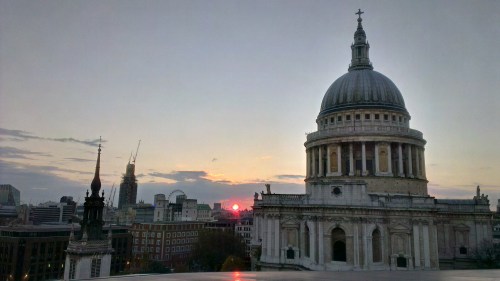
St Paul's Cathedral in the City of London where Sir Winston Churchill's funeral was held

St Paul’s Cathedral in the City of London where Sir Winston Churchill’s funeral was held

I wrote a blog yesterday for 3 Days in London about finding Churchill in London and listed some of the places where you can find him. I’m delighted to say that on the 30th January (next Friday) I will be part of a memorial flotilla on the River Thames commemorating 50 years since he died.

Commemoration flotilla on 30 January 2015

Commemoration flotilla on 30 January 2015 – image courtesy of Thames Clippers

One of his most famous wartime speeches referred to the brave pilots of the Royal Air Force ‘The Few’, who fought so valiantly and without thought to their own lives in the skies above our wee island, the Battle of Britain – a defining battle of WW2.

battle of britain memorial

The Battle of Britain memorial on Victoria Embankment – “Never in the field of human conflict has so much been owed by so many to so few”

the ever so marvellous Spitfire used so effectively during the Battle of Britain in WW2

the ever so marvellous Spitfire used so effectively during the Battle of Britain in WW2


And one of my favourite wartime images

an iconic image of St Paul's Cathedral from during the Second World War

an iconic image of St Paul’s Cathedral from during the Second World War

so here’s to The Right Honourable Sir Winston Leonard Spencer-Churchill, long may he Rest in Peace

Born: November 30, 1874 at Blenheim Palace, Woodstock
Died: January 24, 1965 at Hyde Park Gate, London
Buried: January 30, 1965 at St Martin’s Church, Bladon

…Named the Greatest Briton of all time in a 2002 poll

This is an excerpt from one of my favourite speeches made by Winston Churchill on 29 October 1941 during an address at a school in Harrow during WW2:

“Never give in. Never give in. Never, never, never, never—in nothing, great or small, large or petty — never give in, except to convictions of honour and good sense. Never yield to force. Never yield to the apparently overwhelming might of the enemy.” Sir Winston Spencer-Churchill, Never Give In!: The Best of Winston Churchill’s Speeches

“Never give in, Never, Never, Never…” for the full speech visit http://www.winstonchurchill.org/


Read Full Post »

The WordPress.com stats helper monkeys prepared a 2013 annual report for this blog.

Here’s an excerpt:

The concert hall at the Sydney Opera House holds 2,700 people. This blog was viewed about 13,000 times in 2013. If it were a concert at Sydney Opera House, it would take about 5 sold-out performances for that many people to see it.

Click here to see the complete report.

Read Full Post »

« Newer Posts - Older Posts »

Self Propelled

Self propelled adventures through life; blogging on cycling, touring, micro-adventures, general shenanigans, and environmental news

johnelsewhere

Thoughtful wanderer in search of virtual meaning

Things Helen Loves

TRAVEL, WALKS & EVERYDAY ADVENTURES

Short Walks Long Paths

Wandering trails around the coast of Wales

Port Side Travel By Jill

My travels, photos, tips/tricks and anything else I think of!

Wonderwall

My 360: wonderwalls,theatre, travel, Sheffield, books...

Robyn's Ramblings

My Thoughts. Expressed.

Graham's Long Walk

Graham King's long walks around Britain

The Lawsons on the Loose

Philip & Heather are making memories through their travels.